English
  Polski
  Čeština
  Deutsch
  Español
  Français
  Ελληνικά
  Hrvatski
  Italiano
  Lietuviškai
  Magyar
  Nederlands
  Português
  Română
  Slovenčina
  Svenska
  Türkçe
  Русский
Eye Optometrists: Why the Best Practices Are Abandoning Outdated Systems in 2026
You’re an eye optometrist. Your waiting room is packed. Your phone hasn’t stopped ringing since 8 AM. You’ve got three different software systems open on your computer, and you just double-booked Mrs. Rodriguez because your appointment calendar didn’t sync with your EHR. Again.

Sound familiar?
While you were trained to care for eyes, you’re spending most of your day wrestling with administrative chaos. And you’re not alone – 53.6% of optometrists in the US report burnout symptoms, with the numbers hitting 60.9% among female practitioners. The problem isn’t your clinical skills. It’s the fragmented, outdated systems holding your practice hostage.
Key Insights
The optometry crisis by the numbers:
- Only 90 students graduate annually from University of Waterloo’s optometry program while Canada’s English-speaking population grew 37% since 2000
- 51% of Canadians identify cost as a barrier to eye care; only 43% have vision insurance
- One-third of Canadians are currently overdue for eye examinations
- North American optometry market: USD 2,160.80 million in 2025, growing at 10% annually
- 24% of US counties have no optometrist or ophthalmologist
- Optometry software market expected to grow by USD 644.6 million between 2025-2029
What’s actually causing the chaos:
- Fragmented systems forcing redundant data entry across appointment, clinical, billing, and inventory platforms
- Administrative burden consuming time that should go to patient care
- EHR systems identified as a documented burnout risk factor when poorly implemented
- Months-long wait times becoming the norm, not the exception
The solution that’s working: Modern practices are switching to integrated platforms designed specifically for optical workflows-not generic medical software retrofitted for eye care.Glasson’s practice management system eliminates the administrative bottleneck with a database of 3.5 million lens variants, unified patient records, and automated workflows that actually understand how optical practices operate.
The Labor Shortage Nobody Wants to Talk About
Here’s what’s keeping practice owners up at night: there literally aren’t enough eye optometrists to meet demand.
Canada faces a particularly brutal situation. The country has only two optometry schools, with the University of Waterloo accepting just 90 students per year. Meanwhile, the English-speaking population grew by 37% and the aging population by 48% since the 2000s. Do the math – it doesn’t work.
Even though Canada has one of the highest proportions of optometrists per capita globally, patients are waiting months for appointments. In the US, the situation varies dramatically by region. Rural areas are hit hardest: 24% of counties have no optometrist or ophthalmologist at all. Patients drive hours for basic eye care.
The shortage creates a vicious cycle. Longer wait times mean more pressure on existing practitioners. More pressure leads to burnout. Burnout drives people out of the profession or into reduced hours. And the cycle continues.
What Burnout Actually Looks Like in Your Practice
Let’s get specific about what burnout means in real numbers.
The burnout breakdown among US optometrists:
- 61.4% experience mild burnout symptoms
- 30.4% report moderate burnout
- 8.2% suffer severe burnout
- Female practitioners disproportionately affected (60.9% vs. 40.6% for males)
What causes it? Increased clinic days, higher patient volume per day, and – here’s the kicker – cumbersome EHR systems. Your software is literally making you sick.
Think about your last Tuesday. How many times did you:
- Re-enter the same patient information in different systems?
- Manually check inventory because your POS doesn’t talk to your product database?
- Miss a follow-up appointment because your reminder system failed?
- Spend 10 minutes searching for the right lens specifications instead of 30 seconds?
This isn’t sustainable. You didn’t spend years in optometry school to become a data entry specialist.
7-day free trial
Got Any Questions? Let us know in the Contact Us form below.
The Cost Crisis That’s Limiting Your Patient Base
While you’re dealing with administrative chaos, your patients face their own barriers. Over half of Canadians (51%) say cost prevents them from accessing optometric care. Only 43% have vision insurance, and benefits typically max out at $200-$250 every 24 months.
Here’s what that means for your practice:
Patient behavior driven by cost barriers:
- 29% avoid care entirely due to cost concerns
- One-third are overdue for eye exams
- Many patients skip recommended follow-ups
- Contact lens patients stretch prescriptions beyond safe limits
- People postpone care until problems become serious (and expensive)
The urban-rural divide makes it worse. In underserved areas, patients not only lack nearby providers but also face longer travel costs and time off work. The result? Preventable vision problems become chronic issues.
“The biggest missed opportunity in modern optometry isn’t clinical-it’s operational. Practices running on integrated systems see their patient volume increase by 30-40% without proportionally increasing burnout. The technology exists to serve more people better. The question is whether you’re using it.”
Adam Smith, Product Manager @ Glasson
Why the Market Is Growing Despite These Challenges
Here’s the paradox: optometry faces labor shortages and access barriers, yet the market is booming.
North American optometry market growth:
- Total market value: USD 2,160.80 million (2025)
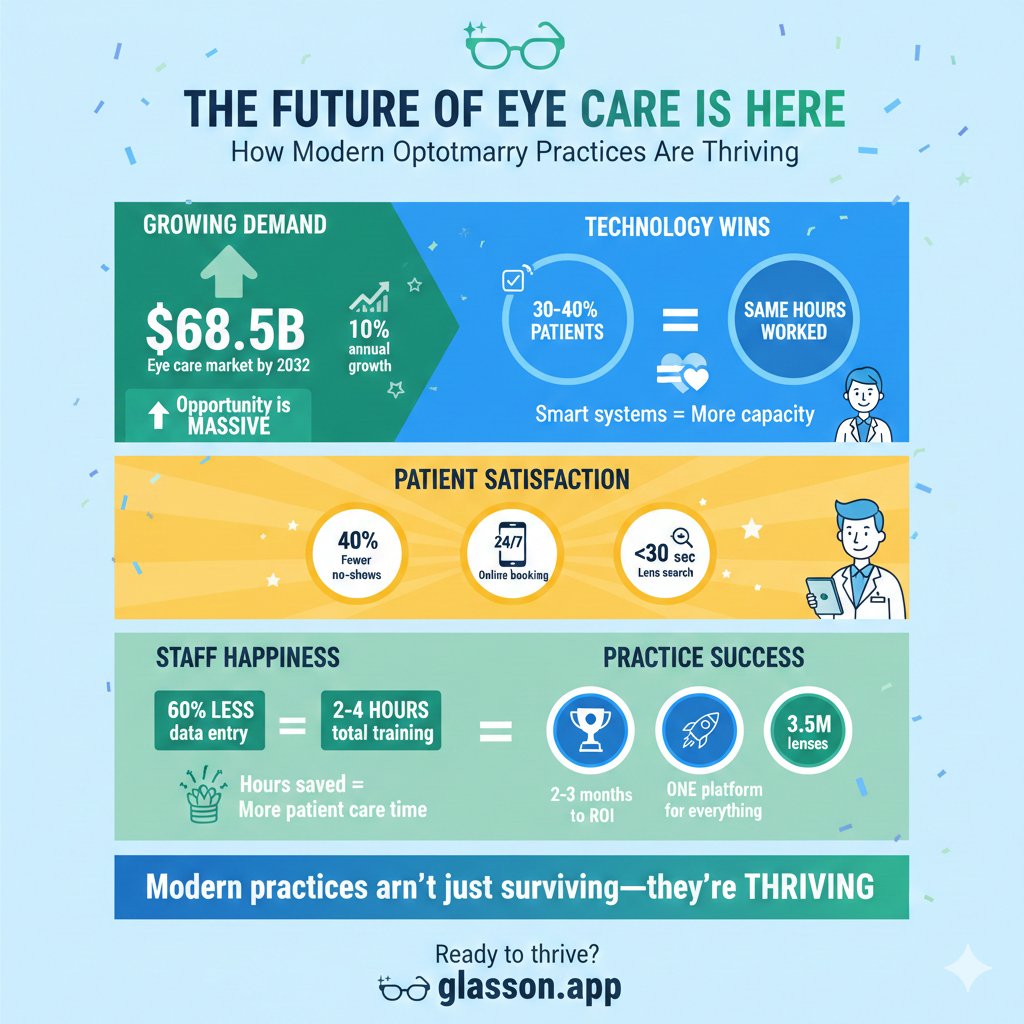
- Growing at 10% CAGR through 2032
- US market: USD 1,704.87 million (9.8% CAGR)
- Canadian market: USD 259.30 million (10.8% CAGR)
- Broader eye care market: USD 45.2 billion (2024) → USD 68.5 billion projected (2032)
What’s driving growth despite the challenges?
Market growth factors:
- Aging population requiring more frequent eye care
- Increasing prevalence of myopia, especially in children
- Rising screen time creating more eye strain and vision problems
- Growing awareness of eye health’s connection to overall health
- Digital health adoption accelerating post-pandemic
- Personalized medicine trends extending to custom lens prescriptions
The opportunity is massive. But only for practices that solve the operational bottleneck.
The Digital Transformation You Can’t Ignore
Let’s talk about what your patients expect in 2026.
They want to book appointments at 11 PM while scrolling their phone in bed. They expect automated reminders via text. They want to renew their contact lens prescription online if they qualify. And they’ll absolutely leave a bad Google review if your system makes them wait on hold for 15 minutes.
What modern patients expect from eye doctors:
- 24/7 online appointment booking
- Automated SMS/email reminders
- Online prescription renewals (where appropriate)
- Digital payment options
- Seamless communication via their preferred channel
- Fast service without sacrificing quality
The technology to deliver this exists. Teleoptometry proves viable for contact lens consultations, subjective refraction, and low-vision services. AI-driven systems optimize scheduling, enhance EHR efficiency, and analyze diagnostic images faster than humans. Cloud-based practice management solutions offer cost-effective, scalable, secure platforms.
Consider the cost difference: an online prescription renewal runs about $40 versus $185 for an in-person exam. For routine renewals in appropriate cases, digital options benefit both patient (convenience, cost) and practice (efficiency, capacity).
Advanced diagnostics like OCT and AI-powered retinal analysis improve both accuracy and speed. The question isn’t whether to adopt these technologies – it’s which platform integrates them seamlessly into your workflow.
What Your Practice Management Software Actually Needs to Do
Stop thinking about software as a necessary evil. Start thinking about it as the infrastructure that determines whether your practice thrives or drowns in administrative quicksand.
Critical features for modern eye optometrists:
- Integrated appointment scheduling with automated reminders, self-booking portals, and real-time availability (check out Glasson’s online reservation system)
- Comprehensive EHR with customizable exam templates specific to optometry workflows
- Real-time inventory management linked directly to point-of-sale – no more overselling discontinued lenses
- Automated patient communication via SMS/email for reminders, follow-ups, recall campaigns
- Integrated insurance billing and claims processing that doesn’t require a specialist
- Analytics dashboards showing exactly which services are profitable and which drain resources
- Equipment integrations connecting OCT, fundus cameras, and diagnostic tools directly to patient records
- Multi-location support with role-based access controls for chains and group practices
- Omnichannel management unifying in-store and online operations in one system
Here’s the real test: Can your current system do all of this without forcing staff to log into multiple platforms? If not, you’re losing money every single day.
Want to see Glasson's full potential?
Book a presentation
The Problem with Frankensteining Your Software Stack
Most practices cobble together solutions: one system for appointments, another for billing, a third for inventory, and a separate EHR. Then they hire someone whose entire job is making these systems talk to each other. Kind of.
What fragmented systems actually cost you:
- Time wasted on redundant data entry
- Errors from manual transfers between systems
- Missed appointments because reminders didn’t sync
- Oversold inventory that you can’t fulfill
- Patient frustration with inconsistent communication
- Staff turnover because nobody wants to do data entry all day
- Your time spent on administration instead of patient care
Let’s be honest: practices don’t fail because of lack of clinical expertise. They fail because the administrative burden becomes unmanageable. When your EHR doesn’t talk to your inventory system, you’re essentially running three separate businesses instead of one unified practice.
And here’s the really expensive part: EHR use itself is a documented burnout risk factor when poorly implemented. The software meant to help you is actually driving you out of the profession.
How Modern Practices Are Actually Solving This
The practices thriving in 2026 aren’t using medical software adapted for eye care. They’re using platforms built specifically for optical workflows from the ground up.
Glasson represents what happens when you design software around how optical salons actually operate, not how hospital IT departments think they should operate.
What makes Glasson different for eye optometrists:
The lens database advantage:
- Access to 3.5 million lens variants with evidence-based prescription matching
- Intelligent search engine reduces manual catalog lookup from minutes to seconds
- Real-time pricing and availability from multiple suppliers
- Customized recommendations based on patient prescription and preferences
The integration that actually works:
- Centralized client management connecting every touchpoint
- Patient records flow seamlessly from intake → exam → prescription → ordering → fulfillment
- Automated communication workflows for reminders, follow-ups, and recalls
- Real-time inventory preventing the “we oversold this lens” conversation
- Unified scheduling for both online and in-store appointments
The interface designed for humans:
- Staff training measured in hours, not weeks
- Workflows match how optical professionals actually work
- Less clicking, more helping patients
- Mobile-friendly for practices with multiple locations
The Real-World Impact on Your Daily Operations
Let’s get tactical about what integrated software does for your practice.
Morning routine transformation:
- Check your dashboard: yesterday’s revenue, today’s appointments, inventory alerts-all in 30 seconds
- Your automated system already sent appointment reminders; no-show rate drops 40%
- New patient booked online at 2 AM? Their intake forms are already in your system
- You start seeing patients at your scheduled time because there’s no administrative backlog
During patient visits:
- Pull up complete patient history in two clicks
- Search lens options in seconds using prescription parameters
- Show patients pricing and availability in real-time
- Process payment, schedule follow-up, trigger automated reminder-all from one screen
Administrative time savings:
- Staff spends 60% less time on data entry
- Inventory tracking happens automatically with each sale
- Follow-up reminders send themselves based on visit type
- Analytics dashboard shows business performance without spreadsheet gymnastics
This isn’t theoretical. This is how modern practices operate every single day.
Addressing the Burnout Crisis Through Better Tools
Remember those burnout statistics? Let’s talk about how the right software specifically addresses documented causes.
How integrated systems reduce burnout:
For the 60.9% of female optometrists experiencing burnout:
- Workflow automation reduces repetitive administrative tasks disproportionately done by women
- Task assignment systems distribute work more equitably
- Remote work capabilities provide flexibility for family responsibilities
For practices dealing with heavy patient volume:
- Efficient scheduling maximizes capacity without requiring longer hours
- Automated workflows handle routine tasks without adding staff
- Self-service patient portals reduce phone calls and interruptions
For everyone struggling with cumbersome EHRs:
- Intuitive interfaces reduce frustration and clicks
- Integrated systems eliminate redundant data entry
- Real-time access to information improves accuracy and confidence
The shortage of optometrists isn’t going away. But practices using modern tools can serve more patients better without proportionally increasing burnout. That’s not marketing speak-that’s what the data shows.
Glasson’s administration tools specifically target the documented causes of optometrist burnout: administrative burden, system complexity, and workflow inefficiency.
Test Glasson for 7 days free of charge
Any questions? Leave your contact details and we'll call you back.
Making Eye Care Affordable and Accessible Through Efficiency
Here’s the connection between your operational efficiency and patient access:
When you reduce overhead through better systems, you can:
- Keep prices more competitive
- Accept more insurance plans
- Offer payment plans more easily
- Serve higher patient volume in the same hours
Technology solutions enabling broader access:
- Telemedicine integration extending care to rural areas
- Online prescription renewals reducing cost for routine needs
- Efficient inventory management preventing price markups from errors
- Better scheduling filling cancellations with waitlisted patients
- Analytics identifying which services are actually profitable
The 51% of Canadians and significant percentage of Americans avoiding eye care due to cost need practices that operate efficiently enough to offer competitive pricing. The one-third of Canadians overdue for exams need practices with capacity for new patients.
Your operational efficiency directly impacts community eye health. When you can see more patients per day without burnout, more people get the care they need.
Why Glasson Stands Apart in a Crowded Market
Yes, other optometry software exists. Solutions like Acuitas 3, RevolutionEHR, Optosys, DrChrono, and CrystalPM all serve the market. So what makes Glasson different?
Glasson’s unique positioning:
Purpose-built for optical practices:
- Not hospital software adapted for optometry
- Not multi-specialty software with an “optometry module”
- Built from scratch around how optical salons actually operate
North American market expertise:
- Understands Canadian billing complexities
- Integrates with US insurance systems
- Supports both countries’ regulatory requirements
The lens database difference:
- 3.5 million lens variants with evidence-based matching
- Real-time pricing and availability
- Intelligent search that understands prescriptions, not just product codes
Modern architecture:
- Cloud-native from day one
- Omnichannel-native, not omnichannel-retrofitted
- API-first design for future integrations
User experience focus:
- Requires minimal training
- Staff actually want to use it (check your current system’s user satisfaction)
- Reduces clicks and increases patient interaction time
Think about the last software “upgrade” at your practice. How long did training take? How many complaints did you hear in the first month? How many workarounds did staff develop because the official process was too cumbersome?
That’s not how modern software works.
Future-Proofing Your Practice for What’s Coming
The optometry market growing at 10% annually with accelerating digital transformation isn’t slowing down. Eye doctors near you are already adopting these systems. The question is whether you’ll lead or follow.
Technology trends reshaping optometry:
AI integration becoming essential:
- Scheduling optimization using predictive analytics
- Diagnostic assistance with AI-powered retinal analysis
- Insurance claim automation reducing rejections
- Inventory forecasting based on prescription patterns
Telemedicine and teleoptometry expanding:
- Remote consultations for appropriate cases
- Online renewals for qualified patients
- Digital pre-screening improving in-person visit efficiency
- Expanded access to underserved rural areas
Smart diagnostics requiring integrated platforms:
- OCT machines generating data that needs seamless EHR integration
- AI diagnostic tools requiring consistent data formatting
- Outcomes tracking across multiple visit types
- Longitudinal patient monitoring for chronic conditions
Personalized medicine trends:
- Custom lens manufacturing based on detailed patient data
- Treatment protocols adjusted by AI recommendations
- Precision measurements from advanced equipment
- All requiring integrated, accurate data systems
Glasson’s cloud-based architecture positions your practice for these coming changes. You’re not investing in today’s technology-you’re building infrastructure for the next decade.
The Real Cost of Staying with Outdated Systems
Let’s do some uncomfortable math.
What fragmented systems actually cost annually:
- Staff time on redundant data entry: 10 hours/week × $20/hour × 52 weeks = $10,400
- Missed appointments from sync failures: 5/month × $200/appointment × 12 months = $12,000
- Inventory errors from poor tracking: $500/month × 12 months = $6,000
- Lost patients due to poor online booking: 10/year × $2,000 lifetime value = $20,000
- Your time on administrative work instead of patient care: priceless (but actually worth about $50,000 in lost productivity)
Total annual cost: $98,400+
Now compare that tomodern practice management software pricing. The ROI isn’t in months-it’s in weeks.
And that’s before accounting for the burnout you’re paying for in turnover, reduced hours, or eventually leaving the profession entirely. How much is your career satisfaction worth?
FAQ: Everything Eye Optometrists Ask About Modern Practice Management
Q: How long does it take to transition from our current system to an integrated platform like Glasson?
A: Most practices complete full migration in 2-4 weeks. Glasson’s team handles data migration, and the intuitive interface means staff training is measured in hours, not days. Many practices run parallel systems for just one week before fully switching.
Q: What if our practice has multiple locations?
A: Glasson supports multi-location practices with centralized management, individual location analytics, and role-based access controls. Your corporate office can oversee all locations while individual managers control their specific operations.
Q: Can the system integrate with our existing equipment (OCT, phoropter, etc.)?
A: Yes. Modern platforms are built with API-first architecture enabling equipment integrations. Diagnostic results flow directly into patient records, eliminating manual data transfer and reducing errors.
Q: How does automated communication work without annoying patients?
A: Smart communication systems use patient preferences (text vs. email, frequency, timing) and send contextually appropriate messages. Appointment reminders 24 hours before, recall notices when exams are due, prescription renewal reminders-all personalized and permission-based.
Q: What about data security and HIPAA compliance?
A: Cloud-based systems from reputable providers often exceed the security of on-premise servers. Look for SOC 2 compliance, encryption at rest and in transit, regular security audits, and HIPAA-specific safeguards. Glasson meets all regulatory requirements for both US and Canadian practices.
Q: How much training do staff need?
A: With intuitive platforms designed around actual workflows, most staff become proficient in 2-4 hours of training. Compare this to legacy systems requiring days or weeks of training-and staff still creating workarounds because the official process is too complex.
Q: Can we try it before committing?
A: Most modern platforms offer trial periods. Glasson provides demos and trial accounts so you can test the system with your actual workflows before making decisions.
Q: What happens to our data if we ever want to switch providers?
A: Reputable systems provide data export in standard formats. You own your data – always. Check any contract for data portability guarantees and export capabilities.
Q: How does the lens database actually work in practice?
A: Enter the patient’s prescription parameters, and theintelligent search engine instantly shows matching lens options across multiple manufacturers, with real-time pricing and availability. Think Google for prescription lenses-fast, accurate, comprehensive.
Q: What’s the real ROI timeline?
A: Most practices see positive ROI within 2-3 months from reduced administrative time, fewer errors, and increased patient capacity. The burnout reduction and career satisfaction improvements? Those start immediately.
Making the Decision: Infrastructure, Not Optional Technology
Practices thriving in 2026 understand something fundamental: software isn’t a business expense-it’s core infrastructure.
You wouldn’t try to run a practice without diagnostic equipment. Why would you try to run one without proper operational infrastructure?
The administrative inefficiency is your real bottleneck, not clinical capability. Eliminate the bottleneck, and suddenly:
- You can see more patients without working longer hours
- Your staff actually enjoys their work
- Your patients get faster, better service
- Your practice becomes more profitable
- Your burnout decreases dramatically

The investment in the right software pays dividends through reduced burnout, better patient outcomes, and improved practice economics. This isn’t optional technology-it’s the foundation of modern practice operations.
Schedule a Glasson demo and see what happens when your software actually works the way you do.
Because eye optometrists deserve tools as sophisticated as the care they provide. And patients near you deserve practices operating at their full potential.