English
  Polski
  Čeština
  Deutsch
  Español
  Français
  Ελληνικά
  Hrvatski
  Italiano
  Lietuviškai
  Magyar
  Nederlands
  Português
  Română
  Slovenčina
  Svenska
  Türkçe
  Русский
Optometrist vs Optician: What’s Actually Different
Ever walked into an optical shop wondering who’s who behind those professional glasses? You’re not alone. Most people think “optometrist” and “optician” are just fancy words for the same job—but mixing them up could mean the difference between getting the right care and wasting your time in the wrong place. Whether you’re booking an eye exam, considering a career change, or just trying to figure out who can actually help with your blurry vision, understanding these roles matters more than you’d think.

Key Insights
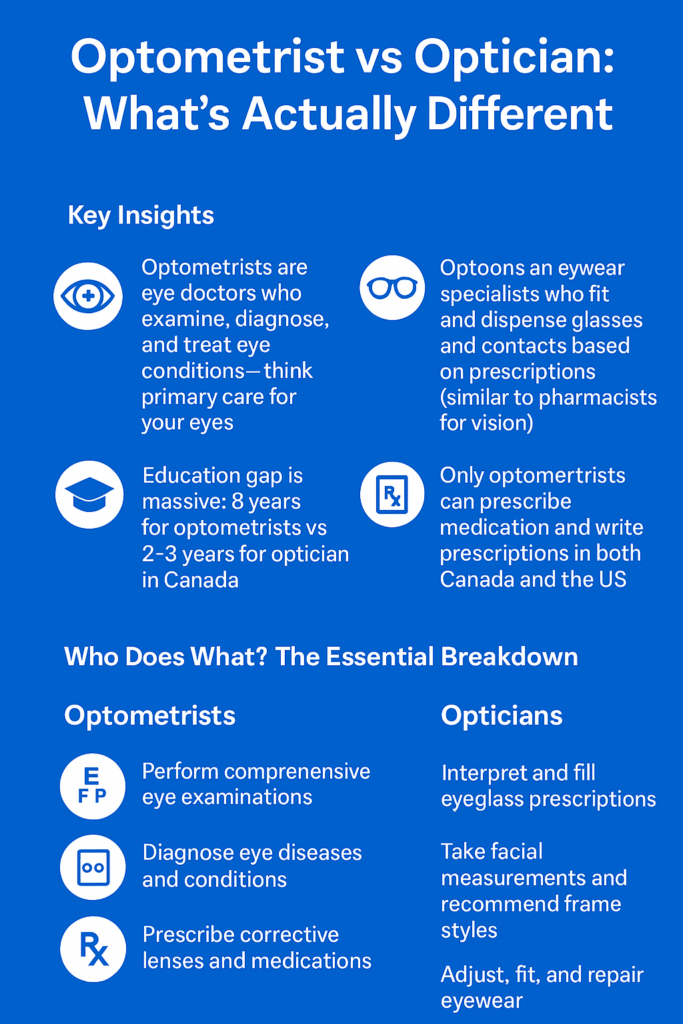
- Optometrists are eye doctors who examine, diagnose, and treat eye conditions—think primary care for your eyes
- Opticians are eyewear specialists who fit and dispense glasses and contacts based on prescriptions (similar to pharmacists for vision)
- Education gap is massive: 8 years for optometrists vs 2-3 years for opticians in Canada
- Only optometrists can prescribe medication and write prescriptions in both Canada and the US
- Salary reflects training: Canadian optometrists average CAD 265,800/year vs roughly half that for opticians
- US regulation is chaotic: All states license optometrists, but only 22 states regulate opticians
- Patient journey is sequential: See the optometrist first for diagnosis, then the optician for eyewear
- Scope is expanding: All US states now allow optometrists to prescribe oral medications
Who Does What? The Essential Breakdown
Here’s the truth most people miss: your optometrist is the one who figures out what’s wrong with your eyes. Your optician is the one who gets you the right glasses to fix it.
Think of it like this: your family doctor diagnoses strep throat and writes a prescription. The pharmacist fills that prescription and explains how to take the medication. Same relationship, different body part.
Optometrists are primary eye care providers. They’re licensed to:
- Perform comprehensive eye examinations
- Diagnose eye diseases and conditions
- Prescribe corrective lenses and medications
- Detect systemic health issues through eye exams (diabetes, high blood pressure, even some cancers)
- Manage and treat conditions like glaucoma, infections, and dry eye
- Refer patients to ophthalmologists for surgery when needed
Opticians are dispensing specialists. They’re trained to:
- Interpret and fill eyeglass prescriptions
- Take facial measurements and recommend frame styles
- Adjust, fit, and repair eyewear
- Educate patients about lens options and coatings
- Work with contact lens prescriptions (with additional certification)
The optician cannot perform eye exams, diagnose conditions, or write prescriptions. That’s not a limitation—it’s professional specialization.
The Education Mountain: 8 Years vs 2 Years
Want to understand why these professions aren’t interchangeable? Look at the training requirements.
Becoming an Optometrist
In Canada, you’re looking at 8 years minimum:
- 3+ years of undergraduate prerequisites (chemistry, biology, physics, math)
- 4-year Doctor of Optometry (OD) degree
- Total cost: Over CAD 100,000
Here’s the kicker: Canada only has two accredited optometry schools. University of Waterloo in Ontario and Université de Montréal in Quebec. The competition is brutal—hundreds of applicants fighting for roughly 100 combined spots each year.
In the United States, the path is similar but with more options:
- 60+ credit hours of prerequisite coursework
- 4-year OD program
- Multiple schools nationwide (20+ accredited programs)
After graduation, many optometrists complete an optional 1-year residency to specialize in pediatrics, ocular disease, contact lenses, or other areas.
Learn more about specialized eye care services
Becoming an Optician
The path here is significantly shorter:
In Canada: 2-3 year college diploma in ophthalmic dispensing from one of 50+ community colleges.
In the United States: Requirements vary dramatically by state:
- 22 states require licensing
- 28 states have no requirements at all
- Options include associate degree programs or apprenticeships (6,240 hours over 5 years)
New Hampshire requires about $110 in fees and no formal education. Nevada demands $1,250+ and passing 7 different exams. Same profession, completely different barriers to entry.
The education gap explains the salary gap, the scope gap, and why these professions serve different functions in eye care.
Licensing: Where Geography Changes Everything
The regulatory landscape differs dramatically between Canada and the US, and even within each country.
Canada’s Relatively Uniform System
Both professions face provincial regulation, but there’s more consistency than you’d find south of the border.
Optometrists must:
- Pass the Optometry Examining Board of Canada (OEBC) national exam
- Register with their provincial regulatory body
- Maintain continuing education requirements
- If educated internationally, navigate FORAC credential assessment
Opticians must:
- Pass the NACOR National Optical Sciences Examination
- Register with provincial colleges (all provinces except Northwest Territories, Nunavut, and Yukon regulate opticians)
The system isn’t perfect, but at least there’s a national framework. Provincial requirements are relatively similar from British Columbia to Nova Scotia.
Discover how Glasson simplifies administration across multiple locations
7-day free trial
Got Any Questions? Let us know in the Contact Us form below.
America’s State-by-State Chaos
Optometrists: All 50 states require licensing. Everyone takes the same 4-part NBEO exam, plus state-specific tests.
Opticians: Complete regulatory mayhem. Only 22 states require licensing. That leaves 28 states where literally anyone can call themselves an optician and start fitting glasses. No exam. No certification.
Even in regulated states, requirements vary wildly. Some require national certification exams, some accept apprenticeship hours, some mandate associate degrees.
This creates situations where an experienced optician moving from California (no licensing) to New York (strict licensing) suddenly needs to take exams despite years of successful practice.
What Can Each Professional Actually Do?
Let’s get specific about scope of practice, because this is where confusion causes real problems.
Optometrist Capabilities
Your optometrist can:
Diagnostic Work:
- Comprehensive eye examinations
- Screening for glaucoma, cataracts, macular degeneration, diabetic retinopathy
- Detection of systemic conditions (high blood pressure, diabetes, autoimmune disorders)
- Visual field testing
Treatment Authority:
- Prescribe corrective lenses
- Prescribe medications—all US states now grant oral medication authority
- Diagnose and treat eye infections, inflammation, dry eye
- Remove foreign bodies from eyes
- Manage chronic conditions like glaucoma
Expanding Procedures (varies by state/province):
- Intraocular injections (Kentucky, Louisiana, North Carolina)
- Laser procedures (5 states: Oklahoma, Kentucky, Alaska, Louisiana, Arkansas)
- Minor surgical procedures
This scope has expanded dramatically over the past 30 years. The trend continues as states expand optometrist scope to improve healthcare access.
Optician Scope: Clear Boundaries, Deep Expertise
Your optician cannot:
- Perform eye examinations
- Diagnose eye conditions or diseases
- Write prescriptions for eyewear or medications
Your optician can:
- Interpret eyeglass prescriptions
- Take precise facial measurements
- Recommend appropriate frame styles
- Explain lens options and coatings
- Adjust and fit eyewear for optimal comfort
- Repair damaged frames
- Educate patients about proper eyewear care
Contact Lens Opticians need additional specialized training to fit contact lenses and teach proper insertion techniques.
See how opticians use Glasson to manage inventory efficiently
Your Patient Journey: Who You See When
Understanding the typical path through eye care prevents wasted time and frustration.
Step 1: Schedule with an Optometrist
You need an eye exam if you haven’t had one in 1-2 years, you’re experiencing vision changes, or you have symptoms like redness or eye strain. The optometrist examines your eyes, diagnoses any conditions, and writes your eyewear prescription.
Step 2: Take Prescription to Optician
Now you choose where to get glasses or contacts. The optician reviews your prescription, discusses your vision needs, takes measurements, shows you frame options, and orders your eyewear.
Step 3: Follow-up
When your glasses arrive, the optician adjusts them for perfect fit and verifies lens accuracy.
This sequential process works because each professional specializes in their domain. Your optometrist focuses on your eye health. Your optician focuses on your eyewear satisfaction.
“The most successful optical practices we work with understand that optometrists and opticians aren’t competing—they’re collaborating. When both professionals have immediate access to shared patient records, prescription histories, and inventory data through a unified system, patients get better outcomes and practices run smoother. We built Glasson specifically to support that collaboration.”
— Adam Smith, Product Manager @ Glasson
Want to see Glasson's full potential?
Book a presentation
When to See Which Professional
Still confused about who to call? Here’s a practical breakdown.
See Your Optometrist First If You Have:
- Sudden vision changes or vision loss
- Eye pain, redness, or discharge
- Injury to your eye
- Seeing floaters, flashes, or spots
- Dry, itchy, or watery eyes
- Headaches related to vision
- Chronic conditions like diabetes
See Your Optician If You Need:
- Glasses adjusted
- Frame repairs
- Help choosing new frames
- Lens replacement
- Contact lens insertion training
The pattern is clear: health concerns go to the optometrist. Eyewear concerns go to the optician.
Explore how Glasson’s Eye Care Module helps optometrists manage examinations
The Money Question: Salaries and Career Prospects
Let’s talk numbers, because educational investment should align with career returns.
Optometrist Compensation
In Canada (2025 data):
- Average salary: CAD 265,800 per year
- Entry-level (0-2 years): CAD 153,800
- Experienced (20+ years): CAD 392,400
- Geographic variation: Ottawa and Ajax show highest salaries (~CAD 500,000+)
In the United States:
- Average salary: $125,000 per year
- Medical collaboration settings: $155,306
- Private practice owners: Often significantly higher
Interesting note: Canadian optometrists out-earn their American counterparts by a substantial margin, possibly due to Canada’s more regulated healthcare system and scarcity of only 2 optometry schools.
Optician Compensation
In Canada: CAD 100,000-130,000 range (roughly 40-50% of optometrist salary)
In the United States: ~$50,000 per year average (range: $35,000-70,000)
The salary gap reflects the education gap: 8 years vs 2-3 years, doctoral degree vs diploma.
Career Advancement
Optometrists can pursue specialization through residencies, private practice ownership, clinical leadership, or academic careers.
Opticians can advance into management roles, contact lens specialization, or senior positions.
See how Glasson helps practices manage employee permissions and roles
Insurance Coverage: A Tale of Two Systems
How payment works depends entirely on where you live—and the differences are substantial.
Canada: Provincial Variation
Canadian eye care coverage operates provincially with some patterns.
Ontario (OHIP) Example:
- Covered: Children 0-19 (one exam/year), seniors 65+ (one every 1-2 years), adults with qualifying conditions (diabetes, glaucoma)
- Not covered: Routine exams for healthy adults 20-64, contact lens fittings
- Out-of-pocket: $75-150 typically for non-covered exams
- Private insurance: Usually covers $75-150 every 1-2 years plus eyewear allowances
Learn how Glasson helps practices manage insurance billing
United States: Fragmented and Complex
American eye care coverage is fragmented.
- Medicare: Covers exams only for specific medical conditions, not routine care
- Medicaid: Varies dramatically by state
- Employer insurance: Medical insurance covers disease treatment; vision insurance (separate plans) covers routine exams
- Out-of-pocket: $50-250 for exams, $200-800+ for glasses
The confusion: Americans often don’t realize medical insurance and vision insurance are completely separate.
Why Glasson Matters for Both Professionals
Running a modern optical practice means juggling two distinct professional workflows. Most practice management systems force you to work around software designed for one role or the other, not both.
Glasson was built specifically for optical practices where optometrists and opticians need to collaborate seamlessly.
For Optometrists:
- Eye Care Module streamlines examinations with customizable forms
- Integrated calendar books follow-ups automatically
- Prescription writing takes seconds with automatic notifications to opticians
For Opticians:
- Lens Finder searches over 3.5 million lens variants in under 0.2 seconds
- Inventory management tracks frames and lenses across multiple locations
- Sales workflow integrates seamlessly without switching screens
For Both:
- Shared client database eliminates duplicate data entry
- Communication tools send reminders without leaving the system
- Statistics dashboard shows clinical and business metrics
- Role-based permissions ensure appropriate access
Most practices using Glasson report that the handoff between optometrist examination and optician dispensing becomes nearly invisible to patients—which is exactly how it should feel.
Test Glasson for 7 days free of charge
Any questions? Leave your contact details and we'll call you back.
Frequently Asked Questions
1. Can opticians perform eye exams?
No. Opticians cannot perform eye exams, diagnose conditions, or write prescriptions. They work with prescriptions provided by optometrists or ophthalmologists.
2. Do I need a prescription to buy glasses?
Yes—in both Canada and all US states, you must have a valid prescription to purchase prescription eyewear. Prescriptions typically expire after 1-2 years.
3. Can optometrists perform eye surgery?
Generally no, with rare state-specific exceptions. Most surgical procedures require an ophthalmologist. However, some US states now permit optometrists to perform specific laser procedures.
4. How often should I see an optometrist vs an optician?
See your optometrist every 1-2 years for comprehensive exams (annually if over 60 or have conditions). See your optician whenever you need adjustments or new eyewear.
5. Are opticians regulated in the US?
Only in 22 states. The other 28 states have no licensing requirements. In Canada, all provinces except three territories regulate opticians.
6. Can optometrists prescribe medication?
Yes, in all US states and all Canadian provinces. All 50 US states now permit optometrists to prescribe oral medications (the last state approved this in 2019).
7. What’s the difference between an optometrist and an ophthalmologist?
Optometrists have OD degrees focused on primary eye care. Ophthalmologists are medical doctors (MD/DO) who completed medical school plus ophthalmology residency, giving them surgical training.
8. Can I become an optician without a degree?
Depends on location. In 28 US states without licensing, technically yes. In 22 US states with licensing and all Canadian provinces, you need a diploma, degree, or apprenticeship completion.
9. Why are Canadian optometrist salaries higher?
Several factors: only 2 accredited schools creating supply constraints, uniform healthcare reimbursement, and provincial regulation supporting higher fee structures.
10. Do opticians work independently?
It varies. Many opticians work independently managing dispensing without direct optometrist supervision for day-to-day tasks, but always within prescriptions written by doctors. Some opticians own their own businesses.

Final Thoughts
Here’s what matters most: optometrists and opticians aren’t interchangeable, and they’re not competing. They’re specialized professionals serving complementary roles in your eye care journey.
Your optometrist is the eye health expert—the diagnostician who detects problems early and manages chronic conditions. Your optician is the vision correction specialist—the expert who translates prescriptions into eyewear that works for your life.
Both matter. Both deserve respect for their distinct expertise. And both work better when they collaborate instead of competing.
If you’re choosing between these careers, pick based on genuine interests—not just salary or education length. If you’re a patient, see the optometrist first for exams and health concerns, then see the optician for perfect eyewear.
And if you’re running an optical practice, invest in systems that make collaboration seamless. Your team will thank you. Your patients will notice. Your business will run better.
Start your free 7-day trial of Glasson