English
  Polski
  Čeština
  Deutsch
  Español
  Français
  Ελληνικά
  Hrvatski
  Italiano
  Lietuviškai
  Magyar
  Nederlands
  Português
  Română
  Slovenčina
  Svenska
  Türkçe
  Русский
What Percentage of People Wear Glasses? The Global Vision Correction Reality
Walk into any coffee shop, board any subway car, or scan any classroom, and you’ll notice something remarkable: glasses are everywhere. But just how common are they? The answer might surprise you—and if you’re running an optical practice, understanding these numbers isn’t just interesting trivia. It’s essential business intelligence.
Approximately 4 billion people worldwide wear prescription glasses—that’s 57% of the global population. To put that in perspective, more people wear glasses than use smartphones. Yet despite this massive prevalence, access to proper vision correction remains wildly uneven across different regions and demographics.
For optical practices in North America, these statistics represent both opportunity and responsibility. With practice management software like Glasson, opticians can better serve this growing population through efficient patient records, streamlined lens selection, and data-driven inventory management that ensures the right products are always available.

Key Insights
- 75% of American adults need vision correction, with 64% wearing prescription glasses
- 76-82% of Canadians use some form of vision correction
- Myopia (nearsightedness) has tripled in children since 1990, now affecting 1 in 3 kids globally
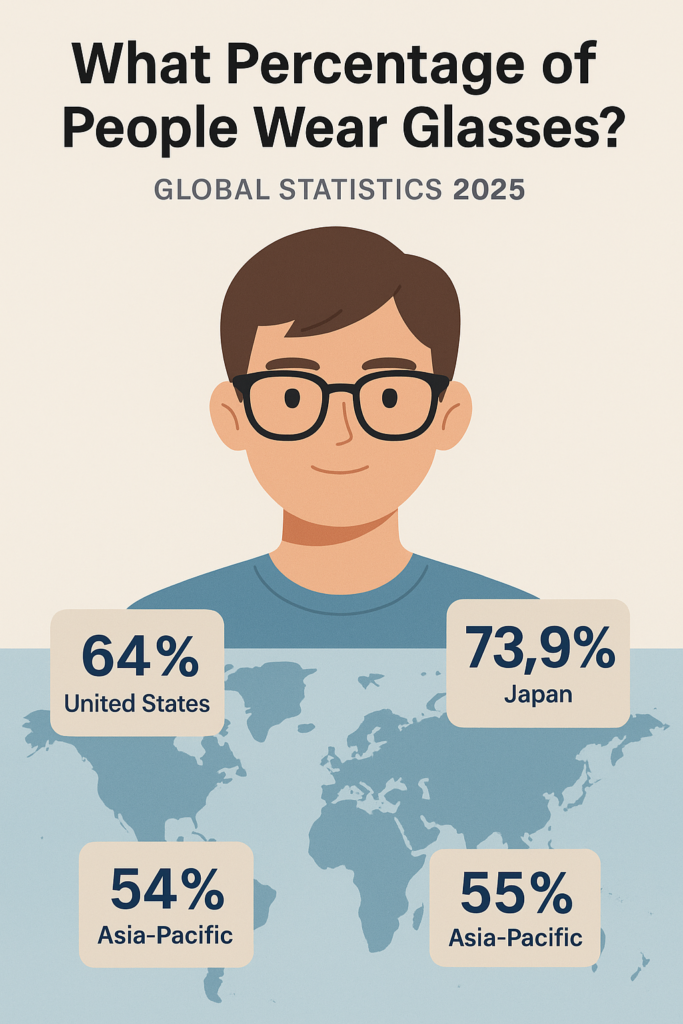
- Japan leads the world with 73.9% of its population wearing glasses
- Sub-Saharan Africa has the lowest access, with only 27-30% coverage despite high need
- The global eyewear market reached $47 billion in North America alone in 2024
- 83-89% of Americans over 45 need reading glasses due to presbyopia
- Contact lenses represent a much smaller segment, with 47% dropout rate within two months
The North American Reality: Canada and the United States Lead the Way
Let’s start close to home, because North America presents one of the most interesting—and well-documented—pictures of vision correction usage in the world.
United States: A Nation of Glasses Wearers
Here’s something you probably already knew from looking around your waiting room: most Americans need vision correction. But the specific numbers tell a more complete story than casual observation ever could.
Three out of four American adults—75%—need some form of vision correction. Of that 75%, a solid 64% wear prescription eyeglasses. That translates to roughly 197.6 million American adults who rely on glasses to see clearly.
Think about that for a moment. If you lined up four random Americans, three would need vision correction, and at least two would be wearing glasses right now. The National Eye Institute puts the total number even higher: over 150 million Americans require corrective lenses.
But here’s where it gets interesting: not everyone who needs correction uses it the same way. About 48% of US adults wear only prescription glasses. Another 12% switch between glasses and contact lenses depending on the day or activity. Only 3% rely exclusively on contact lenses. The remaining 12% who need correction? They’re either using reading glasses, haven’t gotten their prescription updated, or are among the roughly 45 million Americans who wear contact lenses at least occasionally.
Gender plays a surprising role in these numbers. Women are slightly more likely to wear glasses (49%) compared to men (46%). But the real difference shows up in flexibility: 14% of women switch between glasses and contacts, while only 10% of men do. It seems women are more likely to view vision correction as something that can adapt to different situations—work versus weekend, sports versus dinner out.
Age tells an even more dramatic story. Baby Boomers are the glasses generation: 67% wear only glasses, and most wouldn’t dream of poking something into their eye every morning. Generation X sits at 55% glasses-only. But Millennials drop to 39%, and Gen Z to just 37%. Younger Americans are far more likely to alternate between glasses and contacts (13% of Gen Z versus 6% of Boomers) or to wear contacts exclusively (4-6% versus 2%).
Why do most Americans choose glasses over contacts? The reasons are refreshingly practical. Forty-five percent say glasses are simply easier to use. Thirty-six percent highlight the low-maintenance aspect—no cleaning solutions, no nightly routines, no panic when you realize you forgot to pack extra lenses for your weekend trip. Thirty-four percent feel glasses are safer, with less risk of eye infections. Twenty-one percent point to cost, noting that a single pair of glasses can last years while contacts require constant repurchasing. And 15% report that contacts simply aren’t an option for their specific vision needs.
For optical practices managing this diverse population, efficient systems matter. Glasson’s client management features help track these preferences, ensuring you know exactly which patients prefer glasses, which alternate, and when they’re due for updates. When someone walks in asking about contacts after years of wearing only glasses, you’ll have their complete history at your fingertips.
7-day free trial
Got Any Questions? Let us know in the Contact Us form below.
The age breakdown gets even more specific when you look at vision conditions. Myopia (nearsightedness) affects 41.6% of Americans overall, but the prevalence varies wildly by age group. Among 18-34 year-olds, 62% wear glasses. That jumps to 94% for those aged 55-64. People in their 20s and 30s are navigating screens all day, driving at night, and discovering their distance vision isn’t what it used to be. By the time Americans hit their 60s, nearly 75% need some form of vision correction.
Then there’s presbyopia—that age-related loss of close-up focusing ability that hits almost everyone eventually. Between 83-89% of Americans aged 45 and older experience presbyopia, affecting 128-139 million people. Nearly 90% of everyone over 45 will eventually need reading glasses, even if they never needed correction before. Some get progressive lenses, some keep readers scattered around the house, and 34.5 million Americans wear over-the-counter reading glasses they picked up at the pharmacy for $15.
Canada: Close Neighbor, Different Patterns
Cross the border into Canada, and you’ll find similar overall numbers but with some fascinating differences in how people approach vision correction.
Between 76% and 82% of Canadians use some form of vision correction—roughly in line with US rates. Research from the Canadian Longitudinal Study on Aging found that 86% of Canadians aged 45-85 were wearing glasses or contact lenses.
But Canadians behave differently when it comes to eye care. Only 52% of Canadians had an eye exam in the past year, compared to 62% in the United States. Even more striking: 28% of Canadians report their last eye exam was more than two years ago. Some of this might be access-related—1 in 4 Canadians who don’t wear glasses haven’t had an eye exam in over 10 years. But here’s the puzzle: 46% of Canadians with vision benefits said they didn’t plan to use their coverage in 2022. The main barriers? Twenty-eight percent said they have no eyesight issues (debatable, given that presbyopia hits almost everyone), 29% cited cost despite having coverage, and 10% mentioned inconvenience.
The Canadian eyewear replacement cycle tells its own story. The median Canadian keeps their glasses for 24 months—two full years—before buying new ones. Americans tend to replace glasses every 12-18 months. Why the difference? Partly cultural, partly economic, partly related to those lower eye exam rates. If you’re not getting your vision checked as frequently, you’re less likely to discover your prescription has changed.
Canadians also show strong preferences for in-person shopping. A remarkable 87% prefer to buy eyeglasses in stores rather than online, and 34% of those who tried online ordering switched back to brick-and-mortar for their next purchase. When it comes to readers, 65% of Canadians who use them purchased a new pair within the past year—much higher than prescription glasses replacement rates.
Price sensitivity runs high in the Canadian market. Thirty-eight percent paid $99 or less for their glasses, lenses, or frames combined. For non-prescription sunglasses, 55% spent less than $50. This creates interesting opportunities for practices that can offer quality at various price points.
Perhaps most concerning for the long-term Canadian market: the pediatric myopia explosion. Approximately 25% of Canadian children now have myopia—up from 17.5% just six years ago in 2018. Among school children aged 11-13, almost 30% have myopia. The COVID-19 pandemic accelerated this dramatically. Screen time exceeding four hours per day jumped in 2020 and stayed elevated. Children spent extended periods indoors doing “near work”—books, computers, phones—with reduced outdoor time that’s protective against myopia development.
For Canadian optical practices, Glasson’s Eye Care Module provides structured documentation for tracking these young patients’ rapidly changing prescriptions, complete with examination history and progression patterns that help identify which children might benefit from myopia control interventions.
The North American Market: Why These Numbers Matter
The North American eyewear market isn’t just large—it’s massive and growing. In 2024, the market hit $47 billion in value, with projections to reach $73.8 billion by 2033. That’s a growth rate of 4.94% annually. Some analysts project an even higher starting point of $28.86 billion in 2024, growing at 5.12% annually.
Spectacles dominate this market, generating 69% of all eyewear industry revenue. Adults over 40 make up 60% of the prescription glasses consumer base, but the 25-44 age group leads in purchasing, particularly for high-end designer frames.
What does this mean for your practice? With Glasson’s statistical tools, you can track your own practice patterns against these broader trends. Are you capturing your fair share of the Gen Z market? Are your presbyopia patients getting the attention they need? Do your inventory choices reflect the fact that spectacles generate nearly 70% of revenue?
Europe: Where Wealth Meets Access
Europe presents a fascinating study in contrasts. Some of the world’s highest glasses-wearing rates cluster in wealthy northern European countries, while other developed nations show surprisingly lower usage.
Belgium and North Macedonia tie for the European lead at 70% of the population wearing glasses. Switzerland follows closely at 67.7%, then Germany at 63.5% and Norway at 66%. The United Kingdom sits at 59%, Netherlands at 50%, and Italy at 51.8%.
Then things get interesting. France, despite being a major economic power, shows only 29.5% wearing glasses. Turkey and Estonia both clock in at just 20%. These aren’t developing nations with limited access—they’re modern economies with sophisticated healthcare systems.
What explains the difference? Partly genetic factors, partly cultural attitudes toward vision correction, and partly variations in how healthcare systems handle eye care. Some countries include vision care in national health services, others leave it to private insurance or out-of-pocket payment. Some cultures view glasses as medical necessities, others as optional fashion accessories.
Among European children, refractive errors affect approximately 18% overall, but the range is enormous. Russia shows the highest myopia prevalence at 46.17% among children, followed by Greece at 37.24%, Spain at 19.43%, and the Netherlands at just 7.30%. The mean European rate settles around 50.7%—slightly lower than North America but following similar upward trends.
Expert’s Voice
“When we look at European markets versus North America, we see similar clinical needs but vastly different service delivery patterns. The practices that succeed internationally are those that can adapt their inventory and service model to local preferences while maintaining clinical excellence. That’s where having flexible, data-driven systems becomes crucial—you need to know exactly what your market wants, not what worked somewhere else.”
— Adam Smith, Product Manager @ Glasson
For practices serving diverse communities or considering expansion, Glasson’s inventory management handles multiple suppliers, price points, and product categories, letting you adapt your stock to your actual patient demographics rather than generic assumptions.
Want to see Glasson's full potential?
Book a presentation
Asia-Pacific: Where Glasses Are Nearly Universal
If you want to see the future of global vision correction needs, look to East Asia. The region shows some of the highest glasses-wearing rates in the world—and some of the most aggressive myopia progression.
Japan leads globally with 73.9% of its population wearing glasses. Some reports put myopia rates in Japan as high as 85%. In major East Asian cities—Singapore, Hong Kong, Taiwan, parts of China—myopia rates approach or exceed 90%. This isn’t a healthcare failure; it’s a combination of genetic predisposition, intensive education systems that emphasize near work from early childhood, limited outdoor time, and urban environments where distance vision matters less than screen-based tasks.
China’s numbers tell their own concerning story. As of 2020, 52.7% of Chinese children had myopia. Among high school students, 17.6% have high myopia—severe enough to significantly increase risks of retinal detachment and other complications later in life. Projections suggest myopia will rise from 57.2% in 2020 to over 81.5% by 2050 among Chinese adolescents. Urban areas show higher prevalence than rural regions, suggesting lifestyle and education factors outweigh pure genetics.
South Korea reported 45.7% myopia among 16-18 year-olds back in 2005. High myopia affects up to 16% of Asian populations, compared to just 2% of Americans. This isn’t just about needing glasses—it’s about needing strong glasses from young ages and facing elevated risks of vision-threatening conditions.
Southeast Asia shows similarly high rates. Astigmatism prevalence hits 44.8% in the region, second only to the Americas at 45.6%. Myopia in Southeast Asia sits at 32.9% overall.
Australia, despite being geographically close, shows a starkly different pattern: just 23% myopia prevalence in recent studies. The difference? More outdoor time, less intense early education pressure, and genetic factors that provide some protection.
The Asia-Pacific eyewear market generated $51.75 billion in 2024 and holds 30.16% of global market share—the highest of any region. The market is expected to maintain its dominant position throughout the forecast period, driven by sheer population size, rising myopia rates, and growing middle classes with disposable income for premium eyewear.
For practices anywhere in the world, the Asian experience offers lessons about early intervention and myopia control. Tracking progression in young patients isn’t optional anymore—it’s essential clinical care. Glasson’s structured exam documentation helps practices implement consistent monitoring protocols for at-risk children.
The Global Inequality: Where Access Fails
The global picture of glasses-wearing reveals a stark truth: it’s not that some populations don’t need correction—they simply can’t get it.
Global effective refractive error coverage (eREC) stands at just 65.8%—meaning only about two-thirds of people who need glasses actually have them. This rate increased by just 6 percentage points since 2010, despite massive technological advances and falling manufacturing costs. Data collected from over 815,000 participants across 76 countries paints a clear picture of inequality.
High-income regions like North America and Western Europe show eREC rates of 85% for men and 83% for women. These regions are on track to achieve 100% coverage by 2030. Central Europe, Eastern Europe, and Central Asia show 80.4% coverage for men and 76.8% for women—good but not great.
Then the numbers plummet. Pakistan shows 40.2% eREC for men and 36.6% for women. Vietnam: 43.8% for men, 39.4% for women. Philippines: 48.9% for men, 44.5% for women.
Sub-Saharan Africa faces the worst access gap in the world. Only 30% of men and 27% of women who need refractive correction have it. This isn’t because vision problems are rare—refractive errors are universal across populations. It’s because glasses are unavailable or unaffordable. Over 800 million people worldwide lack access to reading glasses despite needing them.
The World Health Organization set a target: a 40 percentage point increase in eREC by 2030. Current trajectory? We won’t even come close without urgent intervention. Women and older adults are disproportionately affected by lack of access, particularly in lower-income regions.
India shows 29% wearing glasses overall. South Africa: 14.6%. Turkey and Estonia, despite being middle-income nations, sit at just 20%. Latin America and the Caribbean show moderate but uneven coverage.
Here’s something remarkable about access: Basic reading glasses cost just $1.50 to manufacture. When proper access is available, studies show reading glasses can increase income by up to 33%. That’s not a typo. Give someone in their 50s or 60s the ability to see up close again, and they can keep working, reading, and functioning independently. The economic return on this minimal investment is extraordinary—yet 800 million people still lack access.
For practices in high-access regions, this context matters. Every patient you see has something many people globally don’t: the ability to walk into an optical practice, get an exam, and walk out with properly fitted glasses. Efficient practice management isn’t just about your bottom line—it’s about making the most of privileged access. Glasson’s comprehensive platform helps practices maximize appointment efficiency, reducing wait times and serving more patients without sacrificing quality.
The Children’s Crisis: Myopia as a Global Epidemic
If you’re seeing more children in your practice than you used to, you’re not imagining it. Pediatric myopia has exploded globally, and the trend shows no signs of slowing.
Nearly 1 in 3 children worldwide are now nearsighted. Myopia prevalence rose from 24% in 1990 to 36% by 2023. Projections suggest it will reach 40% by 2050. That means 740 million children and adolescents will have myopia within the next few decades—up from 35% currently.
Let that sink in. Within one generation, myopia prevalence increased by 50%. This isn’t genetic drift—human genetics don’t change that fast. This is environmental and behavioral.
The age-specific breakdown reveals when myopia typically develops. Among children aged 4-9, myopia prevalence sits at 6.17%. Ages 10-13: still relatively low at 7.04% for hyperopia but climbing for myopia. Ages 14 and up: myopia hits 16.66% and continues rising through adolescence and young adulthood.
Asia leads with approximately 35% myopia prevalence among children—the highest globally. Latin America and the Caribbean show almost 4%—the lowest. Japan ranks among the highest individual countries. Paraguay shows the lowest reported prevalence. The range is enormous, suggesting modifiable risk factors play a major role.
Girls develop myopia more often than boys, and research shows girls spend less time outdoors on average. Outdoor time appears protective against myopia development, possibly due to bright natural light exposure or the eye’s focus on distant objects rather than nearby screens and books.
The COVID-19 pandemic accelerated this crisis dramatically. Lockdowns meant more screen time and less outdoor time. Myopia increases were noted globally starting in 2020, with steeper rises than historical trends would predict. Screen time exceeding four hours per day jumped and stayed elevated even after lockdowns ended. Extended indoor periods meant more “near work”—the close-up focusing that appears to drive myopia progression.
In Canada specifically, approximately 25% of children now have myopia, up from 17.5% just six years ago. That’s a 43% increase in childhood myopia in less than a decade.
Among Canadian school children aged 11-13, almost 30% have myopia. This is the critical age when progression accelerates. A child who develops myopia at age 8 will likely need several prescription changes before their eyes stabilize in their late teens or early 20s. Each year of earlier onset means more total progression and stronger final prescriptions.
For optical practices, this represents both a clinical challenge and a business opportunity. These children need:
- Annual or more frequent exams to track progression
- Potential myopia control interventions (orthokeratology, atropine drops, specialized multifocal lenses)
- Parent education about outdoor time and screen limits
- Multiple pairs of glasses as prescriptions change
- Often, backup contact lenses for sports or social situations as they reach teen years
Glasson’s patient communication tools help practices stay connected with families of myopic children, sending automated reminders for annual checks and sharing educational content about myopia management between visits.
Test Glasson for 7 days free of charge
Any questions? Leave your contact details and we'll call you back.
Presbyopia: The Universal Vision Change Nobody Talks About
While myopia dominates headlines and research attention, there’s another form of vision impairment that affects nearly everyone eventually: presbyopia.
Approximately 1.8 billion people worldwide have presbyopia—about 25% of the global population. By 2030, projections suggest 2.1 billion will be affected. Unlike myopia, which varies dramatically by region and genetics, presbyopia is remarkably democratic. Almost everyone who lives long enough will experience it.
In the United States, between 83-89% of Americans aged 45 and older have presbyopia. That’s 128-139 million Americans currently experiencing age-related loss of near focusing ability. Nearly 90% of everyone over age 45 is affected. In North America overall, nearly 80% of adults aged 45-55 have presbyopia.
The progression follows a predictable timeline. Most people first notice symptoms in their early to mid-40s. They start holding reading material farther away, need better lighting, or experience eyestrain during close work. Initially, drugstore readers with +1.00 diopter power often suffice.
By ages 45-49, most need +1.25 to +1.50 diopters. Ages 50-57: typically +1.75 to +2.00 diopters. Ages 58 and up: usually +2.25 or stronger. Most people need prescription updates every 2-3 years in their 40s and 50s as their near focusing continues to decline. By the 60s, vision usually stabilizes—you’ve lost essentially all natural near focusing ability, so further deterioration is minimal.
Thirty-four and a half million Americans wear over-the-counter reading glasses they bought at pharmacies, dollar stores, or online. These cost anywhere from a few dollars to maybe $20. They work fine for people with no other vision issues who just need a little magnification for close work. But they’re not a substitute for comprehensive eye care.
Over 800 million people globally lack access to reading glasses despite needing them. Remember that $1.50 manufacturing cost and the 33% potential income increase? Presbyopia hits people in their most productive earning years—40s, 50s, 60s. Denying someone the ability to see documents, screens, or detailed work means forcing them out of jobs they could otherwise perform well.
For optical practices, presbyopia patients represent stable, recurring revenue. They need updates every few years, many prefer multiple pairs (one for computer work, one for reading, maybe a third with progressive lenses for general use), and they’re typically in life stages with disposable income and health insurance.
Glasson’s inventory system helps practices maintain adequate stock of reading glasses at multiple powers, progressive lenses in various designs, and occupational lenses for specific working distances—ensuring you always have what presbyopia patients need.
Breaking Down Refractive Errors: What People Actually Need Glasses For
When we talk about glasses wearing, we’re really talking about refractive errors—conditions where the eye doesn’t focus light correctly on the retina. Understanding the specific conditions helps explain both the global statistics and what you’re seeing in your own practice.
Globally among adults:
- Myopia (nearsightedness): 26.5% prevalence
- Hyperopia (farsightedness): 30.9% prevalence
- Astigmatism: 40.4% prevalence
Yes, those add up to more than 100%—many people have multiple conditions. Someone might be both myopic and have astigmatism, requiring glasses that correct both issues.
Among children globally:
- Myopia is highest in Southeast Asia (32.9%) and lowest in the Americas (16.2%)
- Hyperopia is highest in the Americas (45.6%) and lowest in Africa (11.4%)
- Astigmatism is highest in the Americas and Southeast Asia (45.6% and 44.8%)
In the United States specifically:
- Myopia: 41.6% overall, with 33.1% prevalence in ages 20+
- Severe myopia: 6.5% prevalence
- Hyperopia: 3.6% prevalence
- Astigmatism: 36.2% prevalence
The distribution tells us something important: myopia is rising rapidly (particularly in children), astigmatism is extremely common, and hyperopia tends to be less prevalent in modern populations.
Historical trends show the dramatic shift. In 1993, global myopia prevalence was just 10.4%. By 2016, it had more than tripled to 34.2%. Meta-regression analysis shows a steady, accelerating increase over 20+ years.
Future projections are even more dramatic. Myopia is expected to increase from 1.4 billion people in 2020 to 4.8 billion by 2050. High myopia—severe enough to significantly increase risks of retinal detachment, glaucoma, and other vision-threatening conditions—is predicted to reach 24% prevalence in over 120 countries by 2050.
These aren’t just statistics. They represent people who will need glasses, contact lenses, or refractive surgery. They represent children whose parents will bring them to optical practices earlier and more frequently than previous generations. They represent adults who will need stronger prescriptions and more frequent updates.
For practices managing this complexity, efficient systems aren’t optional. Glasson’s complete platform integrates exam findings, prescription history, lens selection, inventory management, and patient communication—ensuring nothing falls through the cracks as you manage growing patient loads with increasingly complex needs.
Market Demographics and Future Trends
The business of vision correction is shifting as dramatically as the clinical landscape.
By age group globally:
- Over 60: 45% require glasses
- Ages 45-59: 26% require glasses
- Ages 18-44: 21% require glasses
- Under 18: 8% require glasses (but rising rapidly)
Among glasses wearers:
- 61% have nearsightedness
- 22% have farsightedness
- Women historically wear glasses more than men, though gaps are narrowing
The global vision care market reached $20.3 billion in 2021 and is projected to hit $41.3 billion by 2031—a 7.4% compound annual growth rate. The eyewear industry overall ranges from $155-201 billion globally in 2025, with spectacles generating 69% of revenue.
What’s driving growth?
First, increased screen time and digital device usage. We’re not going back to pre-smartphone, pre-laptop, pre-tablet life. If anything, screens are becoming more pervasive. Every year of early childhood screen exposure appears to increase myopia risk.
Second, reduced outdoor activities during critical developmental years. Modern children spend dramatically less time outside than previous generations. Urban lifestyles, safety concerns, structured activities, and screen entertainment all contribute to indoor time dominance.
Third, COVID-19’s lasting impact. The pandemic forced millions of children into extended periods of screen-based learning with minimal outdoor time. The myopia increases during 2020-2021 were steep, and rates haven’t returned to pre-pandemic trajectories.
Fourth, aging populations in developed nations. The baby boomer generation is moving through their 60s and 70s, prime years for presbyopia, cataracts, and other age-related vision changes. This demographic bulge means sustained high demand for vision correction.
Fifth, rising standards of living in developing nations. As middle classes grow in Asia, Africa, and Latin America, more people can afford eye exams and glasses. The gap between need and access is slowly narrowing.
Technology innovations are transforming what glasses can do:
- Blue light filtering lenses for digital eye strain (though evidence for effectiveness remains mixed)
- High-definition lens designs that reduce aberrations
- Progressive and multifocal lenses with wider clear zones and easier adaptation
- Smart eyewear integrating displays, cameras, or heads-up information
- Advanced coatings for scratch resistance, anti-reflection, UV protection, and easier cleaning
Yet accessibility challenges persist. Wide disparities between high and low-income countries show little sign of rapid improvement. Women and older adults in developing regions face the worst access gaps. Sub-Saharan Africa’s critical shortage won’t resolve without focused intervention and investment.
For optical practices, these trends mean:
- Growing patient volumes, particularly among children and older adults
- More complex prescriptions as myopia progresses and presbyopia develops
- Higher expectations for technology, service, and convenience
- Greater competition as online retailers and big-box stores expand optical offerings
- Need for efficiency to serve more patients without sacrificing quality or burning out staff
This is where practice management systems stop being optional and become essential. Glasson’s comprehensive approach—from appointment scheduling to exam documentation to inventory management to patient communication—ensures your practice can grow sustainably while maintaining the personal touch that keeps patients loyal.
[banner_blog_4]
What This Means for Optical Practices
So we’ve established that roughly half to three-quarters of people in developed nations need vision correction, with glasses being the dominant choice. We know myopia is exploding in children, presbyopia hits almost everyone eventually, and global access remains uneven. What does all this actually mean for your practice on a Tuesday afternoon when the waiting room is full?
First, population health screening matters more than ever. You’re not just seeing patients who know they need glasses—you’re identifying undiagnosed refractive errors, tracking progression in young myopes, and catching early presbyopia. Every patient interaction is an opportunity to prevent vision problems from worsening through neglect.
Second, pediatric eye care is no longer a small part of optical practice. It’s a growth area demanding specialized skills, equipment, and communication. Parents are worried about myopia. They’re seeing headlines about screen time and outdoor activity. They want evidence-based guidance, not just stronger glasses every year. Practices that can offer myopia control strategies alongside traditional correction will differentiate themselves.
Third, efficiency isn’t about cutting corners—it’s about serving more people well. When 75% of your local population needs vision correction, there’s no shortage of potential patients. The question is whether you can handle the volume. Long wait times, disorganized records, stockouts of common prescriptions, and communication gaps all drive patients away. Glasson’s integrated platform addresses these pain points systematically, helping practices scale without losing the personal connection that makes independent optical practices special.
Fourth, data becomes your competitive advantage. You’re sitting on information about what prescriptions are common in your community, which ages need which services, when patients typically need updates, which products sell and which sit on shelves. Glasson’s statistical tools turn this information into actionable insights, helping you make smarter decisions about everything from staffing to inventory to marketing.
Fifth, communication keeps patients engaged. Between visits, life happens. Kids grow, prescriptions change, glasses break. Automated reminders and educational content keep your practice top-of-mind, reduce no-shows, and position you as a trusted resource rather than just a place people visit every two years when they absolutely must.
The statistics we’ve explored aren’t abstract—they’re your patients, your community, your business. Understanding these patterns helps you serve them better, grow more sustainably, and build a practice that thrives as global vision correction needs continue rising.
Frequently Asked Questions
What percentage of Canadians wear prescription glasses?
Between 76% and 82% of Canadians use some form of vision correction, including prescription glasses, reading glasses, prescription sunglasses, and contact lenses. Research from the Canadian Longitudinal Study on Aging found that 86% of Canadians aged 45-85 wear glasses or contact lenses. Among prescription glasses users specifically, 48% made a purchase within the past year, indicating active ongoing use.
How many people in Canada wear glasses versus contact lenses?
Glasses significantly outnumber contact lenses in Canada. While specific ratios aren’t definitively measured, market data and purchasing patterns suggest approximately 60-65% of Canadians wear glasses regularly, while only 10-15% wear contact lenses. Contact lenses face high dropout rates—47% of new contact lens wearers abandon them within the first two months. Additionally, 87% of Canadians prefer to buy eyeglasses in physical stores rather than online, and 34% of those who tried online eyewear purchasing returned to brick-and-mortar for their next purchase.
What is the average age for first-time glasses wearers in Canada?
The most common age range for first-time glasses is between 6-12 years old. Canadian research shows myopia prevalence at just 6% among children aged 6-8, but jumps dramatically to 28.9% among those aged 11-13. This represents the critical window when most children who need glasses are first diagnosed. However, some adults discover vision problems later, particularly around age 40 when presbyopia develops. About 16% of Canadians were over 31 when they had their first eye exam, suggesting delayed detection in some cases.
What percent of the world wears glasses?
Approximately 4 billion people worldwide wear prescription glasses, representing about 57% of the global population. However, this percentage varies dramatically by region and income level. High-income regions like North America, Western Europe, and East Asia show rates between 60-80%, while sub-Saharan Africa shows only 27-30% coverage despite similar underlying need for correction. Global effective refractive error coverage stands at just 65.8%, meaning many people who need glasses don’t have access to them.
What percentage of the population wear glasses?
Population percentages vary significantly by country and region. The United States shows 64% of adults wearing prescription glasses (out of 75% who need correction). Japan leads globally at 73.9%. Switzerland is at 67.7%, Germany at 63.5%, and Belgium at 70%. The UK shows 59%, while France shows only 29.5%. In developing regions, the percentage wearing glasses is much lower—not because fewer people need them, but because access is limited. India shows 29%, South Africa 14.6%, and sub-Saharan Africa overall around 27-30%.
Why are myopia rates increasing so dramatically in children?
Multiple factors drive the childhood myopia epidemic. Increased screen time and near work (reading, computers, phones) causes prolonged close-up focusing that appears to trigger excessive eye growth. Reduced outdoor time removes the protective effects of natural bright light exposure and distance viewing. The COVID-19 pandemic accelerated these trends, with children spending far more time indoors during critical developmental years. Genetic predisposition plays a role, particularly in East Asian populations, but environmental factors explain why rates have tripled in just three decades—far too fast for genetics alone.
Do more women or men wear glasses?
Globally and in most developed nations, slightly more women wear glasses than men. In the United States, 49% of women wear only glasses compared to 46% of men. However, the gap is narrowing. The more significant gender difference appears in flexibility: 14% of women switch between glasses and contacts versus 10% of men, suggesting women view vision correction as adaptable to different situations. In developing nations with limited access, women are disproportionately less likely to have glasses despite needing them—not due to lower prevalence of refractive errors, but due to economic and social barriers to eye care access.
What’s the difference between myopia and presbyopia?
Myopia (nearsightedness) means you see nearby objects clearly but distant objects appear blurry. It typically develops in childhood or adolescence due to the eyeball growing too long or the cornea being too curved. Presbyopia is age-related loss of near focusing ability that affects everyone eventually, usually starting around age 40-45. It occurs because the eye’s lens becomes less flexible and can’t change shape to focus on close objects. You can have both conditions simultaneously—someone who’s been myopic since childhood will develop presbyopia in middle age and might need bifocals or progressive lenses.
How often should I replace my glasses?
Eye care professionals typically recommend comprehensive eye exams every one to two years for adults, more frequently for children with progressive myopia and older adults with changing vision. Replace glasses when your prescription changes, when frames break or become uncomfortable, or when lenses are scratched or damaged. Some people with stable prescriptions keep the same glasses for several years. However, Canadian data shows a median replacement cycle of 24 months, while Americans tend to replace glasses more frequently—every 12-18 months. Insurance coverage often allows for replacement every year or two, which can be a good guideline if your vision is changing.
Can I buy glasses online as effectively as in-store?
Online glasses can work well if you have a current, accurate prescription (including pupillary distance measurement) and understand frame sizing and fit. However, 87% of Canadians prefer buying glasses in stores, and 34% who tried online purchasing returned to physical stores for their next pair. In-store purchases allow professional fitting, immediate adjustments, verification that lenses are correctly centered for your eyes, and assistance selecting frames that complement your face shape. For complex prescriptions (high powers, progressive lenses, prism correction), in-person fitting is strongly recommended. Online options work best for simple prescriptions and backup pairs.
Will everyone eventually need glasses?
Not everyone, but the vast majority will. Presbyopia affects 83-89% of people over age 45, so almost everyone needs reading glasses eventually even if they never needed distance correction. Add in the increasing prevalence of myopia (now affecting 1 in 3 children globally), and the percentage needing glasses continues rising. Some people maintain excellent vision throughout life—estimates suggest 15-25% never need correction—but they’re increasingly the exception rather than the rule.