English
  Polski
  Čeština
  Deutsch
  Español
  Français
  Ελληνικά
  Hrvatski
  Italiano
  Lietuviškai
  Magyar
  Nederlands
  Português
  Română
  Slovenčina
  Svenska
  Türkçe
  Русский
Optical Shop Software: Why Your Choice Determines Whether You Scale or Struggle

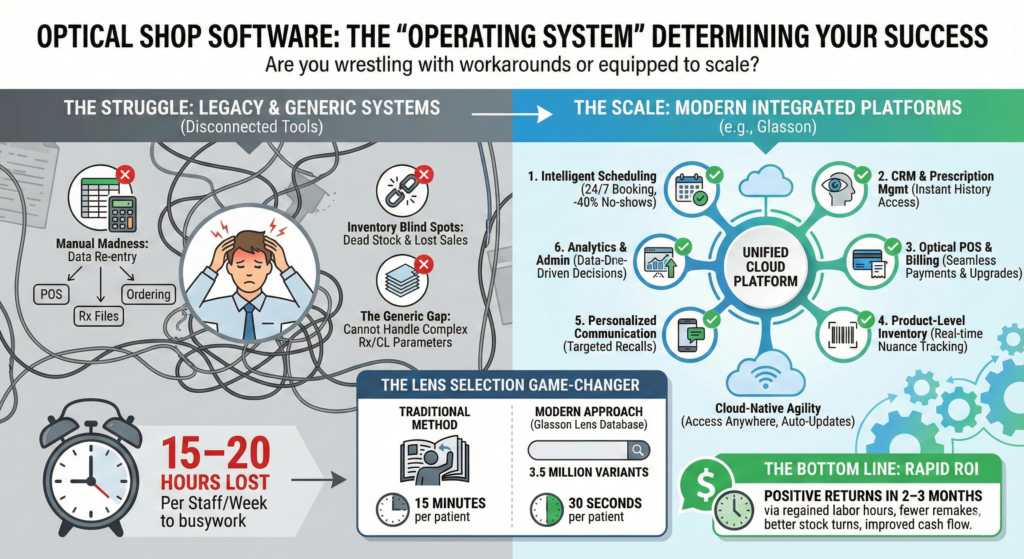
Your optical shop software isn’t just a tool—it’s the operating system of your entire business. Choose wrong, and you’ll spend 15-20 hours per week per person wrestling with manual workarounds, inventory blind spots, and lost opportunities. Choose right, and you’ll automate the busy work, eliminate costly remakes, and finally have the bandwidth to grow.
Key Insights
- The real cost of bad software: Most optical retailers lose 15-20 hours weekly per staff member to manual tasks, data re-entry, and workarounds—easily exceeding the cost of modern cloud platforms
- Seven operational pillars: Best optical shop management systems integrate POS, inventory management, including lens finder, EHR, scheduling, communication, and analytics into one workflow
- Legacy vs. modern divide: Outdated optical shop management software forces you to bridge gaps between disconnected systems; purpose-built platforms like Glasson eliminate silos entirely
- ROI timeline: Specialized optical software for retail stores typically delivers positive returns within 2-3 months through reduced admin time and fewer processing errors
- Strategic risk: Generic retail systems and aging platforms
- Lens selection advantage: Modern optical retail software includes massive databases (Glasson offers 3.5 million lens variants) that turn what used to take 15 minutes into a 30-second decision
What Optical Shop Management Actually Means?
Think about the last time you bought a car. You didn’t just look at the seats—you looked at the engine, the bed capacity, the towing power, the fuel efficiency. That’s because you understood it as a complete system, not just a place to sit while driving.
Most optical shop owners approach software the same way they’d approach those truck seats: they focus on what’s immediately visible (the POS screen, the appointment calendar) without examining the engine underneath. Does your inventory sync automatically with your sales data? Can your prescription records flow into lens orders without re-keying? Does your communication system know which patients are due for recalls? Does your intelligent lens finder instantly search over 3.5 million variants based on prescription parameters, lifestyle needs, and frame details to recommend optimal options in under 0.2 seconds?
The best optical shop management software handles the complete workflow: from the moment a patient books online to the instant their finished glasses are ready for pickup. Everything in between—the exam records, the lens selection, the lab orders, the billing, the insurance, the follow-up reminders—lives in one connected system.
Beyond Basic POS: What Optical Retail Actually Requires?
Here’s what separates generic retail software from true software for optical shops: an optical business speaks a different language. You don’t just track SKUs; you track prescriptions with sphere, cylinder, axis, and PD measurements. You don’t just manage inventory; you manage frame collections with different sizes, colors, and brands, plus contact lens parameters that change by power and base curve.
Most practice management software for other industries can’t handle this complexity. They force you into workarounds: spreadsheets for lens codes, paper files for prescriptions, separate apps for recalls. Each workaround creates another point where errors creep in and hours disappear.
Specialized optical shop software understands your workflows from the ground up. It knows that when a patient orders progressive lenses, you need to track fitting height. It knows that contact lens inventory requires expiration date monitoring. It knows that your busiest hours determine optimal appointment intervals.
The Six Pillars of Effective Optical Shop Management Systems
Ever made a business decision based on “what feels right” and regretted it later? Let’s break down what actually matters in software for optical retail—not based on vendor marketing, but on how each pillar affects your bottom line.
POS and Billing Systems
Your point of sale does more than process payments. The right optical shop POS software captures every revenue opportunity at checkout: the lens coating upgrade, the second pair discount, the warranty add-on. It handles split payments between insurance and patient responsibility without making your optician do mental math. It prints detailed invoices that patients can submit for reimbursement.
When your POS billing is slow or clunky, customers wait longer. They get impatient. They skip the add-ons. One practice switched to Glasson and found their average transaction value jumped 12% simply because the checkout process became smooth enough for staff to comfortably suggest extras.
Inventory Management at the Product Level
How many times this month did someone ask for a specific frame only to discover it’s out of stock—but your system said you had three? Inventory errors don’t just annoy customers; they tie up cash in dead stock while you stock out on bestsellers.
The best optical retail software uses barcode scanning to track every frame and contact lens box in real-time. Your inventory system should tell you which products generate profit and which ones just collect dust.
7-day free trial
Got Any Questions? Let us know in the Contact Us form below.
CRM and Prescription Management
Your patient data is gold—if you can actually use it. How quickly can you pull up someone’s complete history: their last three prescriptions, their preferred frame style, their insurance details, their purchase patterns?
Generic retail software treats customers as transaction records. Software for opticians treats them as patients with evolving eye health needs. The difference shows up in service speed: finding the right prescription takes 10 seconds instead of two minutes. It shows up in personalization: you remember they prefer rimless frames and always decline coatings. It shows up in revenue: you know exactly when they’re due for their next exam.
Glasson’s client management stores prescriptions, documents, visit history, and lifestyle notes in one searchable database. No more hunting through filing cabinets or asking patients to remember details from two years ago.
Scheduling and Appointment Systems
Empty appointment slots cost you twice: lost exam revenue and lost opportunity to sell eyewear. The right optometry software fills your calendar intelligently—booking the right appointment types at optimal times, sending automated reminders that reduce no-shows by 40%, and enabling online reservation so patients book at midnight when they’re finally thinking about their vision.
One optometrist told us their old system required phone tag for every appointment change. After switching to modern optical practice management software, 60% of bookings happened outside business hours. Their phone stopped ringing off the hook, and their schedule stayed full.
Communication Tools That Actually Get Read
You send recall reminders, but do they work? Most optical retail shops blast the same generic text to everyone: “Time for your annual exam!” No wonder response rates hover around 8%.
Smart optical software for retail personalizes automatically. It knows who’s due for contact lens refills versus who needs a pediatric exam for their daughter. Communication features should feel personal even when they’re automated.
Think about your own phone: you ignore generic marketing messages, but you read personalized texts from businesses you trust. Your patients are the same.
Analytics and Administration
How do you know which frames sell best? Which staff member closes the most multi-pair sales? What your peak hours are? Whether your marketing actually drives appointments?
Most optical store owners make decisions by gut feel because their software doesn’t surface the numbers. Modern optical management systems put real-time statistics on your dashboard: sales by category, inventory turn rates, patient lifetime value, staff performance metrics.
One chain owner discovered through their analytics that they were spending 40% of inventory budget on designer frames that generated just 12% of sales. They rebalanced stock and increased margins by 8 percentage points in one quarter.
The administration panel also handles staff permissions, multi-location controls, and compliance requirements without requiring an IT department.
Expert’s Voice
“The practices that grow aren’t necessarily the ones with the fanciest equipment or the best location. They’re the ones that eliminated friction from their operations. When your software handles the repetitive work—the data entry, the recall scheduling, the inventory tracking—your team has mental bandwidth for what actually matters: helping patients see better and feel confident in their eyewear choices.”
Adam Smith, Product Manager @ Glasson
Legacy vs. Generic vs. Purpose-Built: What are The Real Differences?
Let’s talk about what you’re actually choosing between.
Legacy On-Premise Systems
These were built when optometrists still used PDAs and dial-up internet. They work—sort of—but they’re showing their age. The interfaces look like Windows 98. Adding a new location requires buying another server. Updates happen once a year if you’re lucky. Want to check inventory from home? Too bad; the system lives on your office computer.
The bigger problem isn’t the outdated look; it’s the hidden costs. Legacy systems charge per module: one fee for POS, another for scheduling, another for inventory. Want to integrate with your lab? That’s a custom development project. Need to export data? Better hope you have an IT person who understands proprietary database formats.
These platforms worked great in 2003. In 2026, they’re anchors.
Want to see Glasson's full potential?
Book a presentation
Generic Retail or Medical Software
Some optical retailers try to save money with general retail business POS systems. Others use generic practice management tools designed for medical clinics. Both approaches end up costing more than they save.
Generic retail software doesn’t understand prescriptions. It can’t handle PD measurements or lens parameters. You’ll build workarounds—usually spreadsheets—to track optical-specific data. Those workarounds break. Data gets out of sync. Staff waste time reconciling conflicts.
Generic medical software has the opposite problem: it’s built for diagnosis codes and treatment protocols, not retail inventory and fashion preferences. Try explaining to your general medical EHR why you need to track frame colors and temple lengths. Try running a trunk show when your system thinks inventory means bandages and syringes.
Purpose-Built Optical Software
Software designed specifically for optical retail shops understands your business from day one. It knows what a progressive lens is. It tracks frame inventory by brand, style, size, and color. It handles insurance claims for vision benefits, not medical procedures.
The best software for optical shops also stays current with how your business evolves. Modern cloud platforms add features regularly: online booking, digital measurements, automated marketing, advanced analytics. You don’t buy modules; you subscribe to a service that improves over time.
Glasson exemplifies this approach: cloud-native architecture, optical-first design, transparent pricing, and regular updates based on what practicing opticians actually need.
Where Glasson Changes the Math?
Most optical shop management systems treat lens selection as an afterthought—maybe a basic search function, maybe a PDF catalog, maybe nothing at all. Glasson built the entire platform around the insight that choosing the right lens is the most critical (and most time-consuming) part of serving patients.
The Lens Database Advantage
Imagine you’re fitting a patient with a -6.50 prescription who drives at night and uses a computer all day. With traditional methods, you’d flip through manufacturer catalogs, verify compatibility with their frame choice. Best case: 10-15 minutes of research. Worst case: you recommend something suboptimal because you didn’t want to keep them waiting.
Glasson’s lens finder searches 3.5 million variants in seconds. Type the prescription parameters, add lifestyle factors (night driving, computer use), specify the frame, and get ranked recommendations with pricing. What used to take a quarter-hour now takes 30 seconds.
That speed compounds: serve more patients per day, reduce decision fatigue, eliminate ordering errors from manual catalog lookups. One optician calculated they saved 12 hours per week just on lens research.
True Integration, Not Duct Tape
Most “integrated” software suites are actually separate products loosely connected. Patient data lives in one database, inventory in another, accounting in a third. Changes in one system don’t automatically update the others. You discover problems retroactively: the lens you just sold was actually out of stock, the patient’s insurance information was outdated, the frame never got marked as delivered.
Glasson’s optical retail pos system was designed as a unified platform from the start. Book an appointment in the calendar, and the patient record is ready when they arrive. Complete an exam, and the prescription feeds directly into lens selection. Finalize a sale, and inventory decrements in real-time while the billing system generates an invoice.
This isn’t marketing speak about “seamless integration.” It’s basic sanity: one database, one source of truth, no manual syncing required.
Cloud-Native for Modern Operations
On-premise software made sense when internet connections were unreliable and data security meant locking servers in closets. Now it’s just an anchor. You can’t check inventory from home. You can’t access patient records at satellite locations without complex VPNs. You can’t add new staff without buying licenses and configuring permissions on the office network.
Cloud software works anywhere with internet. Check tomorrow’s schedule from your phone. Let part-time optometrists access exam records from their home office. Add a new location without buying servers or running network cables. Automatically back up data without remembering to swap backup drives.
Security concerns about the cloud are mostly outdated. Reputable platforms use bank-level encryption, regular security audits, and automatic updates that patch vulnerabilities immediately—all more reliable than hoping your office IT person remembers to install updates.
What Are The Real Cost of Doing Nothing?
You might be thinking: “Our current system works fine. Why change?” Fair question. Let’s do the math.
Time Costs Add Up Fast
If each staff member loses just 15 minutes per day to software friction—re-entering data, looking up information that should be automatic, reconciling inventory discrepancies—that’s 1.25 hours per week per person. For a practice with four staff members, that’s five hours weekly, or 260 hours yearly.
At an average wage of $25/hour, that’s $6,500 in wasted labor annually. Good optical software costs less than that per year, and the time savings are usually much higher than 15 minutes daily.
But the real cost isn’t just wages. It’s opportunity cost: those 260 hours could have been spent serving patients, following up on recalls, training staff on new products, or developing marketing campaigns. Time wasted on administrative friction is time stolen from growth.
Errors Cost More Than Hours
Manual processes create errors. You transpose a prescription digit. You order the wrong lens thickness. You miss that the patient’s insurance plan changed. You stock three copies of a discontinued frame while being out of stock on your bestseller.
Most optical retailers track these as “cost of doing business.” They shouldn’t. Each remake eats profit. Each stockout loses a sale. Each insurance rejection creates awkward conversations and payment delays.
Modern optical software doesn’t eliminate all errors—humans still make mistakes—but it eliminates the errors caused by disconnected systems and manual data entry. That’s most of them.
Strategic Inflexibility
Bad software doesn’t just cost money today; it limits what you can do tomorrow. Want to launch a subscription program where patients pay monthly for annual eye exams plus discounted eyewear? Want to add AR virtual try-on to your website? Your current platform has no API for integration. Want to analyze which marketing channels drive the most valuable patients? Your reports don’t track source attribution.
Every business opportunity you can’t pursue because of software limitations is revenue left on the table. In a competitive market, that inflexibility becomes fatal.
Glasson’s architecture anticipates future needs: API-first design, modular features, regular updates based on industry trends. It’s not just software for where your practice is today; it’s infrastructure for where you want to go.
Making the Switch: What Actually Matters?
So you’re convinced modern optical shop management software makes sense. How do you choose?
Ask About Total Cost, Not Just Subscription Price
Legacy vendors love complex pricing: base license plus per-user fees plus module add-ons plus integration fees plus annual maintenance. You end up paying for features you don’t use and getting surprised by hidden costs.
The best optical software uses transparent pricing. One monthly fee per location or user, all features included, Glasson’s pricing works this way: you know exactly what you’ll pay before you start.
Also ask about switching costs: data migration support, training time, overlap period where you run both systems. The cheapest monthly fee might not be the lowest total cost if it takes six months and consultant fees to implement.
Test Glasson for 7 days free of charge
Any questions? Leave your contact details and we'll call you back.
Evaluate Speed to Value
Some enterprise systems take months to deploy: configure servers, customize workflows, import data, train staff, run parallel operations. That’s months of paying for two systems while getting limited value from the new one.
Cloud platforms often go live in days: sign up, import your existing data (usually via CSV), customize basic settings, and start using it. Most staff learn the interface in a few hours. You’re seeing benefits by week two, not month six.
Test the Actual Workflows
Don’t just watch vendor demos. Get a free trial (Glasson offers one) and actually use the system for your daily work. Book appointments. Look up patient records. Search for lenses. Process sales. Send reminders. Generate reports.
Pay attention to friction points: How many clicks to complete common tasks? Does the interface feel intuitive or do you constantly consult the manual? Does it speed up your work or just digitize the same slow processes?
Also test it on the devices you actually use: desktop computers in the exam room, tablets at the front desk, phones when you’re checking inventory in the back. The best software for optical retail works seamlessly across all of them.
Check the Support Quality
Software breaks. Questions arise. You’ll need help. Evaluate support before you commit: response time, availability (24/7 or business hours only?), support channels (phone, email, chat?), quality of documentation.
Read reviews from actual users, not just the sanitized testimonials on the vendor’s website. Search for “[software name] support issues” and see what comes up. Join optical professional forums and ask what people’s real experiences have been.
Good software with mediocre support beats mediocre software with great support, but both together is what you want.
ROI: When Does Investment Pay Off?
Let’s ground this in reality. Modern optical retail software typically costs $100-300 per month for a single-location practice. That’s $1,200-3,600 annually. When do you break even?
Most practices see positive ROI within 2-3 months from these sources:
Time savings: Reclaiming even 10 hours weekly (at $25/hour) means $13,000 annually in labor productivity. That more than covers software costs.
Fewer errors: Eliminating just two remakes per month (at $150 lost profit each) saves $3,600 yearly.
Better inventory management: Reducing tied-up cash by 10% frees capital and improves stock turns. For a practice carrying $50,000 in frame and contact lens inventory, that’s meaningful.
Improved collections: Automated reminders and clearer billing reduce outstanding receivables. Even a 5% improvement in collection rates adds thousands to cash flow.
Higher patient volume: Better scheduling and faster service means you can see more patients without adding hours. That’s pure incremental revenue.
Add it up and the math isn’t close: the software pays for itself quickly, then keeps delivering value through operational efficiency and growth enablement.
The Glasson Advantage: Built Different
What makes Glasson different from other optical shop management systems? It’s the combination of advantages, not any single feature.
The lens engine is the flagship differentiator: 3.5 million lens variants searchable by prescription, lifestyle needs, and budget. But that engine sits within a complete platform that handles client management, inventory, scheduling, communication, analytics, and administration as one integrated workflow.
The cloud-native architecture means you’re always on the latest version, always backed up, always accessible from anywhere. The transparent pricing means no surprises. The optical-first design means the software speaks your language from day one.
But perhaps the biggest difference is philosophical: Glasson was built by people who understand that optical retail isn’t just retail and isn’t just medical—it’s a specialized business with unique requirements. The software reflects that understanding in every feature.
FAQ: Your Questions Answered

What makes optical shop software different from regular retail POS systems?
Optical software manages prescription data (sphere, cylinder, axis, PD), integrates with optical labs, tracks eyewear-specific inventory (frame sizes, lens types, contact lens parameters), and handles vision insurance billing—none of which general retail systems support properly.
How long does it take to implement new optical shop management software?
Cloud-based platforms like Glasson typically go live within a few days: import your patient database, configure basic settings, train staff (usually 2-4 hours), and start using it. Legacy on-premise systems can take months to deploy.
Can optical software integrate with my existing lab and supplier systems?
Modern platforms use standard formats to connect with most optical labs and frame suppliers. Check specific vendor compatibility before committing, but most major labs work with popular software solutions.
Do I need IT staff to run cloud-based optical software?
No. Cloud platforms handle all technical maintenance—servers, backups, security updates, uptime—as part of the subscription. You just need internet access and standard devices (computers, tablets, or phones).
How much does quality optical shop management software cost?
Pricing varies, but expect $100-300 monthly for single-location practices, with volume discounts for multiple locations. Watch for hidden fees: some vendors charge extra for “premium” features, support, or data storage.
What happens to my data if I switch software providers?
Reputable vendors let you export your data (usually as CSV files) at any time. Before signing up, confirm the export process and what formats are supported. Your patient records, prescription history, and inventory data are yours.
Will my staff resist switching to new software?
Change is always challenging, but modern interfaces are so much easier than legacy systems that most staff prefer them within a week. Focus on training around actual workflows, not just feature lists.
Can optical software help with insurance billing and claims?
Yes, specialized optical billing software tracks insurance eligibility, processes claims, manages copays, and flags rejected claims for follow-up. This alone saves hours weekly for most practices.
How does optical shop software handle contact lens inventory differently than frames?
Contact lens inventory requires tracking parameters (base curve, diameter, power), expiration dates, and often special ordering for custom prescriptions. Good software automates reorder alerts and tracks patient contact lens fitting history.
What reporting and analytics should I expect from optical management systems?
At minimum: sales reports by product category, staff performance metrics, inventory turn rates, appointment utilization, patient retention rates, and revenue trends. Advanced platforms add patient lifetime value, marketing ROI, and predictive analytics.