English
  Polski
  Čeština
  Deutsch
  Español
  Français
  Ελληνικά
  Hrvatski
  Italiano
  Lietuviškai
  Magyar
  Nederlands
  Português
  Română
  Slovenčina
  Svenska
  Türkçe
  Русский
Practice Management in Optometry: Why Your Software Either Saves You or Drowns You
You know that moment around 2 PM on Tuesday when you realize you’ve spent the entire morning not examining eyes, but hunting down a missing patient file, calling insurance companies, and manually updating inventory because someone sold the last pair of progressive lenses without logging it? That’s not optometry. That’s digital paperwork hell.

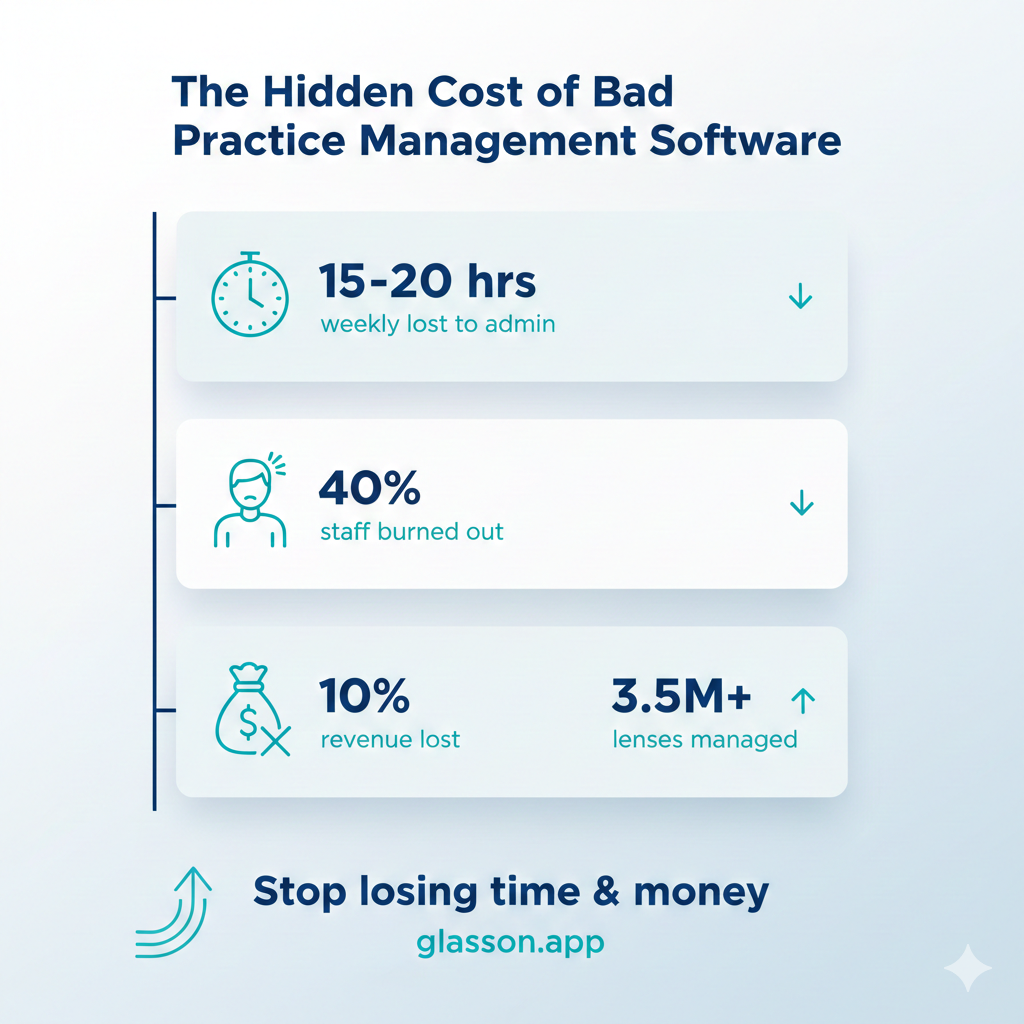
Here’s the uncomfortable truth: Most optometrists spend 15-20 hours every single week on administrative tasks—not because they’re slow, but because their practice management system is fighting them instead of helping them.
Key Insights
- Administrative burden is stealing your clinical time: ODs lose 15-20 hours weekly to tasks that modern practice management software should handle automatically
- Poor scheduling cascades into everything: Overbooking drops patient satisfaction by 23%, while underutilization wastes your most expensive resources
- Billing errors cost you 10% of revenue: Without real-time insurance verification and integrated billing, practices lose significant income to preventable claim denials
- Your staff is burned out: 40% of optical practice staff report feeling worn out at the end of each day, directly linked to administrative overload
- Fragmented systems multiply data entry: When scheduling, clinical records, and billing don’t communicate, your team enters the same information 3-4 times
- Inventory chaos kills revenue: Manual tracking leads to overstocking (cash flow drain) and understocking (lost sales)
- You’re flying blind without KPIs: Most practices make decisions based on gut feeling instead of data because their system doesn’t surface critical metrics
- Integration isn’t optional anymore: “Best-of-breed” approaches where you cobble together separate systems create more problems than they solve
The Real Cost of “Making Do” with Your Current System
Ever made a business decision based on “what feels right” and immediately regretted it? That’s what happens when your practice management system in optometry doesn’t give you visibility into what’s actually happening in your practice.
Let’s talk about Dr. Sarah’s optical practice in Toronto. Successful by most measures—good patient reviews, steady exam bookings, nice location. But here’s what her typical Monday morning looked like:
7:30 AM: Staff arrives early to manually confirm appointments because the scheduling system doesn’t send automatic reminders. Three no-shows this week alone.
9:15 AM: First patient complains about waiting 25 minutes because the previous appointment ran long. Nobody knew that patient had complex needs because the scheduling system doesn’t talk to the clinical records.
11:00 AM: Front desk discovers insurance coverage was entered incorrectly three weeks ago. Now they’re calling the patient back to collect additional payment—awkward conversation, frustrated patient.
2:00 PM: A patient wants specific progressive lenses discussed during their exam. Nobody can quickly confirm if they’re in stock because inventory updates manually at end of day.
5:30 PM: Staff stays late entering data from paper forms into three different systems: scheduling, EHR, and billing. Same information, typed three times.
This isn’t exceptional. This is Tuesday.
When Scheduling Becomes Your Enemy Instead of Your Tool
Your appointment calendar should be the backbone of everything else. Instead, for most practices, it’s the source of daily chaos.
Here’s what poor scheduling actually costs you:
- Rushed appointments hurt clinical quality: When your schedule is overbooked, exam times fall below the recommended minimums. You know you’re rushing. Your patients definitely know it.
- Staff morale tanks: Your team spends hours confirming, rescheduling, and correcting appointments manually. That’s not clinical work—that’s preventable busywork.
- Revenue opportunities vanish: When appointments run late, there’s no time to discuss premium lens options, specialized coatings, or multiple-pair purchases. You’re leaving money on the table every single day.
- Idle time drains profits: Underutilization means you’re paying staff and maintaining equipment that’s sitting unused.
The practices that fix scheduling first report something surprising: patient satisfaction improves before they change anything clinical. Why? Because reliable systems make your practice feel professional and organized, even before patients see you for the exam.
Your Inventory Is Either Making Money or Losing Money—There’s No Middle Ground
Think about how many SKUs you’re actually managing: hundreds of frame styles, thousands of lens combinations, contact lens boxes, solutions, cases. Now imagine tracking all of that on spreadsheets or—let’s be honest—partially in your head.
Manual inventory tracking doesn’t just create administrative headaches. It actively costs you money:
- Overstocking ties up cash flow in frames that sit on shelves for months or lenses that expire before you use them
- Understocking means telling patients “we don’t have that” and watching them walk out to order online
- Stock discrepancies multiply when your inventory management doesn’t connect to your dispensing process
- Vendor chaos overwhelms you when managing dozens of suppliers across different systems
One practice owner told us: “I finally calculated what we lose annually to obsolete inventory and missed sales from out-of-stocks. It was more than my entire software budget for three years.”
Real-time inventory integration means when a patient selects frames during their exam, your system immediately confirms availability, reserves the item, and triggers reordering if you’re running low. That’s not magical—that’s just how modern practice management in optometry should work.
7-day free trial
Got Any Questions? Let us know in the Contact Us form below.
The Revenue Cycle Problem Nobody Talks About
Insurance billing in optometry is uniquely complicated. You’re not just navigating medical insurance—you’re handling medical AND vision insurance simultaneously for the same patient. Sometimes the exam goes through medical. Sometimes it’s vision. Sometimes it’s split.
Without proper practice management system optometry tools, here’s what happens:
- Manual insurance verification takes 5-10 minutes per patient (multiply that by 30 patients/day)
- You provide services not covered by the patient’s plan because you didn’t verify eligibility in real-time
- Coding errors for specialized procedures (OCT, fundus photography, contact lens fitting) generate claim denials
- Patients get surprise bills weeks later because nobody knew their actual out-of-pocket cost upfront
Over 85% of healthcare executives cite claim denials and underpayment as their top financial stress. Your clean claim rate should exceed 95%. Your denials percentage should stay between 5-10%. If you don’t know those numbers off the top of your head, that’s your first problem.
Billing errors cost practices an estimated 10% of annual revenue—not because billing staff are incompetent, but because manual processes in fragmented systems create inevitable errors.
The Patient Experience Collapses When Your Systems Don’t Talk
Your patients don’t see “systems.” They see chaos.
They arrive for their appointment and watch front desk staff manually type information that should already be in the system. They wait 20 minutes past their scheduled time with no explanation. They call two weeks later about their glasses order and nobody can find the information without searching through three different screens.
Modern patients expect:
- Confirmation texts and email reminders (not phone calls)
- Online scheduling that works 24/7
- Digital access to their prescription and order status
- Communication through their preferred channel (SMS, email, or patient portal)
- Smooth transitions between your website, scheduling system, and in-office experience
When your systems are fragmented, you can’t deliver any of this consistently. Patient communication becomes sporadic and manual. Your team means well, but they’re overwhelmed.
One practice manager put it this way: “We’d love to offer a patient portal and automated reminders, but our current system treats those as expensive add-ons that don’t integrate properly. So we don’t offer them at all.”
That’s not a technology problem. That’s a competitive disadvantage.
Your Staff Doesn’t Have a Work Ethic Problem—They Have a Systems Problem
Let’s address the elephant in the exam room: staff turnover.
40% of optical practice staff report feeling completely worn out at the end of each workday. High turnover follows naturally. And every time someone leaves, you lose:
- The investment in recruiting and training them
- Institutional knowledge about your patients and workflows
- Consistency in patient experience
- The trust patients built with that team member
Young staff members join optometry practices excited about patient care and clinical work. Then they discover they’re drowning in manual data entry, fighting with software that doesn’t communicate between modules, and apologizing to frustrated patients for system failures.
They don’t leave because the work is hard. They leave because the systems make everything unnecessarily harder.
“The practices we work with consistently report that implementing integrated systems reduces administrative workload by 40-60%. That’s not marginal improvement—that’s transformational. When you give staff tools that actually work, job satisfaction improves immediately because they can finally focus on patient care instead of fighting their software.”
— Adam Smith, Product Manager @ Glasson
The irony? The root cause is almost never lack of dedication. It’s poor systems that turn motivated professionals into frustrated data entry clerks.
Want to see Glasson's full potential?
Book a presentation
Flying Blind: The KPI Visibility Problem
Quick question: What’s your revenue per OD hour? Your capture rate for premium progressive lenses? Your clean claim rate? Your A/R aging beyond 90 days?
If you had to pull reports to answer any of those questions, you don’t have real visibility into your practice performance. You’re making decisions based on intuition instead of data.
Here’s what you can’t manage without visibility:
- Which premium lens types drive the most revenue (so you know where to focus sales training)
- Which staff members excel at converting exams to eyewear purchases
- Why insurance claims are being denied (so you can prevent future denials)
- Which patient communication methods get the best response rates
- Where scheduling bottlenecks occur (so you can optimize resource allocation)
Most practice management systems in optometry can generate reports—eventually, after someone exports data to Excel and manually creates pivot tables. That’s not visibility. That’s archaeology.
Modern practice analytics should surface critical KPIs in real-time dashboards that you check daily, not quarterly reports you dread running.
What Modern Practice Management System Optometry Actually Needs
Not all practice management software is created equal. Some systems claim to be “comprehensive” while forcing you to use clunky workarounds for basic workflows. Others excel in one area while failing completely in others.
Here’s the baseline for adequate practice management in optometry:
Scheduling That Actually Works
- Unified calendar: Online bookings, in-store appointments, and recalls all on one platform—not bolted together afterward
- Intelligent appointment types: Different visit types automatically map to appropriate time slots
- Automated patient communications: Reminders and confirmations without manual staff effort
- Real-time availability: Prevents double-booking and overbooking automatically
Clinical Records That Support Actual Workflows
- Customizable EHR templates: Built for optometry, not generic healthcare
- Equipment integration: Direct connectivity to OCT, fundus cameras, and other diagnostic tools
- Fast documentation: Reduces charting time without sacrificing thoroughness
- Seamless data flow: Clinical findings automatically feed into dispensing and billing
Inventory Management That Prevents Chaos
- Real-time stock visibility: Staff see what’s available during patient consultations
- Automatic updates: When patient selects frames/lenses, inventory adjusts immediately
- Smart reordering: Triggers based on stock levels and sales velocity
- Comprehensive lens database: Like Glasson’s 3.5M+ lens variant database that eliminates “we don’t have that combination” problems
Billing That Doesn’t Make You Want to Scream
- Real-time insurance verification: Before the patient sits down for their exam
- Multi-factor eligibility: Automatically determines medical vs. vision coverage
- Electronic claims submission: No manual data entry or paper forms
- Denials tracking: Flags problem claims for immediate review
Patient Engagement That Builds Loyalty
- Multi-channel communication: SMS, email, and patient portal all integrated
- Automated campaigns: Birthday messages, recall reminders, educational content
- Online access: Patients can request prescription refills and check order status 24/7
- Preference tracking: System remembers how each patient prefers to be contacted
Analytics That Actually Help You Decide
- Real-time dashboards: Critical KPIs visible at a glance
- Customizable reports: Focus on metrics that matter to your specific practice
- Comparative data: Benchmark against your own historical performance
- Actionable insights: Data that clearly points to what needs attention
If your current system is missing any of these fundamentals, you’re not running a modern practice—you’re running an expensive paperwork operation that occasionally examines eyes.
Why “Best-of-Breed” Systems Don’t Work in Optometry
Some consultants will tell you to pick the “best” scheduling software, the “best” EHR, the “best” billing system, and integrate them. That sounds logical. It’s also catastrophically wrong in practice.
Here’s what actually happens with fragmented systems:
Your scheduling system doesn’t communicate with your EHR, so patient history doesn’t inform appointment length. Your EHR doesn’t feed into billing automatically, so staff manually re-enter diagnosis codes and procedures—hello, claim denials. Your inventory system exists separately from your dispensing module, so stock levels are always wrong. Your billing system can’t automatically verify insurance eligibility before the appointment because it doesn’t connect to your scheduling system.
The result? Staff spend their entire day moving data between systems manually. Every time they copy information from one system to another, errors multiply. A wrong patient birthday in scheduling means insurance verification fails. A missing diagnosis code means the claim gets rejected.
Integration gaps create workflow bottlenecks. Clinical information doesn’t flow to billing. Inventory doesn’t update when patients select frames. The “best” software in one category refuses to communicate with the “best” software in another category.
The middleware and API layers you need to make them talk? Expensive, complicated, and fragile. They break every time any vendor updates their software.
One practice tried the “best-of-breed” approach. After six months, they calculated that staff spent an extra 12 hours per week manually coordinating between systems. That’s half a full-time employee just moving data around.
The alternative? Purpose-built, integrated solutions like Glasson that understand optical practice workflows from the ground up.
How Glasson Makes Practice Management Actually Work
Glasson wasn’t built by healthcare IT consultants unfamiliar with dispensing. It was designed specifically for optical practices—the unique workflows where clinical care meets retail, where you need to manage both patient health records and frame inventory, where insurance billing combines medical and vision coverage.
Here’s what makes Glasson different:
Built for Your Actual Workflow
Optometry isn’t just clinical care. It’s not just retail. It’s both simultaneously. Generic medical software fails because it doesn’t understand frame selection, lens databases, or optical retail. Retail POS systems fail because they don’t handle clinical documentation or medical billing.
Glasson handles both because it was built specifically for practices like yours. Online booking integrates seamlessly with in-store operations. Clinical findings flow automatically into dispensing and billing.
Comprehensive Lens Intelligence
That 3.5M+ lens variant database isn’t just a marketing number. It means when a patient has an unusual prescription or wants a specific combination of features, your staff isn’t spending 20 minutes searching catalogs or calling labs. The intelligent lens search engine finds the right solution in seconds with evidence-based recommendations.
Real Integration, Not Middleware Band-Aids
When a patient books online at midnight, that appointment appears immediately in your clinic schedule. When you complete an exam, findings are already prepared for billing—no manual transfer. When a patient selects frames, inventory updates automatically. That’s real integration.
Modern Cloud Architecture
No servers to maintain. No IT infrastructure to worry about. Access from any device with internet. Automatic updates and security patches. Your data is safer in Glasson’s cloud infrastructure than on any local server in your back office.
Data That Drives Decisions
Built-in analytics show revenue per OD hour, capture rates, premium lens adoption, scheduling efficiency, and patient retention metrics in real-time dashboards. You’re not waiting for quarterly reports—you’re checking key metrics daily.
The Real ROI: Time, Money, and Sanity
Let’s talk numbers because practice management system optometry investments need to justify themselves financially.
Billing errors alone cost practices up to 10% of annual revenue. If you’re generating $500,000 annually, that’s $50,000 you’re leaving on the table through preventable claim denials and coding errors.
Appointment no-shows waste significant revenue. Automated reminders through proper patient communication systems reduce no-shows by 30-50%. If you’re losing $10,000 annually to no-shows, you’re recovering $3,000-5,000 immediately.
Staff inefficiency from fragmented systems costs both time and money. When integrated systems reclaim 10-15 hours weekly per staff member, that’s capacity to serve more patients without hiring additional staff.
Better inventory management prevents both overstocking losses and understocking missed sales. Most practices implementing real-time inventory systems report 15-25% improvement in inventory turns within the first year.
Improved patient retention through consistent engagement drives recurring revenue. A 5% increase in retention can increase profits by 25-95% because you’re not constantly replacing lost patients.
Most practices recover their software investment within 6-12 months through combined efficiency gains. After that, it’s pure margin improvement.
Test Glasson for 7 days free of charge
Any questions? Leave your contact details and we'll call you back.
Getting Started: Evaluate Your Current Situation
Before you consider any new system, honestly assess where you are now. Ask yourself these questions:
Do your staff enter the same data into multiple systems? If yes, you have a fragmentation problem costing you hours daily.
Can you access critical KPIs with one click? If no, you’re making decisions based on intuition instead of data.
Do your patients receive consistent, automated communication? If no, you’re losing retention opportunities every single day.
Does your scheduling system know about patient clinical history? If no, you’re consistently booking the wrong appointment lengths.
Can you verify insurance eligibility before the patient sits down? If no, you’re providing services you might not get paid for.
Does inventory update automatically when staff dispense products? If no, your stock counts are always wrong.
The good news? You don’t have to fix everything simultaneously. Modern practice management implementations can roll out module by module: scheduling first, then EHR, then billing. You don’t shut down your practice for three weeks while converting systems.
Glasson provides comprehensive training and ongoing support. The cloud-based architecture means minimal IT infrastructure needed. And because the interface is intuitive and modern, staff adoption happens faster than with legacy systems where everyone needs weeks of training.
Frequently Asked Questions

How long does it take to implement a new practice management system in optometry? Most practices complete initial setup within 2-4 weeks with staged rollout. Core modules like scheduling and patient records go live first, followed by billing and analytics. Cloud-based systems like Glasson significantly reduce implementation time compared to legacy on-premise software.
Will my staff need extensive training on new software? Modern, intuitive systems require significantly less training than outdated legacy software. Most staff become comfortable with core functions within 2-3 days. Glasson provides comprehensive training resources and ongoing support to ensure smooth adoption.
How do I migrate data from my current system? Reputable practice management vendors include data migration services as part of implementation. Patient records, appointments, prescriptions, and historical data transfer to your new system. The migration team handles technical complexities while your staff continues serving patients.
What if my practice has multiple locations? Cloud-based practice management systems excel at multi-location practices. Shared patient databases, centralized inventory visibility, and unified reporting across locations are standard features. Each location maintains scheduling autonomy while corporate has full visibility.
Can patients really book appointments online outside business hours? Yes—online scheduling integrated with your calendar allows patients to book 24/7 based on real-time availability. You control which appointment types are available online and which require staff assistance. Most practices report 20-30% of bookings happen outside regular hours.
How does real-time insurance verification actually work? Modern practice management systems connect to insurance clearinghouses that verify eligibility electronically in seconds. The system checks medical and vision coverage, identifies applicable copays, and flags any eligibility issues before the appointment starts—eliminating surprise billing later.
What happens if internet goes down—can I still see patients? Quality cloud-based systems include offline functionality for core features. You can continue documenting exams and scheduling appointments. Data synchronizes automatically when connection restores. This is actually more reliable than local servers that can fail completely.
How much does proper practice management software cost? Comprehensive systems typically range from $150-400 monthly depending on practice size and features needed. Consider this against the cost of billing errors (10% of revenue), staff inefficiency, and lost retention opportunities. Most practices achieve positive ROI within 6-12 months. Check current pricing options.
Can the software integrate with equipment I already own? Modern practice management systems integrate with most diagnostic equipment through standard protocols. OCT machines, fundus cameras, autorefractors, and phoropters typically connect directly. Verify specific equipment compatibility during software evaluation.
What if I’m happy with parts of my current system? Some practices prefer hybrid approaches initially—keeping certain legacy components while modernizing others. However, true integration benefits only emerge when all systems communicate seamlessly. Most practices eventually migrate fully to integrated platforms for maximum efficiency.