English
  Polski
  Čeština
  Deutsch
  Español
  Français
  Ελληνικά
  Hrvatski
  Italiano
  Lietuviškai
  Magyar
  Nederlands
  Português
  Română
  Slovenčina
  Svenska
  Türkçe
  Русский
Where to Buy Glasses: Your Complete Guide to Finding the Perfect Eyewear in 2026
You check your phone 96 times per day. Your laptop screen glows for eight hours straight. By evening, your eyes feel like they’re staging a rebellion. Sound familiar? You know you need new glasses—but here’s the million-dollar question: where should you actually buy them?
Walk into any optical practice and you’re looking at $400 for basic frames. Scroll through online retailers and you’ll find similar styles for $40. Yet somehow, 85% of people still buy their prescription glasses in person. What gives? The eyewear market hit new levels of confusion in 2026, with options ranging from $7 drugstore readers to $700 designer frames available with just a few clicks.
This isn’t your grandparents’ glasses-shopping experience anymore. The North American eyewear market is growing at 5.12% annually, while online eyewear sales are exploding at 5.8% per year. Whether you need prescription glasses, computer glasses for those endless Zoom calls, or just readers for your bedtime thriller, this guide cuts through the noise and shows you exactly where to buy—and why it matters more than you think.

Key Insights
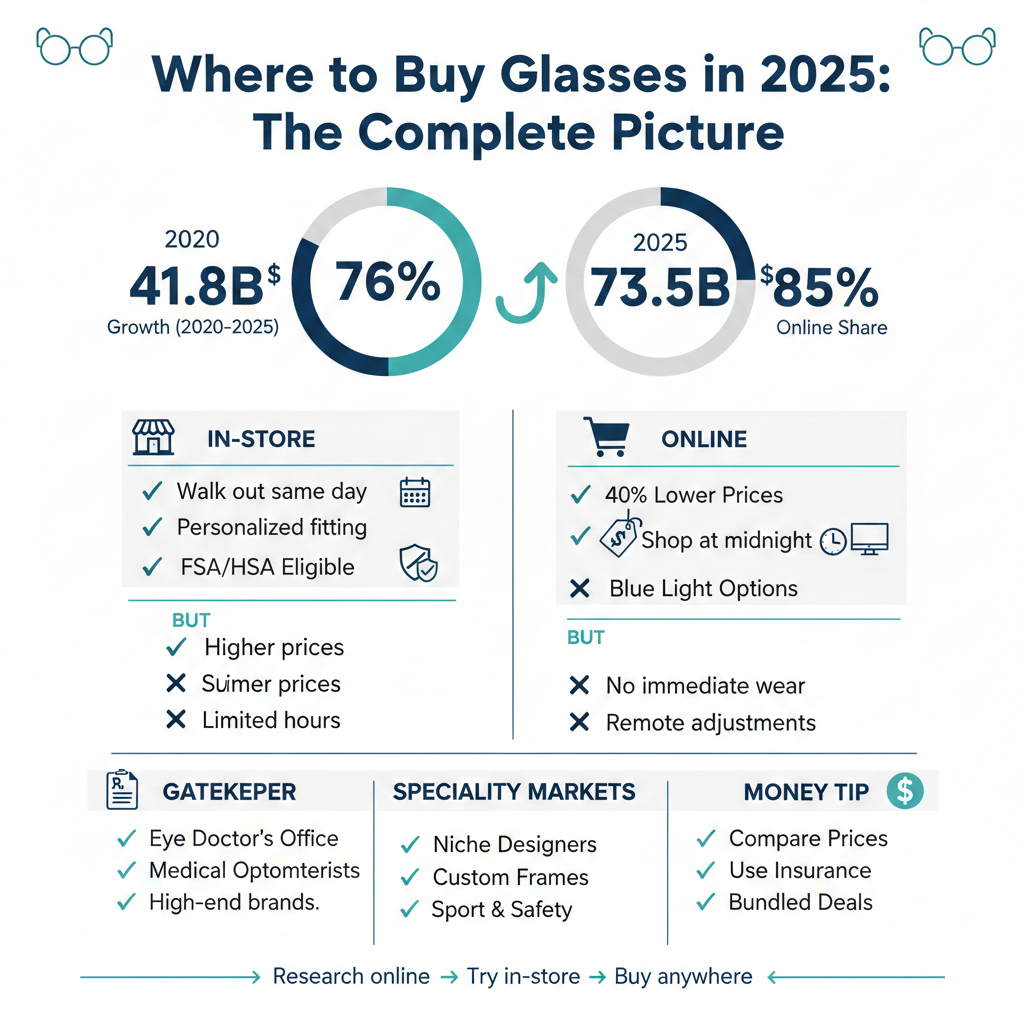
- In-store dominates but online is surging: 85% of prescription glasses are still purchased in-person, but e-commerce eyewear will grow from $41.8B in 2024 to $73.5B by 2034
- Price gap is massive: Online retailers typically offer 40% lower prices than physical stores—but convenience comes with tradeoffs
- Your prescription is the gatekeeper: Without a valid prescription from a licensed optometrist, even the cheapest frames online are useless
- Specialty markets are booming: Blue light blocking glasses market will double from $2.9B (2024) to $5.8B (2034)—remote work created an eyewear revolution
- 68% of shoppers hesitate online: Despite price advantages, most people fear buying glasses online due to fit and style uncertainty
- The future is omnichannel: 34% of Canadians who previously bought online returned to physical retailers—modern shoppers want flexibility, not forced choices
The Eyewear Buying Maze: Why Everyone’s Confused
Remember when buying glasses meant one trip to your local optometrist? You’d get your exam, pick from 50 frames on display, and walk out with glasses two weeks later. Done.
Those days died somewhere between 2010 and now.
Today’s eyewear market throws you into a decision labyrinth. Online pure-play retailers promise designer frames at drugstore prices. Your optometrist’s office has that personal touch but makes your wallet cry. Big-box stores split the difference but limit selection. Virtual try-on technology claims to solve fit problems you didn’t know existed.
The buying journey fragmented into chaos: research frames on Instagram at 11 PM, get your eye exam Thursday morning, check prices during lunch, buy from completely different retailer Friday evening. This isn’t shopping—it’s eyewear expedition planning.
But here’s what nobody tells you upfront: this confusion isn’t random. The market fundamentally restructured itself over the past decade, and understanding why helps you navigate it like a pro instead of wandering aimlessly through options.
What Actually Drives Your Glasses-Buying Decision
Let’s talk about something nobody mentions at optical shops: you’re not making a purely rational decision when you buy glasses.
Sure, you need vision correction. That’s the clinical part. But eyewear purchases are emotional, social, and psychological in ways that surprise most people. Your frames aren’t just medical devices—they’re symbols of identity sitting on your face for 12 hours daily.
Research identifies four distinct customer attitudes when shopping for eyewear:
- Style-focused shoppers obsess over appearance and social approval—they want frames that make them look smart, creative, or professional
- Vision-focused buyers prioritize clarity and eye health above everything else
- Friction-avoiding customers just want the process to be painless and quick
- Information-seeking types need technical lens specifications before making any decision
Here’s why this matters: opticians who understand these psychology patterns tailor their guidance to match your specific expectations. Style-focused customers need appearance validation (“these frames really complement your face shape”). Information-seekers want technical details about lens index, coatings, and anti-reflective treatments.
This psychology explains bizarre-seeming market behavior. Why do people willingly spend 40% more buying in-store when identical frames exist online for fraction of the cost? Because they’re buying professional validation, human reassurance, and personalized guidance—not just plastic and glass.
7-day free trial
Got Any Questions? Let us know in the Contact Us form below.
Traditional Retail: The In-Store Shopping Experience
Physical optical stores—independent optometry practices, chains like LensCrafters, big-box retailers—still dominate eyewear sales. 85% of prescription glasses purchases happen in person, and for good reason.
Walking into an optical practice gives you tangible benefits that no website can fully replicate:
- Try before you buy: Physically wearing frames reveals exactly how they sit on your nose, press against your temples, balance on your face
- Professional optician guidance: Trained staff identify facial features, recommend frame shapes, adjust fit on the spot
- Instant gratification: Walk out same day with glasses (if not special order)
- Vision insurance integration: Most retail stores partner directly with insurance providers, simplifying coverage verification
- Human reassurance: Face-to-face interaction reduces purchase anxiety, especially for first-time glasses wearers
For presbyopes selecting progressive lenses or specialized frames, in-store shopping becomes practically essential. The difference between standard and premium progressive lenses involves technical nuances that trained opticians explain far better than website copy ever could.
The catch? Limited selection compared to online behemoths. Your local practice might display 50-200 frames. Online retailers stock 10,000+ designer frames from 250+ brands. Retail prices run higher due to overhead costs—rent, staff, utilities all built into frame pricing.
Appointment flexibility is another friction point. Most practices operate 9-5 on weekdays. If you work standard office hours, scheduling an optical visit requires taking time off, using lunch breaks, or squeezing in Saturday morning appointments.
The Online Eyewear Revolution: Convenience Meets Pricing
The online eyewear market didn’t just grow—it exploded. $1.7 billion in the US alone for 2026, expanding at 4.1% annually. Globally? The e-commerce eyewear sector will hit $73.5 billion by 2034, up from $41.8 billion in 2024.
Why the surge? Three words: convenience, selection, and price.
Online retailers operate with fundamentally different economics than brick-and-mortar stores. No rent for prime retail locations. Minimal staff overhead. Warehouses in low-cost areas. These savings translate directly into your wallet—online frames typically cost 40% less than identical products sold in physical stores.
Major players dominate the space, each with distinct positioning:
- Zenni Optical: Budget champion with frames starting at $7, massive selection, practical approach
- Warby Parker: Mid-range pricing ($95-195), trendy designs, home try-on program, some physical showrooms
- GlassesUSA: Widest selection (10,000+ frames), designer brands, virtual try-on technology
- FramesDirect: Premium focus, authentic designer eyewear, luxury positioning
Selection beats any physical store by orders of magnitude. Want cat-eye frames in specific shade of burgundy? Oversized rectangular frames with spring hinges? Titanium rimless progressives? Online retailers stock them all, in every color variation imaginable.
Convenience factor is undeniable: shop at 2 AM in pajamas, compare 50 frames in 10 minutes, have glasses delivered to your door in 1-2 days. No commute required, no waiting rooms, no pressure from hovering salespeople.
But online shopping introduces friction points that drive 68% of potential buyers to hesitate. You can’t physically try frames before purchasing. Shipping takes time (immediate gratification disappears). Fit remains uncertain until package arrives. Returns involve hassle—printing labels, going to post office, waiting for refund.
The biggest barrier? Getting accurate prescription and PD measurement in the first place.
Your Prescription: The Gatekeeper to Everything
Here’s uncomfortable truth about online eyewear shopping: without a valid prescription from licensed optometrist, even the cheapest frames are completely useless.
Prescriptions expire within 1-2 years in most jurisdictions. They require professional optometrist or ophthalmologist sign-off—no exceptions. This isn’t bureaucratic red tape; it’s safety regulation ensuring someone qualified actually examined your eyes before you order lenses.
PD (pupillary distance) measurement adds another layer. Most eye exams don’t automatically include PD measurement because it’s optician’s responsibility, not optometrist’s. Without accurate PD—the distance between your pupils measured in millimeters—your lenses won’t align properly with your eyes. Headaches, eye strain, and blurred vision follow.
Online retailers handle this various ways:
- Some provide printable PD measuring tools (accuracy questionable)
- Others offer virtual PD measurement using smartphone cameras (better but not perfect)
- A few partner with optical practices for PD measurement services
- Many simply trust customers to know their PD (risky)
This prescription barrier explains why 47% of Canadian prescription glasses wearers still buy from their exam provider. They’re already at the practice. Optometrist just confirmed prescription. PD measurement happens automatically during fitting. Why introduce friction by shopping elsewhere?
The pathway remains: get exam from optometrist → get prescription → buy from wherever. Online retailers can’t replace the first step. Modern optometry practices understand this dynamic and position themselves accordingly—not as competitors to online retailers, but as complementary services providing essential medical care that enables eyewear purchases wherever customers prefer.
The Trust Problem: Why 68% of Shoppers Hesitate Online
Picture this: you’re scrolling through frames at midnight, found perfect pair that matches your style, price is unbeatable. Yet you close the browser without buying. Sound familiar?
68% of online shoppers hesitate to buy glasses due to fear of poor fit or style dissatisfaction. Unlike ordering a shirt you can return easily, glasses sit on your face advertising your choice to everyone you meet. Stakes feel higher—because they are.
Glasses occupy unique category: medical device + fashion accessory + identity symbol. Without tactile feedback or face-to-face professional assurance, doubt creeps in. Will these frames make you look serious and professional, or like you’re trying too hard? Will they slip down your nose during Zoom calls? Press uncomfortable against your temples after two hours?
Trust is the most crucial factor in digital eyewear experience. Online retailers recognize this and throw technology at the problem:
Virtual try-on systems use artificial intelligence to:
- Track your face in real-time via smartphone or desktop camera
- Overlay realistic 3D glasses matching exact positioning
- Simulate how frames look from multiple angles
- Let you compare frames side-by-side instantly
- Adjust for lighting, gravity, and motion
Some platforms take personalization further—AI recommendations based on facial features, skin tone, previous purchase history, style preferences. Upload selfie, receive curated frame suggestions matching your face shape.
Does it work? Effective personalization dramatically increases purchase confidence. Returns for eyewear overwhelmingly link to fit, comfort, or style mismatches. Virtual try-on technology preempts these issues before you spend money.
But technology hasn’t fully solved trust gap. That’s why 34% of Canadians who previously bought online returned to physical retailers for their most recent purchase. Digital simulation helps, but some people need to physically wear frames before committing.
Want to see Glasson's full potential?
Book a presentation
The Omnichannel Reality: How People Actually Shop Now
Forget the “online vs. in-store” debate. That binary thinking died years ago, but retail marketing departments keep pretending it’s relevant.
Modern eyewear shoppers expect flexibility—ability to research online, try in-store; order online, adjust in-store; check inventory digitally, purchase wherever convenient. This isn’t demanding unreasonable things. It’s basic customer experience in 2026.
Consider typical modern shopping journey:
Monday evening: Browse Instagram, discover frame style you love, save brand name
Tuesday lunch break: Research frames online, check reviews, compare prices across retailers
Wednesday after work: Visit local practice, try similar styles in person, verify fit
Thursday morning: Order online from retailer offering best price
Friday delivery: Try glasses at home, realize slight adjustment needed
Saturday: Visit local practice for professional adjustment
This fragmented journey frustrates single-channel retailers. Pure online stores can’t provide in-person adjustments. Pure physical retailers lose customers who research digitally then buy elsewhere.
Practices offering online appointment booking recognize this shift. Corporate location customers show balanced preference between online and in-person interactions. The Amazon effect fundamentally changed expectations—customers want seamless experience across all touchpoints.
Single-channel retailers (purely online or purely in-store) face competitive disadvantage versus omnichannel competitors. Customers vote with wallets, choosing retailers supporting their preferred shopping behavior rather than forcing artificial channel constraints.
Where to Buy Prescription Glasses: Evaluating Your Options
So where should you actually buy prescription glasses? Honest answer: depends on what you value most.
Buying from your optometrist practice:
- Best for personalized service and fit assurance
- Vision insurance integration simplifies coverage
- Professional adjustments included with purchase
- Limited frame selection (typically 50-200 styles)
- Higher prices due to overhead costs
- Immediate support if problems arise
Big-box retailers (Walmart, Costco, Target):
- Reasonable pricing without extreme markups
- Convenience if you’re shopping anyway
- Selection better than independent practices, worse than online
- Basic service without personalization depth
- Some carry budget designer brands
Online pure-play retailers (Zenni, Warby Parker, GlassesUSA):
- Lowest prices—often 40% less than retail
- Widest selection by far (10,000+ frames)
- Virtual try-on technology increasingly sophisticated
- Shipping to door eliminates travel
- No physical try-before-buy creates uncertainty
- Returns involve hassle and waiting
Hybrid approach:
- Research frames online to narrow preferences
- Visit practice to validate fit and style in person
- Purchase wherever offers best value
- Return to practice for adjustments if needed
Decision factors to weigh:
- Budget: Online typically wins on pure price
- Timeline: In-store delivers immediate gratification
- Selection: Online vastly superior for variety
- Fit certainty: In-store eliminates guesswork
- Insurance: Physical practices handle claims easier
“The most successful optical practices in 2026 don’t force customers into single channel. They recognize that someone might research frames online at midnight, book an appointment through their website, visit for fitting, then decide whether to purchase in-store or online. Supporting this flexibility through integrated systems isn’t optional anymore—it’s baseline expectation.”
— Adam Smith, Product Manager @ Glasson
Test Glasson for 7 days free of charge
Any questions? Leave your contact details and we'll call you back.
Where to Buy Reader Glasses: Accessibility for Everyone
Need reading glasses but don’t require prescription? You’ve got options everywhere.
Reader glasses (also called reading glasses or magnifying glasses) don’t require prescription—they’re available over-the-counter at virtually every retailer imaginable:
Budget options:
- Dollarama (Canada): Basic readers for $1.75, decent quality for price point
- Five Below (US): Multiple styles under $5
- Walmart: Readers starting at $7.99, various styles and strengths
- Amazon: 5-pack options, bulk purchasing, widest selection online
Premium options:
- Izipizi (France-based): Stylish, high-quality readers ($30-60 range)
- Readers.com: Specialty retailer focusing exclusively on reading glasses
- Designer brands: Kate Spade, Foster Grant, Peepers offer fashionable readers ($40-100)
Purchase powers range from +1.0 to +6.0, covering most presbyope needs. Lower numbers (+1.0, +1.5) suit early presbyopia. Higher numbers (+3.0, +4.0, +5.0) accommodate more advanced vision changes.
Strategic approach: Many people buy multiple pairs at different powers, storing them around house, office, car, purse. At budget prices, this makes practical sense. Keep +2.0 readers by your bed for nighttime reading. Stash +2.5 pair in your desk drawer for computer work. Leave +2.0 backup in car’s glove compartment.
Important distinction: OTC readers provide universal power (same reading strength both eyes). If your eyes need different corrections, you’ll require prescription readers from optometrist. Also, OTC readers don’t correct astigmatism—only sphere power.
Where to Buy Blue Light Glasses & Computer Glasses
Your eyes weren’t designed for 8-hour screen marathons, but your job description doesn’t care. Enter blue light blocking glasses—the eyewear category that exploded during remote work revolution.
Blue light blocking glasses market: $2.9 billion (2024) growing to $5.8 billion by 2034—that’s 7.3% annual growth. Alternative estimates project even faster expansion: some analysts forecast 16.5% CAGR globally.
What’s driving this boom?
- Remote work normalizing 10+ hour screen days
- Online education becoming permanent fixture
- Gaming culture mainstreaming (esports legitimacy)
- Sleep health awareness increasing
- Digital eye strain recognition spreading
Computer glasses and blue light glasses available in two formats:
- Prescription versions (58% of market): Get your exact vision correction plus blue light filtering
- Non-prescription versions (41.3% of market): Blue light protection without vision correction, for people with 20/20 vision suffering digital eye strain
Where to buy them:
- Online retailers: Widest selection, best prices, most convenient
- Optical practices: Prescription versions with professional fitting
- Big-box stores: Increasing selection of non-prescription options
- Specialty retailers: Felix Gray, Pixel Eyewear focus exclusively on blue light glasses
Lens options to consider:
- Clear lenses (61.3% of market): All-day wearable, no obvious tint, colleagues won’t know you’re wearing blue light glasses
- Amber-tinted lenses: More obvious, stronger blue light blocking, better for evening use
Primary demographics: Remote workers, students, gamers, professionals with extended screen time. If you spend more than 6 hours daily looking at screens, blue light glasses deserve consideration—especially if you experience headaches, eye fatigue, or sleep disruption.
Market growth will accelerate as workplaces further digitalize, education systems embrace permanent hybrid models, and gaming culture continues mainstreaming. Expect blue light filtering to become standard feature on all prescription glasses within next few years.
Progressive & Multifocal Lenses: Beyond Basic Bifocals
Turned 40 recently? Welcome to presbyopia—where your arms suddenly aren’t long enough to hold menus at comfortable reading distance.
Progressive lenses provide seamless vision across three distances (distance, intermediate, near) without visible bifocal lines your grandparents wore. Modern progressives eliminate the “old person glasses” stigma while giving you functional vision at all ranges.
Standard progressive lenses:
- Affordable entry point (starting around $38)
- German-engineered quality
- Balanced comfort for most wearers
- Sufficient for part-time wear
- Adaptation period of 1-2 weeks typically required
Premium progressive lenses:
- 40% wider viewing areas compared to standard
- Significantly less distortion in peripheral zones
- Easier transition between distance zones
- Customized to your specific lifestyle needs
- Worth investment for full-time wear (starting around $53)
Who should choose premium?
- Anyone wearing progressives all day
- People who drive frequently
- Those working on computers extensively
- Customers who struggled adapting to standard progressives
- Anyone wearing smaller frames (less lens surface area demands better design)
Bifocals vs. progressives: Bifocals have visible line separating distance and near zones—functional but dated appearance. Progressives look like regular single-vision lenses while providing multifocal correction. Social expectation increasingly favors progressives over bifocals.
Presbyopia affects everyone over 40 eventually. By 50, almost nobody can read comfortably without correction. Optical practices with comprehensive lens databases help customers understand options and make informed choices between standard and premium progressive lenses based on actual lifestyle needs, not upselling tactics.
Virtual Try-On Technology: The Game-Changer
Remember when buying glasses online meant ordering blind and hoping for the best? Those days ended with augmented reality (AR) revolutionizing eyewear e-commerce.
Virtual try-on technology rapidly became industry standard across major online retailers. It’s not fancy extra feature anymore—it’s baseline customer expectation.
How it works:
Face tracking: Smartphone or desktop camera identifies facial landmarks (eyes, nose, jawline, cheekbones) with precision
AR overlay: Digital 3D glasses placed on your face in real-time, matching exact positioning
Realistic visualization: Advanced rendering simulates accurate lighting, gravity effects, natural motion
Customization options: Try different colors, lens tints, frame sizes instantly
AI recommendations: Algorithms suggest frames based on facial shape, skin tone, style preferences
PD measurement integration: Some systems automatically calculate pupillary distance using face-tracking technology
Impact on purchasing behavior:
- Reduces return rates: Customers confident in fit before ordering
- Increases conversion: Hesitation disappears when you can “try” frames
- Extends session time: Trying frames digitally is addictive—keeps customers engaged
- Enables comparison: Side-by-side frame comparison impossible in physical stores becomes trivial online
Hybrid systems combining AR + AI + 3D modeling offer most comprehensive personalized experience. Upload one clear face photo, receive curated frame recommendations, virtually try each option, compare favorites side-by-side, order with confidence.
Technology hasn’t fully replaced physical try-on experience—68% hesitation rate proves that. But it dramatically narrowed the gap between online convenience and in-store confidence. Practices integrating virtual try-on into their own websites provide omnichannel experience customers increasingly expect.
[banner_blog_4]
FSA & HSA Benefits: Making It Affordable
Here’s the money-saving tip most people overlook: FSA (Flexible Spending Account) and HSA (Health Savings Account) eligible for eyeglasses and contacts at most retailers, both online and physical.
This means you’re purchasing eyewear with pre-tax dollars—automatic 20-30% savings depending on your tax bracket. Yet many people with FSA/HSA accounts never use them for vision products.
Where FSA/HSA accepted:
- Online retailers (GlassesUSA, FramesDirect, Zenni, Warby Parker)
- Optical practices (most participate)
- Big-box stores (Walmart, Costco, Target)
- Specialty retailers (various smaller chains)
Strategic approach:
- Check FSA/HSA balance before year-end (most accounts “use it or lose it”)
- Purchase prescription sunglasses as second pair using FSA/HSA funds
- Buy backup glasses to maximize account value
- Consider blue light computer glasses if FSA/HSA balance remaining
One caveat: Online purchasing via FSA/HSA receives equal tax benefit to in-store purchasing. Some consumers mistakenly believe in-person purchases offer better FSA/HSA treatment—they don’t. Tax advantage identical regardless of channel.
Overall FSA/HSA usage for vision products declining slightly (2022-2023 data), but still relevant financial tool for eligible consumers. If your employer offers FSA/HSA and you need new glasses, you’re leaving money on table by not using it.
Making the Choice: Your Personal Evaluation Framework
Enough information overload. Time for practical decision framework tailored to your priorities.
Choose online pure-play retailers if you prioritize:
- Absolute lowest cost (budget is primary concern)
- Maximum selection (want 10,000+ frame options)
- Convenience (shop at midnight, delivery to door)
- Trend-forward styles (avant-garde designs)
Choose in-store optical practice if you prioritize:
- Fit assurance (need to physically try before buying)
- Personal service (value professional guidance)
- Immediate gratification (walk out same day with glasses)
- Vision insurance integration (want seamless claims)
Choose big-box retailers if you prioritize:
- Middle-ground pricing (not cheapest, not expensive)
- Shopping convenience (getting groceries anyway)
- Basic service without complexity
Choose omnichannel retailers if you prioritize:
- Flexibility (research online, try in-store, purchase anywhere)
- Best of both worlds (selection + assurance)
Reality check: Most consumers use hybrid approach—research online, validate in-store, purchase wherever offers best value for that specific situation. This isn’t indecision; it’s smart shopping behavior leveraging advantages of each channel.
Your perfect answer might vary by purchase type. Budget readers from Amazon make sense. Prescription progressive lenses benefit from in-person professional fitting. Computer glasses with specialized blue light filtering might warrant online retailer specializing in digital eye strain solutions.
Why Optometrists Remain Essential Despite Online Competition
Online eyewear retailers fundamentally changed market economics, but they didn’t—and can’t—replace optometrists. Here’s why.
Valid prescription requires licensed professional sign-off. That’s regulatory requirement, not business model choice. You cannot legally order prescription lenses without optometrist or ophthalmologist verifying your vision needs. Online retailers can sell frames and assemble lenses, but they can’t examine your eyes and write prescriptions.
This explains persistent optometrist loyalty despite online price advantages: 47% of Canadian glasses buyers purchase from their exam provider. Quality perceived similar whether buying online or in-store. Prescription validity identical. Yet patients still choose their optometrist.
Why? Relationship value extends beyond transaction. Your optometrist monitors eye health over years, tracks vision changes, identifies potential problems early, provides professional guidance tailored to your lifestyle needs. That continuity matters.
Smart optometry practices recognize they’re not competing with online retailers—they’re complementary services. The practice provides medical care and professional expertise. Patients buy eyewear wherever they prefer. Practices supporting omnichannel experience through online appointment booking, digital prescription delivery, and inventory transparency position themselves as modern, patient-centric operations rather than fighting inevitable market evolution.
Regular eye exams remain essential regardless of where you buy glasses. Eye health monitoring catches glaucoma, cataracts, diabetic retinopathy, and other conditions before symptoms appear. Online retailers can’t replace that medical necessity.
Optometrists aren’t endangered by e-commerce—they’re adapting alongside it.
How Modern Practice Management Systems Enable Omnichannel Success
Here’s where technology stops being abstract and starts solving real business problems for optical practices.
The challenge: customers expect online research, in-store try-on, flexible purchasing, seamless inventory visibility, appointment booking at midnight, and prescription access from their phones. Meeting these expectations requires integrated systems, not disconnected tools.
Modern practice management systems like Glasson bridge the online/in-store divide through:
- Unified appointment systems: Online self-booking + in-store scheduling on single platform. Patient books exam at 11 PM Saturday, practice sees appointment Monday morning, confirmation and reminders automated.
- Integrated patient records: Prescription data, purchase history, frame preferences, PD measurements accessible across all touchpoints. Staff knows customer’s journey before consultation begins.
- Real-time inventory visibility: Customers browsing online see exactly what practice has in stock. No disappointment discovering desired frames unavailable after traveling to practice.
- Virtual try-on integration: Customers preview frames digitally before visiting. Arrives with informed preferences rather than starting from zero.
- Multi-channel communication: Appointment reminders, prescription renewal notifications, personalized recommendations via SMS, email, or patient portal—whatever customer prefers.
- Comprehensive lens database: Access to 3.5M+ lens variants ensures staff can discuss every option, from basic single-vision to specialized progressive lenses, blue light filtering, photochromic transitions.
- Automated follow-up: Prescription expiring soon? System reminds patient automatically. Time for progressive lens upgrade? Recall campaign triggers. New blue light options available? Personalized suggestion sent.
This integrated approach transforms customer experience from fragmented to seamless. Research online, book appointment, arrive prepared, receive personalized guidance, purchase with confidence, access records anytime—all friction points eliminated.
The Future of Eyewear Retail: Hybrid Is Winning
Where’s eyewear retail heading? Short answer: omnichannel integration becomes universal expectation, not competitive differentiator.
Online retail channel forecasted as fastest-growing distribution channel through 2034. E-commerce eyewear market expanding from $41.8 billion (2024) to $73.5 billion (2034). AI and VR becoming standard features, not novelties. Direct-to-consumer brands fundamentally changed price expectations and transparency demands.
But physical retail isn’t dying—it’s evolving. 85% of prescription glasses still purchased in-person despite massive online growth. That statistic isn’t accident; it’s customer preference revealing real value of face-to-face professional guidance.
Winning strategy for practices: become indispensable through omnichannel integration, not by resisting online trends. Customers want choice, not channel restrictions. Practices supporting flexible shopping journeys position themselves as modern operations serving customer needs, not protecting outdated business models.
Future likely hybrid: some customers primarily shop online with occasional in-store visits for complex fittings. Others primarily shop in-store but research online. Most bounce between channels depending on specific need. Smart retailers support all behaviors seamlessly.
Subscription models emerging but face regulatory challenges—prescription validity requirements complicate automatic renewals. Pure online success still depends on customers obtaining prescriptions from optometrists first.
The optometry practice that thrives in 2026 and beyond looks like this:
- Professional optometry care remains core service
- Online appointment booking standard
- Digital prescription delivery automatic
- Inventory visible online with real-time accuracy
- Virtual try-on integrated into practice website
- Purchase options flexible (in-store or online)
- Communication multi-channel (SMS, email, portal)
- Patient records accessible across touchpoints
This isn’t fighting technology—it’s leveraging technology to deliver better patient experience while maintaining essential human expertise that online retailers can never replace.
Your Next Steps: Where Will You Buy Your Glasses?
You’ve got the information. Now make the call.
Evaluate your priorities honestly:
- Need absolute lowest price? → Online pure-play (Zenni, GlassesUSA)
- Want personalized professional fitting? → Local optometry practice
- Balancing price and assurance? → Omnichannel retailer (Warby Parker)
- Just need basic readers? → Drugstore or Amazon
- Need blue light computer glasses? → Specialty online or practice
- Require progressive lenses first time? → In-store professional fitting recommended
Questions to ask yourself:
- Do I have valid prescription and PD measurement?
- Am I comfortable purchasing glasses sight-unseen?
- Do I need specialized lenses (progressives, blue light, high-index)?
- Is my vision insurance accepted online or only in-person?
- How urgent is timeline—can I wait 1-2 days for shipping?
Red flags to watch for:
- Suspiciously low prices (beware counterfeit designer frames)
- No return policy or restrictive return terms
- Missing prescription verification process
- Unclear PD measurement process
- Website lacking virtual try-on technology
Smart approach: Start with online research to narrow frame preferences. Visit local practice if you want professional validation. Compare final prices across channels. Purchase wherever offers best value while meeting your specific needs.
The “perfect” answer varies by person, situation, and specific eyewear purchase. Budget readers from Amazon? Makes complete sense. First-time progressive lenses? Professional fitting worth premium. Computer glasses for remote work? Online specialty retailer might offer best selection.
You’re not locked into single channel forever. Buy readers online, prescription progressives in-store, backup computer glasses from different online retailer. Mix and match based on what each purchase requires.
FAQ

Q: Where’s the cheapest place to buy prescription glasses?
Online pure-play retailers (Zenni, GlassesUSA, EyeBuyDirect) typically offer lowest prices—often 40% less than in-store retailers. Budget frames start at $7-15, though shipping and potential returns add cost. Big-box stores (Walmart, Costco) provide middle-ground pricing. Independent optometry practices generally most expensive but include personalized professional service.
Q: Can I buy glasses online without seeing an optometrist?
No. You must have valid prescription from licensed optometrist or ophthalmologist to order prescription lenses legally. Prescriptions expire within 1-2 years and require professional examination. Online retailers verify prescriptions before fulfilling orders. You can buy non-prescription readers, sunglasses, or blue light glasses without prescription.
Q: Where can I buy reading glasses without prescription?
Reading glasses (OTC readers) available everywhere: drugstores (CVS, Walgreens), big-box stores (Walmart, Target, Costco), dollar stores (Dollarama for $1.75), Amazon (bulk options), and specialty retailers (Readers.com, Izipizi). Powers range from +1.0 to +6.0, typically $5-30 depending on quality and brand.
Q: Are online glasses the same quality as store-bought glasses?
Quality depends on retailer, not channel. Reputable online retailers (Warby Parker, GlassesUSA, FramesDirect) offer identical quality to physical stores—same lens manufacturers, same frame materials, same coatings. However, sketchy budget sites selling suspiciously cheap “designer” frames may offer inferior or counterfeit products. Research retailer reputation before purchasing.
Q: Where should I buy computer glasses or blue light blocking glasses?
Computer glasses available both online and in-store. Online retailers (Felix Gray, Pixel Eyewear, major eyewear sites) offer widest selection and competitive pricing. Optical practices provide prescription computer glasses with professional fitting. Big-box stores increasingly stock non-prescription blue light glasses. Choose prescription version if you need vision correction; non-prescription if you have 20/20 vision but suffer digital eye strain.
Q: How do I get my pupillary distance (PD) measured for online glasses?
Three options: (1) Request PD measurement during eye exam at optometrist (often not included automatically—ask specifically), (2) Use online retailer’s virtual PD measurement tool via smartphone camera, (3) Visit optical practice for professional PD measurement (some charge small fee, others provide free). Accurate PD critical for proper lens alignment—don’t guess or estimate.
Q: Can I return online glasses if they don’t fit properly?
Most reputable online retailers offer 30-60 day return policies, though terms vary. Some provide full refunds, others charge restocking fees. Return process involves printing labels, shipping glasses back, waiting for refund processing. Read return policy before purchasing. Virtual try-on technology reduces return likelihood by improving fit confidence before ordering.
Q: Where can I buy progressive or multifocal lenses?
Progressive lenses available both online and in-store. First-time progressive lens wearers benefit from in-store professional fitting—adaptation period easier with optician guidance. Experienced progressive lens users comfortable ordering online (Zenni offers standard and premium progressives). Prices: online standard progressives start around $38, premium around $53; in-store significantly higher due to overhead costs.
Q: Should I buy glasses online or in-store?
Decision depends on priorities. Choose online if price and selection matter most, you’re comfortable with virtual try-on, and can wait 1-2 days for delivery. Choose in-store if fit assurance, immediate gratification, and professional guidance matter most, or if purchasing complex prescriptions (first progressives, high prescriptions, specialized lenses). Many people use hybrid approach—research online, validate in-store, purchase wherever offers best value.
Q: Do optical practices accept FSA and HSA for glasses purchases?
Yes. Flexible Spending Accounts (FSA) and Health Savings Accounts (HSA) cover prescription eyeglasses and contact lenses at most retailers—both online and physical stores. This allows pre-tax purchase, effectively saving 20-30% depending on tax bracket. Major online retailers (GlassesUSA, Zenni, Warby Parker), optical practices, and big-box stores accept FSA/HSA payments. Check account balance before year-end to avoid losing unused funds.