English
  Polski
  Čeština
  Deutsch
  Español
  Français
  Ελληνικά
  Hrvatski
  Italiano
  Lietuviškai
  Magyar
  Nederlands
  Português
  Română
  Slovenčina
  Svenska
  Türkçe
  Русский
Why Optometry Software Matters: Transforming Your Practice in 2026

Key Insights
- Modern optical practices require integrated platforms: Disconnected systems create costly inefficiencies, data errors, and staff frustration that directly impact patient experience and practice profitability. Quality optical practice management software eliminates these issues.
- Patient expectations have evolved: Today’s patients demand 24/7 online booking, automated reminders, digital communications, and transparent access to their health data—just like they receive from retail and service businesses.
- Real-time data drives better decisions: Practices using integrated software report measurable improvements in patient volume, reduced no-shows, fewer billing errors, better inventory accuracy, and increased staff productivity.
- Security and compliance are non-negotiable: Healthcare data breaches average $11 million per incident, making cloud-based systems with enterprise-grade security essential for modern practices.
- The right software scales with your practice: From solo practitioners to multi-location chains, quality optometry platforms grow alongside your business without requiring disruptive system replacements.
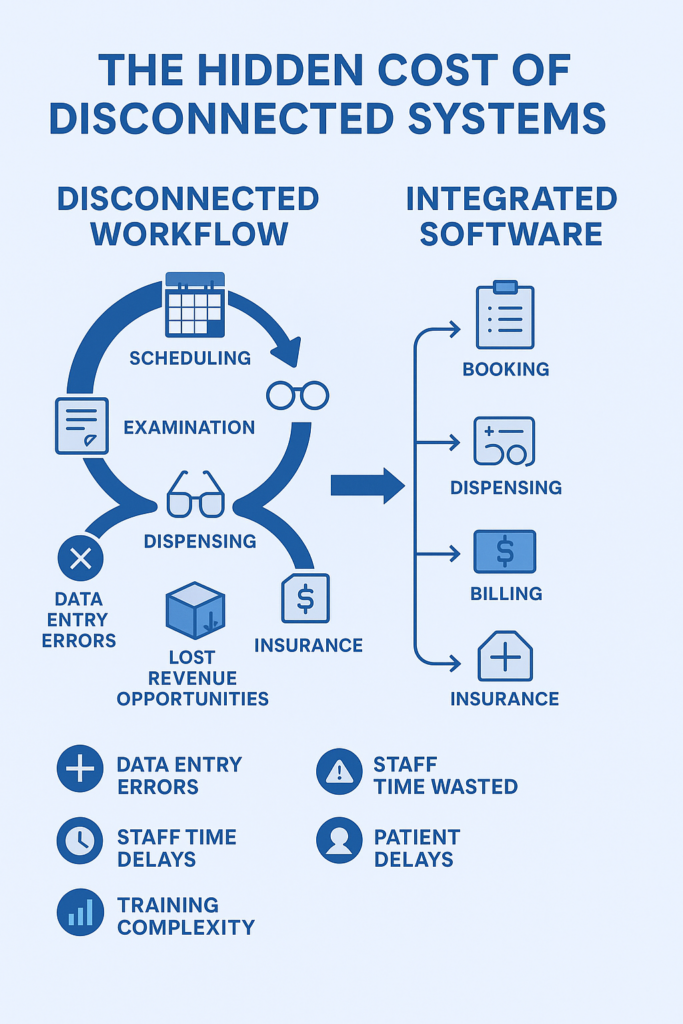
The Hidden Cost of Disconnected Systems
Walk into most optical practices today, and you’ll witness a familiar scene: staff toggling between multiple software programs, manually re-entering patient information, cross-referencing paper notes with digital records, and spending precious minutes on tasks that should take seconds. This fragmentation isn’t just inconvenient—it’s expensive.
Every minute spent switching between systems is a minute not spent with patients. Every manual data entry creates an opportunity for error. Every disconnected tool adds training complexity for new staff members and increases the likelihood of information falling through the cracks.
Consider a typical patient visit without integrated optometrists tools:
- Front desk staff enter patient information into the scheduling system
- Clinical staff re-enter the same information into the examination software
- Dispensing staff manually transfer prescription details to inventory systems
- Billing staff copy examination and product information into accounting software
- Insurance claims require yet another round of data entry
This redundant work creates multiple problems:
- Data entry errors that affect patient care and billing accuracy
- Inconsistent information across different systems
- Wasted staff time that could be spent on revenue-generating activities
- Frustrated employees dealing with inefficient workflows
- Delayed patient service as staff navigate multiple platforms
- Increased training burden when onboarding new team members
Modern optometry software eliminates these inefficiencies by creating a single source of truth where patient information flows seamlessly from booking through examination, prescription generation, eyewear dispensing, inventory updates, and billing—without requiring manual intervention at each stage.
How Integrated Software Transforms Daily Operations
Let’s look at three areas where good software makes an immediate difference in how your practice runs day-to-day.
Streamlined Appointment Management
Traditional appointment scheduling often involves phone tag, manual calendar management, and last-minute cancellations that leave costly gaps in your schedule. Modern optometrist software revolutionizes this process through intelligent automation.
24/7 online booking allows patients to schedule appointments at their convenience—often outside business hours when they’re finally able to focus on personal tasks. This captures patients who might otherwise postpone scheduling or choose a competitor with more convenient booking options.
Automated reminder systems dramatically reduce no-shows, which represent a staggering $150 billion annual cost across the healthcare industry. SMS and email reminders sent automatically 48 hours and 24 hours before appointments keep patients engaged and prepared, while reducing the administrative burden on your front desk staff.
Smart scheduling algorithms analyze historical data to optimize appointment lengths based on service type, practitioner availability, and typical patient flow—ensuring your schedule remains efficient without creating unrealistic time pressures during examinations.
7-day free trial
Got Any Questions? Let us know in the Contact Us form below.
Clinical Excellence Through Digital Workflows
Think about how many times you’ve watched a patient stare at the ceiling while their optometrist clicks through five screens just to pull up their last prescription. Nobody wants to work that way—not the doctor, not the patient. Better examination workflows fix this problem.
Customizable examination templates allow practitioners to build forms containing only the necessary fields for specific test types. Rather than navigating through dozens of irrelevant options, you move quickly through a streamlined workflow tailored to your practice’s unique approach to patient care.
Intelligent auto-suggestions reduce typing requirements by presenting common findings, diagnoses, and recommendations based on the specific examination context. This allows practitioners to maintain eye contact and conversation with patients rather than staring at computer screens.
Real-time access to complete patient history—including previous prescriptions, frame preferences, past purchases, and clinical notes—provides instant context that improves diagnostic accuracy and enables truly personalized care recommendations.
Inventory Management That Actually Works
For many optical practices, inventory management remains frustratingly manual. Staff spend hours counting frames, tracking down missing items, and discovering stock-outs only when patients request specific products. This reactive approach costs money through both overstock waste and lost sales opportunities.
Real-time inventory tracking integrated with your point-of-sale system updates stock levels automatically with each transaction. When a patient purchases a specific frame, the system immediately reflects this change—eliminating manual counting errors and providing complete visibility to all staff members simultaneously.
Barcode and QR code scanning streamlines the dispensing process by linking frames and lenses directly to patient prescriptions with a simple scan. This eliminates transcription errors while speeding up the transaction process and improving patient experience.
Automated reorder alerts monitor inventory levels and trigger notifications when stock reaches preset thresholds. Rather than discovering you’re out of a popular frame style when a patient requests it, you receive advance warning that enables proactive reordering—maintaining optimal stock levels without costly overstock situations.
Expert’s Voice
“After interviewing hundreds of optical practice owners, we’ve identified a consistent pattern: practices don’t fail because they lack clinical expertise—they struggle because administrative inefficiency consumes the time and energy that should be invested in patient care. Modern optometry software doesn’t just digitize old workflows; it fundamentally reimagines how optical practices operate by eliminating redundant tasks, automating routine communications, and providing real-time visibility that enables better decisions. The practices thriving in 2026 are those that embraced integrated platforms designed specifically for how optical salons actually work—not generic medical software retrofitted to optometry.”
Adam Smith, Product Manager @ Glasson
The Patient Experience Revolution
Your patients don’t think of themselves as “healthcare consumers” with “evolved expectations.” They just know they can book a haircut online at midnight, track their pizza delivery in real-time, and text their dentist to reschedule. When they have to call your office during business hours and wait on hold to book an eye exam, it feels outdated. Because it is.
Digital Communication That Patients Expect
Automated appointment reminders via SMS and email have become table stakes. Patients expect to receive confirmation immediately after booking, along with timely reminders that help them prepare for visits and reduce the likelihood of forgetting appointments.
Personalized follow-up messages transform one-time transactions into ongoing relationships. Birthday greetings, lens replacement reminders based on prescription date, and special occasion promotions make patients feel valued beyond their annual examination.
Prescription access portals provide transparency and control that patients increasingly demand. Secure online access to examination history, prescription details, and past purchases empowers patients while reducing staff time spent on information requests.
Want to see Glasson's full potential?
Book a presentation
The Mobile-First Reality
Your patients check their phones about 96 times per day (yes, someone studied this). Text message open rates hit 90% compared to 20% for email. When you need to remind someone about their appointment tomorrow, which channel do you think works better?
Modern optometry software enables practices to leverage this mobile reality through:
- One-click appointment confirmations sent via text
- Mobile-optimized online booking that works seamlessly on smartphones
- Digital prescription and payment links sent directly to patient phones
- Two-way messaging that allows patients to ask questions or request changes without phone calls
Data-Driven Practice Management
Ever made a business decision based on “what feels right” and regretted it later? Most practice owners have. You add Saturday hours because you think patients want them, then discover nobody books appointments. You stock expensive designer frames that sit unsold for months. You hire another optician when your real bottleneck is the front desk.
Here’s what changes when you can actually see what’s happening in your practice:
Real-time dashboards provide instant visibility into key performance indicators:
- Daily appointment volume and schedule utilization
- Revenue trends by service category and product type
- Staff productivity metrics and service efficiency
- Inventory turnover and product profitability
- Patient retention rates and recall effectiveness
These insights enable proactive management rather than reactive problem-solving. When you can see appointment volume trending downward, you can implement targeted marketing campaigns before the decline becomes severe. When specific products show strong demand, you can increase inventory strategically rather than running out of popular items.
Customizable reports help identify patterns that might otherwise remain invisible:
- Which services generate the highest profit margins
- What appointment times experience the highest no-show rates
- Which staff members excel at specific services
- Where operational bottlenecks slow patient flow
- When seasonal trends affect product demand
Multi-location practices gain centralized visibility across all clinics, enabling consistent performance tracking, fair staff comparisons, and strategic resource allocation. Rather than managing locations as independent silos, practice management optometry systems help you operate as a coordinated network with shared best practices and unified standards.
Security, Compliance, and Cloud Infrastructure
Data breaches make headlines because they’re expensive—averaging $11 million per incident in healthcare. But the real cost is the phone call where you tell Mrs. Johnson that her medical records, Social Security number, and credit card information might be in the hands of criminals. Nobody wants to make that call.
This is where cloud-based systems actually outperform the server sitting in your supply closet.
Why Cloud-Based Systems Offer Superior Security
A lot of practice owners worry that “the cloud” means their data is floating around somewhere vulnerable to hackers. Actually, the opposite is true. Cloud vendors employ dedicated security teams, invest millions in security infrastructure, and maintain certifications that would cost your practice more than your annual revenue to achieve independently.
Enterprise-grade encryption protects data both in transit (when moving between devices and servers) and at rest (when stored in databases). This military-grade encryption makes intercepted data useless to attackers without the proper decryption keys.
Automatic security updates ensure your system remains protected against newly discovered vulnerabilities without requiring manual intervention or technical expertise from your staff. Traditional on-premises software often remains unpatched for months, creating security gaps that attackers actively exploit.
Redundant backups stored in multiple geographic locations protect against data loss from hardware failures, natural disasters, cyberattacks, or human error. Cloud vendors maintain multiple copies of your data across different data centers, ensuring you can recover information even if an entire facility becomes unavailable.
Multi-factor authentication and role-based access controls ensure that employees see only the information necessary for their specific roles. Front desk staff don’t need access to financial reports, while managers may not need to view detailed clinical notes—granular permissions reduce the risk of unauthorized access while simplifying compliance auditing.
Compliance Documentation Made Simple
HIPAA compliance, GDPR requirements, and other regulatory frameworks create complex documentation and security requirements that can overwhelm small practices. Quality optometrist software handles much of this burden automatically:
- Comprehensive audit trails track every access to patient records
- Automated compliance reports document security measures
- Standard operating procedures built into software workflows
- Regular security assessments and penetration testing
- Business associate agreements covering cloud vendor responsibilities
Instead of spending hours creating compliance documentation yourself, you use software designed to meet regulatory requirements from the start—less legal risk, less administrative work.
The Glasson Advantage: Software Built for Optical Salons
Most optometry platforms started as general medical software that someone adapted for eye care. That’s like driving a pickup truck because someone welded seats into the bed—technically it works, but it’s not actually designed for passengers. Glasson started with a different question: what if we built software specifically for how optical salons actually operate?
Here’s what that approach delivers:
Intuitive Design That Requires Minimal Training
Traditional medical software often requires weeks of training before staff become productive. Glasson’s interface is intuitive enough that team members typically become functional within their first couple days—sometimes by the end of day one.
This rapid onboarding dramatically reduces the business disruption typically associated with software implementations. Rather than losing weeks of productivity while staff learn complex menus and workflows, your practice maintains normal operations while gradually discovering advanced features at a comfortable pace.
Intelligent Lens Search Engine
Glasson’s database of over 3.5 million lens variants eliminates the ten-minute catalog hunt while your patient sits there wondering if you’ve forgotten about them. Type in the prescription, get recommendations in 30 seconds.
Smart filtering options allow staff to refine results based on:
- Lens material and index specifications
- Coating types and UV protection
- Progressive lens design categories
- Budget constraints and price ranges
- Manufacturer preferences and availability
Your staff can recommend the right lenses without needing to memorize every manufacturer’s catalog.
Test Glasson for 7 days free of charge
Any questions? Leave your contact details and we'll call you back.
Customizable 8-Step Diagnostic Framework
Practitioners can build completely customized examination forms by selecting only the fields necessary for specific test types. Instead of clicking through dozens of irrelevant options during every exam, you build workflows that match how you actually practice.
The framework guides practitioners through: patient interview, refraction testing, recommended corrections, optometric assessment, anterior eye segment examination, posterior eye segment examination, diagnosis summary, and care recommendations—with each section fully customizable to your clinical preferences.
Built-In Marketing Automation
Automated patient communications reduce manual staff work while improving patient engagement. The system handles all patient touchpoints automatically:
- Appointment confirmations sent immediately after booking
- Multi-stage reminder sequences (48 hours and 24 hours before appointments)
- Post-visit follow-up messages checking on adjustment to new prescriptions
- Birthday greetings and special occasion promotions
- Lens replacement reminders based on prescription age
- Recall campaigns for patients overdue for examinations
These automated messages keep patients engaged without eating up your staff’s time—they can focus on people actually in the office instead of sending reminder texts.
Clear, Actionable Business Intelligence
Glasson’s reporting focuses on insights that actually matter for optical practice decision-making. Instead of drowning you in complex reports that nobody reads, the system shows key numbers through visual dashboards that make sense at a glance:
- Daily revenue and appointment volume trends
- Inventory turnover and product profitability
- Staff productivity and service efficiency
- Patient retention and recall effectiveness
- Cash flow and pending order values
Make better decisions about staffing, inventory, and marketing based on what’s actually happening—not what you think might be happening.
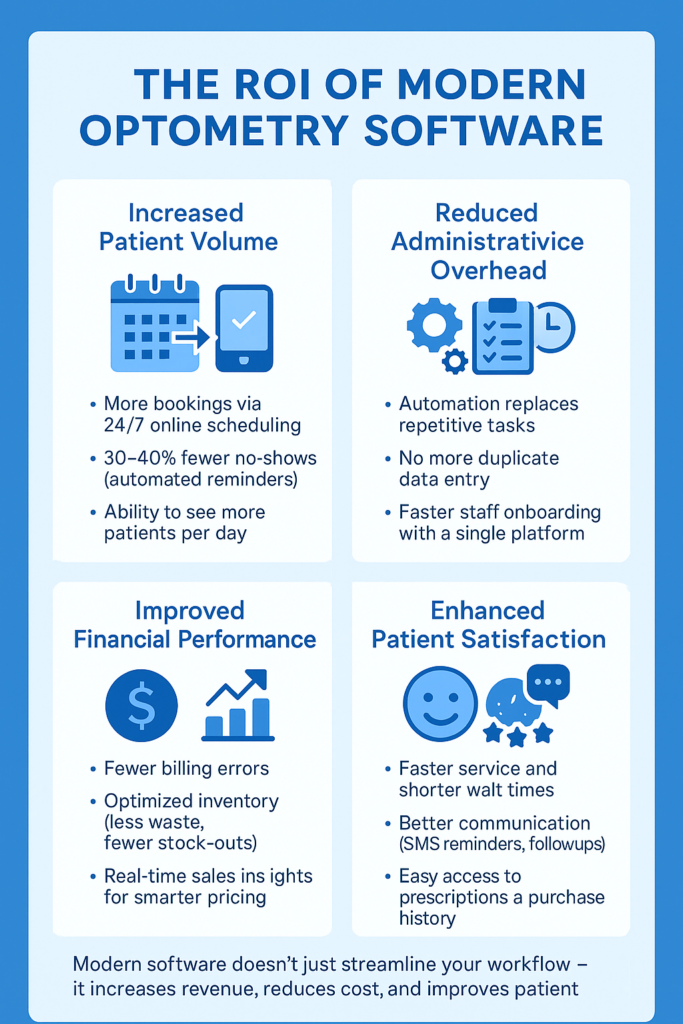
Measuring Success: The ROI of Modern Optometry Software
Software vendors love talking about “strategic value” and “digital transformation.” Practice owners want to know: will this actually make me money, or is it just another expense?
Fair question. Here’s where the return comes from with quality optical practice management software:
Increased Patient Volume
- Fill schedule gaps more efficiently: Online booking captures patients outside business hours who might otherwise postpone scheduling or choose competitors with more convenient options.
- Reduce no-show rates: Automated reminders decrease missed appointments that leave costly gaps in your schedule—many practices report 30-40% reductions in no-shows after implementing automated reminder systems.
- Accommodate more patients daily: Streamlined workflows allow practitioners to see additional patients without rushing examinations or sacrificing care quality—even small efficiency gains compound over hundreds of annual patient visits.
Reduced Administrative Overhead
- Automate repetitive tasks: Appointment confirmations, billing, insurance claim submission, inventory management, and patient recalls handled automatically free staff time for revenue-generating activities.
- Eliminate duplicate data entry: Information entered once flows automatically to all relevant systems—examination details populate insurance claims, sales records update inventory levels, and patient histories reflect immediately across all staff devices.
- Simplify staff training: A single unified platform requires significantly less training than multiple disconnected tools—reducing onboarding time for new employees and minimizing ongoing training costs.
Improved Financial Performance
- Reduce billing errors: Accurate automated claims submission decreases rejection rates and accelerates payment timelines—improving cash flow and reducing follow-up work on denied claims.
- Optimize pricing strategies: Real-time sales data and profitability analysis enable evidence-based pricing decisions that maximize revenue without pricing yourself out of competitive markets.
- Minimize inventory waste: Accurate tracking prevents overstock situations that tie up capital in slow-moving products while automated reorder alerts prevent stock-outs that force patients to wait for popular items.
Enhanced Patient Satisfaction
- Faster service delivery: Streamlined workflows reduce patient wait times and transaction processing duration—creating more positive experiences that generate referrals and positive online reviews.
- Improved communication: Consistent automated touchpoints make patients feel valued and well-cared-for beyond their annual examinations—increasing retention rates and lifetime customer value.
- Greater transparency: Patient portals providing access to prescriptions, purchase history, and appointment scheduling empower patients with the information control they increasingly expect from service providers.
[banner_blog_4]
FAQ: Your Optometry Software Questions Answered
These are the questions we hear most often from practice owners evaluating software options:
What are the key features to look for in optometry software?
The most critical features include: integrated appointment scheduling with automated reminders, comprehensive electronic health records (EHR) with customizable exam templates, real-time inventory management linked to point-of-sale, automated patient communication via SMS and email, integrated insurance billing and claims processing, detailed business analytics and reporting, cloud-based access for security and flexibility, and multi-user support with role-based permissions. Look for optometry practice management software platforms that integrate these functions instead of making you juggle separate systems.
Which optometry software is best for small practices?
Glasson and Visual-Eyes both excel for small practices but serve different needs. Glasson offers the most intuitive interface with minimal training requirements and rapid implementation—ideal for practices prioritizing simplicity and speed. Visual-Eyes provides maximum customization with modular pricing allowing small practices to pay only for features they actually use—perfect for practices with specific workflow requirements or budget constraints. Both platforms scale effectively as practices grow, avoiding disruptive system replacements when expanding services or locations.
Can I try Glasson before committing?
Yes, Glasson offers a 7-day free trial that provides full access to the platform without requiring credit card information upfront. After opening a trial account and completing verification (typically within 12 hours), you gain unlimited access to all features—including the lens database, appointment scheduling, patient records, inventory management, and business analytics. This trial period allows your entire team to evaluate the software with real workflows before making a financial commitment.
How much does optometry software cost?
Pricing varies significantly based on practice size, feature requirements, and deployment model. Entry-level packages for single practitioners typically range from $99-159 per month, while comprehensive platforms for multi-location practices require custom enterprise pricing. Glasson offers transparent subscription plans: Package for Optometrists at $99-109/month (Eye Care Module only), Optician package at $149-159/month (full feature set including lens database), and custom pricing for optical chains. Most platforms offer discounts for annual commitments versus monthly subscriptions.
What are the benefits of cloud-based optometry software?
Cloud-based optometrists tools offer multiple advantages over traditional on-premises software: access from any internet-connected device enables flexible work arrangements and remote clinical reviews; automatic backups protect against data loss from hardware failures or disasters; enterprise-grade security infrastructure that most small practices couldn’t afford independently; automatic software updates ensuring you always use the most current version with latest security patches; scalability allowing easy addition of users or locations without hardware purchases; and reduced IT burden since vendors manage infrastructure, security, and maintenance. Cloud platforms also facilitate multi-location operations through centralized data access across all clinic sites.
Which optometry software integrates with insurance billing?
Acuitas 3 and Optosys both offer strong insurance integration, though serving different markets. Acuitas 3 provides comprehensive insurance billing capabilities suitable for practices of all sizes, with particular strength in enterprise multi-payer environments. Optosys excels specifically for Canadian practices, offering direct integration with provincial programs like OHIP, Telus Health billing, and provincial insurance management that eliminates manual submission workflows. Eye Cloud Pro also includes integrated audit tools and CPT monitoring ensuring billing accuracy and compliance. Practices should verify specific payer compatibility before selecting platforms based primarily on insurance integration capabilities.
How to switch from paper records to optometry software?
Transitioning from paper records requires systematic planning but delivers immediate efficiency gains. Start by selecting software with data migration support and training programs for your staff. Most vendors provide migration services that digitize key historical records, though practices typically don’t need to convert entire paper archives—focus on active patients and essential history. Implement gradually using a “forward-only” approach where new patients enter the digital system while existing patient records migrate opportunistically during visits. Train staff in phases, starting with front desk scheduling and gradually adding clinical workflows as comfort increases. Maintain paper backup temporarily during the transition period, but begin using digital as primary source immediately to build staff confidence and competence.
What features does Glasson offer for optical salons?
Glasson provides optical salon-specific functionality including: intelligent lens finder with 3.5+ million variants and smart recommendations; comprehensive inventory management for frames, lenses, contact lenses, and accessories; integrated point-of-sale with real-time stock updates; customizable 8-step diagnostic examination framework; automated patient communication including appointment reminders and marketing campaigns; complete client relationship management with purchase history and preferences; real-time business analytics focusing on optical retail KPIs; digital service list management; staff permission controls; and envelope printing for lens orders. The platform emphasizes optical salon workflows rather than forcing practices to adapt to generic medical software not designed for retail-clinical hybrid operations.
Are cloud-based systems secure for patient data?
Yes, reputable cloud-based platforms provide superior security compared to most on-premises systems. Enterprise cloud vendors invest millions in security infrastructure including: military-grade encryption for data in transit and at rest; redundant backups across multiple geographic data centers; automatic security patches and updates; multi-factor authentication and role-based access controls; comprehensive audit trails tracking all data access; regular security assessments and penetration testing; HIPAA compliance certifications; ISO 27001 and SOC 2 Type II security certifications; and 24/7 security monitoring by dedicated teams. Most small practices cannot afford equivalent security infrastructure independently, making cloud platforms significantly more secure than traditional on-premises servers maintained without dedicated IT expertise.
Which optometry software is best for multi-location practices?
Acuitas 3 leads for enterprise multi-location operations, offering native omnichannel architecture, centralized data management across all locations, advanced Power BI analytics for cross-location performance comparison, and scalability from independent practices through national optical chains. Eye Cloud Pro also provides strong multi-location support through cloud-native architecture with centralized management capabilities suitable for growing practices. Glasson’s optical network plans support chain operations with shared client databases, inventory visibility across locations, and coordinated operations management. The optimal choice depends on complexity—sophisticated enterprises benefit from Acuitas 3’s advanced capabilities, while smaller chains may prefer the simplicity and cost-effectiveness of Glasson or Eye Cloud Pro.
Choosing Your Path Forward
There’s no “best” optometry software that works for everyone—just like there’s no “best” pair of glasses that fits every patient. What works depends on how your practice operates, where you’re located, and what problems you’re actually trying to solve.
Choose Glasson if you prioritize intuitive user experience, rapid implementation, and minimal training requirements. Practices wanting modern technology that staff can master quickly—often within days rather than weeks—will appreciate Glasson’s design philosophy focused on simplicity without sacrificing functionality. The intelligent lens search, automated patient communications, and optical salon-specific workflows make this particularly attractive for practices that have struggled with overly complex general medical software.
Choose Optosys if you operate in Canada and need provincial billing integration, OHIP compatibility, and Telus Health direct billing. The platform’s Canadian regulatory expertise and bilingual capabilities (English/French) address requirements that general-purpose software often handles awkwardly through workarounds. Canadian practices prioritizing local support and understanding of provincial programs will find Optosys designed specifically for their operational reality.
Choose Visual-Eyes if your practice has unique workflow requirements that standard software doesn’t address well. The 100% customizable modular approach allows you to build exactly the system you need without paying for unnecessary features—particularly valuable for practices with specialized service offerings or unconventional operational approaches.
Choose Acuitas 3 if you operate multiple locations, need sophisticated omnichannel capabilities integrating online and in-store operations, or require enterprise-level analytics through Power BI integration. Optical chains and complex multi-location operations benefit from this platform’s native omnichannel architecture and advanced scalability.
Choose Eye Cloud Pro if you want modern cloud-native infrastructure designed by optometrists specifically for optometry practices. The platform emphasizes operational simplicity through cloud architecture while maintaining strong security, compliance, and clinical focus—appealing to practices prioritizing modern technology without unnecessary complexity.
Taking the Next Step
Optical practices won’t get less competitive or less digital next year. The practices that invest in integrated software now will have an easier time competing on efficiency, patient experience, and profitability. The ones still using paper calendars and three different programs in 2027 will wonder where all their patients went.
Start by identifying what’s actually broken in your practice: Is appointment scheduling chaotic? Does inventory management feel like guesswork? Are your staff frustrated by entering the same information three times? Do patients complain they can’t book appointments online? Are you making business decisions based on gut feeling because you don’t have real data?
These problems guide your software evaluation—focus on platforms that fix your actual issues instead of being distracted by impressive-sounding features you’ll never use.
Most quality optometry software providers offer free trials or demonstrations. Use them. Get your entire team involved in testing—software that looks great in a sales demo sometimes turns out to be frustrating in daily use, while platforms that seem less polished initially might work better where it actually matters.
Good optometry software changes your practice from constant firefighting to actually running a business. Your patients get better experiences, your staff waste less time on busywork, and you finally have the data you need to make smart decisions instead of expensive guesses.
The practices doing well in 2026 aren’t necessarily the ones with the fanciest equipment or biggest marketing budgets. They’re the ones that stopped trying to run a modern optical practice with outdated tools.

Ready to see what Glasson can do?
Start your 7-day free trial and find out why optical practices prefer software built specifically for optical salons—not generic medical software someone adapted for eye care.