10 Optical Store Marketing Ideas That Actually Work and How Glasson Helps You Execute Them

Most optical store marketing advice falls into one of two categories: too vague to act on, or too expensive to justify. Post on social media. Build a loyalty program. Run seasonal promotions. Sure — but how, exactly, when you’re also running appointments, managing stock, and serving clients all day? The answer is usually: you need software that makes execution frictionless. This article covers 10 specific optical store marketing ideas, and in each case, explains how Glasson’s built-in tools make them practical rather than aspirational.
Key insights
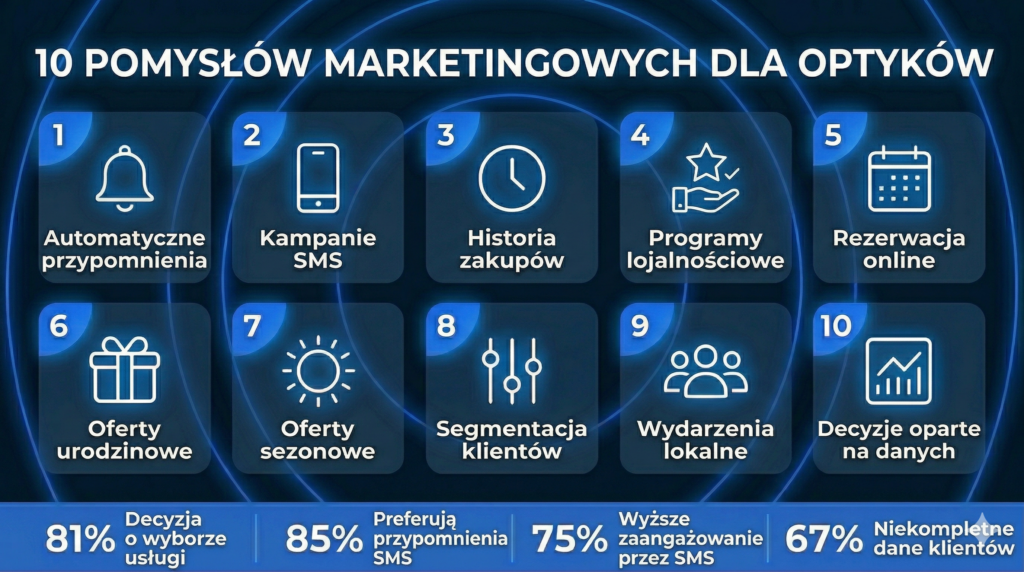
- 81% of clients say their buying decisions are based on the level of customer service they receive — marketing that reinforces great service has a direct revenue impact.
- 85% of clients find it helpful to receive a text reminder to collect their glasses — a simple automated message is one of the highest-return actions in optical retail.
- 75% more client engagement is observed when clients are contacted via SMS, compared to no outreach at all.
- 67% of optical stores don’t collect their client sales data — meaning most practices are marketing blind, without the purchase history needed to personalize any message.
- Effective optical store marketing doesn’t require a separate marketing platform — Glasson’s communication and client modules cover campaigns, reminders, bulk messaging, and client segmentation within the same system you use daily.
- The marketing ideas with the highest return in optics tend to be retention-focused, not acquisition-focused: bringing existing clients back costs less and converts at a higher rate than finding new ones.
Why does marketing for optical stores need software support?
Here’s the honest problem with optical store marketing: most of the tactics that work depend on knowing your clients well enough to reach the right person with the right message at the right time. A birthday offer only works if you know when birthdays are. A recall campaign only works if you know when someone last came in. A personalized frame recommendation only works if you know what they bought before.
All of that data exists in your practice — it’s just not always organized in a way that’s easy to act on. Glasson’s client management module centralizes purchase history, prescriptions, personal details, and communication records in one place. That makes the data actionable: you can filter your client base by purchase behavior, last visit date, or other criteria, then send targeted messages to specific groups — without exporting to a separate marketing tool.
With that foundation in place, here are 10 marketing ideas worth implementing, each grounded in what Glasson actually makes possible.
7-day free trial Got Any Questions? Let us know in the Contact Us form below.
What are the most effective optical store marketing ideas right now?
These ideas are organized roughly from easiest to implement to more involved. Start with the ones at the top if you’re setting up for the first time; layer in the rest as your practice’s data and workflows mature.
Idea 1: Automated appointment reminders that actually reduce no-shows?
Yes — and this is the single easiest marketing action with the clearest return. Every no-show is a slot you couldn’t fill and revenue you can’t recover. Glasson’s communication module sends automated SMS and email reminders before appointments, triggered without any manual work once they’re configured.
The engagement numbers are hard to ignore: 85% of clients find it helpful to receive a text reminder about their appointment or order collection, and client engagement via SMS is 75% higher than when there’s no contact at all. A reminder that prevents one no-show per day, in a practice with a typical appointment value, pays for itself many times over.
In Glasson, you can also set automated messages for orders that are ready to collect — so clients who’ve been waiting for their glasses get notified the moment the order is marked complete, without staff having to remember to make the call.
Idea 2: Is SMS marketing actually worth it for an optical store?
Done with a purpose and the right data behind it, yes — significantly. The key is not sending generic promotional blasts, but sending relevant messages to people who have a reason to care. Glasson’s SMS Premium feature lets you send messages that display your practice name as the sender rather than a phone number, which changes how clients perceive the message before they’ve even read it.
Think about the difference between a client receiving a message from an unknown number versus seeing your store’s name in their notifications. One gets ignored; the other gets opened. Use SMS for order-ready alerts, seasonal eye health reminders, appointment recalls, and genuinely relevant offers — not blanket promotions sent to everyone.
The full SMS and email communication options are covered on the Communication feature page.
Idea 3: How do you use purchase history to drive repeat sales?
This is where the 67% statistic becomes a competitive advantage. If most of your competitors aren’t collecting client sales data, any store that does has a meaningful edge. Glasson’s client records include full purchase history — which frames a client has bought, which lenses, what their prescription has been over time, and what they’ve spent.
That data makes personalization possible in ways that generic promotions can’t match. A client who bought progressive lenses two years ago is a strong candidate for a recall message about their next eye examination. A client who bought a premium frame brand is more likely to respond to a new arrival message about that brand than to a general sale announcement.
You can filter your client base in Glasson by these kinds of criteria and send targeted messages to the resulting group — turning what would otherwise be a broadcast into something that feels like a personal recommendation.
Client records, purchase history, and files are managed through the Clients module.
Idea 4: What’s the simplest loyalty tactic that optical stores can run?
Multi-pair promotions are one of the highest-leverage tactics in optical retail — and Glasson’s purchase tracking makes them easy to execute. The idea is straightforward: identify clients who bought a single pair and send them a targeted offer for a second pair at a preferential price. The client gets value; you increase average order value without acquiring a new customer.
The reason most practices don’t do this consistently isn’t that they don’t want to — it’s that they don’t have an easy way to identify who bought one pair in the last year, or to send a message specifically to that group. With client data centralized in Glasson, that kind of segmented campaign becomes a 20-minute task rather than a project.
Style profiles saved on client records take this further: if you’ve noted a client’s preference for lightweight titanium frames, a new arrival message for that specific product type is far more likely to land than a generic promotion.
Idea 5: Should optical stores make online booking a marketing tool?
Absolutely — and it’s underused for this purpose. Most practices think of online booking as an operational convenience. It is that, but it’s also a visibility and conversion tool. When your booking link appears on your website, Google Business Profile, and social media, every one of those placements becomes a direct path from discovery to appointment without a phone call as the barrier.
Glasson’s Online Reservation module gives each practice its own public booking link that can be shared anywhere. Clients can book 24/7 from any device, choose their preferred service and time, and receive an SMS confirmation — all without calling the practice. For clients who discover you outside of business hours, that means the booking happens immediately rather than being a mental note that gets forgotten.
The system also includes SMS verification to prevent fake bookings, and lets you configure how far in advance clients can book, what time intervals are available between slots, and which services and staff members are bookable online.
The full setup is described on the Online Reservation page.
Want to see Glasson's full potential? Book a presentation
Idea 6: How do birthday campaigns actually work in practice?
A birthday message is one of the most reliably well-received types of communication a business can send — clients respond to being remembered on their birthday. The challenge is doing it at scale without someone manually checking who has a birthday each week.
With client birthdates stored in Glasson’s client profiles, you can set up message templates that go out on or around a client’s birthday with a relevant offer — a discount on frames, a complimentary consultation, or simply a personal acknowledgment. The key is that it feels individual, even when it’s automated. Use the client’s name, keep the message short, and tie the offer to something relevant to them based on their purchase history.
The same logic applies to other milestone-based messages: anniversary of first visit, one year since last glasses purchase, or any other date-based trigger that makes sense for your client relationship.
Idea 7: What’s the right approach to seasonal promotions in optical retail?
Seasonal campaigns work best when they’re tied to a genuine reason to buy eyewear — back to school, new year new glasses, summer sunglasses, winter driving conditions. The mistake most practices make is sending the same message to their entire client base and hoping for the best.
Glasson’s bulk messaging capability lets you send seasonal campaigns to your full list when broad reach makes sense, but also allows you to filter and target sub-groups when a more specific angle is relevant. A back-to-school campaign, for example, lands much better when it’s sent specifically to clients whose records show they’ve previously bought children’s eyewear — rather than to everyone on your list, regardless of whether they have children.
Message templates in Glasson can be prepared in advance, so seasonal campaigns can be built during quieter periods and scheduled to send at the right time — without taking staff away from client-facing work during a busy season.
Idea 8: Can client segmentation realistically be done by a small optical practice?
Yes — and it doesn’t need to be complicated to be effective. The most useful segments for an optical store are based on recency (when did they last visit?), purchase category (what did they buy?), and spending level (how much have they spent with you?). Those three dimensions let you build campaigns that feel targeted without requiring advanced analytics.
Lapsed clients — those who haven’t visited in 18 months or more — are a particularly high-value segment for a focused win-back campaign. A message that acknowledges the time since their last visit, mentions that their prescription may be due for a check, and includes a specific offer gives a clear reason to act rather than just a generic reminder that you exist.
New client follow-up is another easy win: a message sent a week after a first visit, thanking them for coming in and prompting them to book their next appointment, creates a second touchpoint while the experience is still fresh.
Idea 9: How do independent optical stores compete with chains on marketing?
The honest answer is that independent stores have an advantage that chains can’t replicate: genuine personal relationships with clients. The goal of independent optical store marketing should be to make that advantage visible and reliable — not to try to out-budget a chain’s advertising spend.
Community events, free eye health screenings, school partnerships, and local charity work all build the kind of trust and goodwill that no paid advertising budget can buy. These activities work best when they’re followed up systematically — which is where Glasson comes in. After a community event, you can use the client communication module to follow up with attendees, share relevant information, and offer a path back to your practice.
Glasson’s client files and notes mean every interaction — whether it happened in-store, at an event, or over SMS — can be logged against the relevant client record. That turns one-off community touchpoints into the start of an ongoing relationship.
Idea 10: How does your statistics data feed back into marketing decisions?
Marketing without measurement is just spending. Glasson’s statistics module gives you the sales data to evaluate what’s working: which product categories are growing, which clients are buying most frequently, what your average order value is, and how revenue trends across different periods.
The Top 10 product and client views are particularly useful for marketing planning. Knowing which frames sell best tells you what to feature in your next campaign. Knowing which clients spend the most tells you who to prioritize for personal outreach. That feedback loop — campaign to sale to data to next campaign — is what separates practices that grow consistently from those that market reactively.
The data breakdown available in Glasson is covered on the Statistics feature page.
Expert’s voice
“The most common mistake I see in optical store marketing is treating it as something separate from daily operations. You run the practice, and then somewhere you also do marketing. But the data you need to market effectively is generated every single day in your practice — every sale, every visit, every conversation. Glasson is designed so that data stays in one place and is immediately usable. You don’t need to export anything or connect a separate tool. The client who bought progressive lenses 18 months ago, whose prescription is probably due for a check — they’re right there in your client list. The practice that acts on that consistently will always outperform the one that doesn’t, regardless of which frames they stock or how nice their window display is.”
Marcin Debski, Product Manager @ Glasson
Quick reference: which Glasson feature powers which marketing idea?
Here’s a summary of how each marketing tactic maps to the tools available in Glasson:
| Marketing idea | Glasson feature used | Primary outcome |
| Automated appointment reminders | Communication module: SMS/email templates and automation | Fewer no-shows, reduced staff follow-up time |
| SMS campaigns with practice name | Communication: SMS Premium with named sender | Higher open and response rates vs. anonymous number |
| Purchase history segmentation | Clients module: purchase records, filtering by history | Relevant messages to the right clients, better conversion |
| Multi-pair and loyalty promotions | Clients: purchase tracking + Communication: targeted send | Higher average order value from existing clients |
| Online booking as a conversion channel | Online Reservation: public booking link, 24/7 access | More bookings from web, social, and Google presence |
| Birthday and milestone messages | Clients: stored birthdates + Communication: templates | High-engagement personal touchpoints, incremental visits |
| Seasonal campaigns | Communication: bulk messaging + message templates | Timely promotions with minimal preparation time |
| Client segmentation campaigns | Clients: data filtering by recency, category, spend | Targeted win-back and retention campaigns |
| Community and event follow-up | Clients: notes and files + Communication: follow-up messages | One-off events converted to ongoing client relationships |
| Data-driven marketing planning | Statistics: Top 10, revenue by category, sales reports | Campaigns based on what actually sells, not guesswork |
Test Glasson for 7 days free of charge Any questions? Leave your contact details and we'll call you back.
Where should you start if you’re new to systematic optical store marketing?
The answer is almost always the same: start with your existing clients before you invest in finding new ones. Your current client base already knows you, has bought from you, and is more likely to respond to a well-timed message than a cold prospect.
In practical terms, that means three things as a first phase:
- Set up automated appointment reminders — configure the SMS reminder in Glasson so it goes out automatically before every appointment. This one change reduces no-shows and costs nothing beyond the SMS credit.
- Identify lapsed clients — filter your client list in Glasson to find everyone who hasn’t visited in 12–18 months. Send them a recall message with a specific reason to come back.
- Make your booking link visible — add Glasson’s Online Reservation link to your website, your Google Business Profile, and your Facebook page. This captures bookings you’re currently missing from people who discover you outside business hours.
Those three steps require no budget beyond the SMS credits for reminders, and they address the two biggest leakage points in most optical practices: missed appointments and lapsed clients. Once those are running, you can layer in more sophisticated segmentation and campaign work.
Glasson’s 7-day free trial gives you enough time to set up your client base, configure your communication templates, and run a test campaign to see how the workflow fits your practice.
Start the trial at glasson.app — no payment details required.
FAQ

What’s the most cost-effective marketing strategy for an optical store?
Retention marketing — keeping existing clients coming back — consistently delivers higher returns than acquisition. Automated appointment reminders, prescription recall messages, and targeted SMS campaigns to lapsed clients all have low cost and measurable impact.
Does Glasson include marketing tools, or do I need a separate platform?
Glasson includes SMS and email communication, message templates, bulk messaging, automated reminders, and client segmentation in the same platform you use for sales, appointments, and inventory. You don’t need a separate marketing tool.
How do automated appointment reminders reduce no-shows?
Glasson sends automated SMS or email reminders before scheduled appointments. The data from Glasson’s research shows 85% of clients find these reminders helpful, and SMS contact produces 75% higher engagement than no outreach.
Can I send targeted messages to specific client groups in Glasson?
Yes. Glasson’s client records store purchase history, visit dates, personal details, and other data that can be used to identify and message specific segments — such as clients who bought progressive lenses, lapsed clients, or clients with upcoming prescription renewals.
How does online booking help with marketing?
Glasson’s Online Reservation module gives you a public booking link you can share on your website, social media, and Google Business Profile. This turns every online mention of your practice into a direct path to booking — 24/7, without a phone call required.
What kind of SMS messages work best for optical stores?
Order-ready collection alerts, appointment reminders, prescription recall messages, birthday offers, and targeted seasonal promotions. Messages with a clear, relevant reason to act outperform generic promotional blasts.
Can Glasson send birthday messages automatically?
Glasson stores client birthdates in client profiles. You can use the communication module’s templates to create birthday messages and send them to clients on or around their birthday — manually to a filtered group, or as part of a planned campaign.
How should a small optical practice start with marketing in Glasson?
Start with automated appointment reminders (configured once, runs automatically), a lapsed-client recall campaign (filter by last visit date, send a targeted message), and adding your booking link to your website and Google profile. These three steps cover the highest-impact, lowest-effort marketing actions.
Does Glasson’s reporting help with marketing planning?
Yes. The Statistics module in Glasson shows which products sell best (Top 10), revenue by category, and sales trends by period. That data tells you what to feature in campaigns, who your highest-value clients are, and which product categories have room to grow.
How is marketing for independent optical stores different from chains?
Independent stores compete on personal relationships and community trust, not advertising budgets. The most effective tactics for independents are relationship-based: personalized messages, community events, genuine recall campaigns, and service quality follow-up — all of which Glasson’s client and communication modules support.