Optical Business Marketing: A Practical Playbook for Independent Stores

You sell eyewear, not marketing campaigns — and yet here you are, trying to figure out why the store down the street seems busier than yours. Marketing for an optical store doesn’t have to mean billboards or a flashy agency retainer. It means a repeatable system for getting the right people in the door, turning visits into sales, and making sure they come back — and most of that runs on information you already collect every day.
This is a playbook, not a wish list. It’s organised around the three stages every client moves through — getting noticed, converting the visit, and keeping them — so you can see where your effort actually pays off.
Key insights
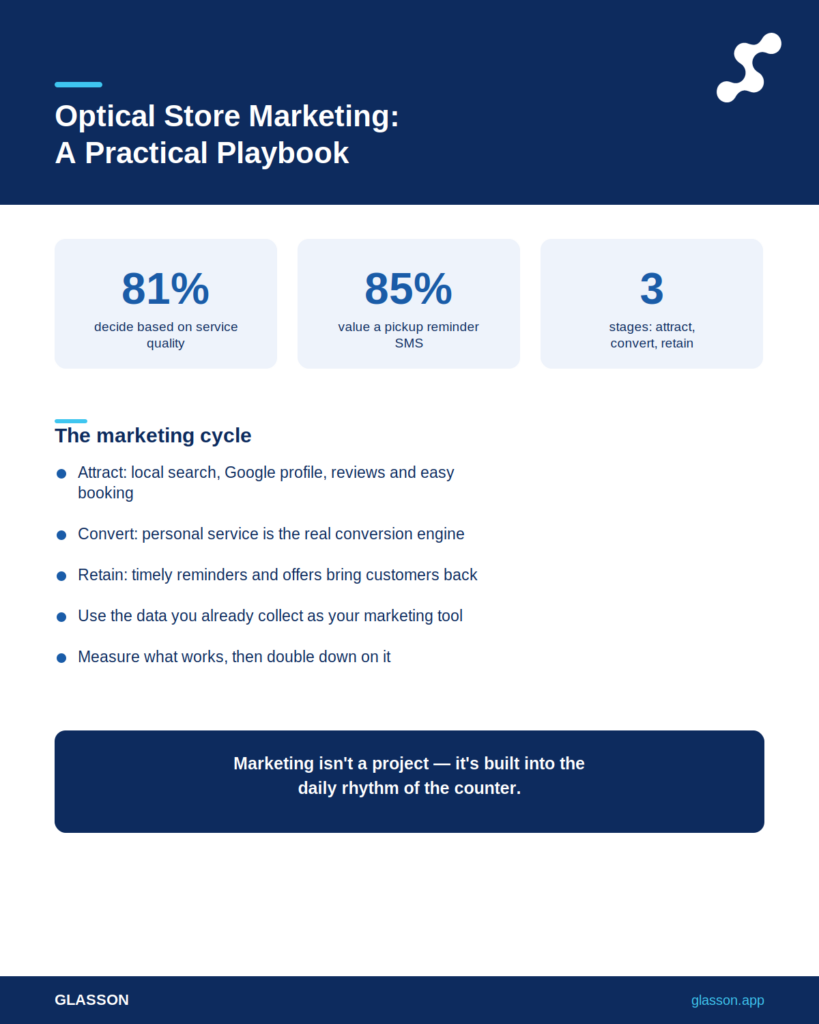
The short version, before we dig in. Effective optical marketing isn’t a single campaign — it’s a loop of attracting, converting, and retaining clients, powered by the data your store already generates.
- Three stages, one loop: attract, convert, retain — and retention feeds the next round of attraction through referrals.
- Local search and your Google presence are where most new optical clients begin.
- The in-store experience is your real conversion engine — service drives the decision.
- Your client data is the most underused marketing asset you own.
- Automated communication does the follow-up you’d otherwise forget.
- Measuring what works lets you spend your limited time on the tactics that pay.
Why do most optical stores struggle with marketing?
Because they treat it as occasional bursts of activity rather than a steady system. A sale here, a Facebook post there, a leaflet drop when things go quiet — none of it connects, so none of it compounds. The stores that win at marketing don’t do more of it; they do the same few things consistently and let the results stack up over time.
To make it consistent, it helps to break marketing into the journey a client takes with you. Let’s start at the beginning — getting found.
How do new clients find an optical store?
Mostly by searching online when they need glasses, then choosing from whoever looks closest and most trustworthy. For a local optician, the battle for new clients is largely won or lost on the search results page. If your store shows up clearly when someone nearby searches for an optician, with strong reviews and accurate details, you’ve done most of the hard work of attraction.
Here’s where to focus your attraction effort, in rough order of impact for a small store.
Is your local search presence in order?
This is the foundation, and it’s free. A complete, current Google Business Profile — hours, photos, services, and a steady flow of reviews — is what decides whether a searcher clicks you or your competitor. Local discovery is the highest-return marketing channel for an independent optician precisely because the people finding you are ready to buy glasses now.
Pair that with a simple, mobile-friendly website that makes your location, services, and booking obvious. You don’t need a big site — you need one that answers “where are you and how do I book?” instantly.
Can people book you the moment they decide?
If the only way to book is a phone call during business hours, you’re losing the clients who decide at 9pm. Glasson Online Reservation gives your store a public link you can share on your website, Facebook, or Google so clients can book any time, from any device. Capturing a booking at the exact moment someone decides to act is one of the simplest marketing wins available to you.
Getting found and getting booked is only half the job, though. Once someone’s in your store, a different kind of marketing takes over.
7-day free trial
Got Any Questions? Let us know in the Contact Us form below.
What turns a visit into a sale?
The experience you give people once they’re standing at your counter. This is the stage most “marketing” advice ignores, yet it’s where the money is decided. On Glasson’s research, 81% of clients say their decisions are based on the level of customer service they receive — meaning your conversion rate is really a service rate.
So how do you systematically deliver service good enough to convert? It starts with knowing who you’re serving.
Do you know your client before they say a word?
You can, if their history is on screen when they walk in. A returning client whose last prescription, frame style, and preferences you can see instantly gets a faster, more personal experience. Glasson Clients stores sales history, prescriptions, notes, and even photos of past purchases on one profile. Walking up to a returning client already knowing what they bought last time is the kind of detail that turns a browser into a buyer.
That same knowledge powers smarter recommendations — the right second pair, the right lens upgrade — which lifts the value of each sale without any hard selling.
Are you removing friction from the sale?
Every minute spent hunting through catalogues or back-office folders is a minute the client spends losing interest. The Glasson Lens Finder searches over 3.5 million lens variants and returns matches in under a fraction of a second, so the technical part of the sale happens while the client is still engaged. A smooth, quick sale signals competence, and competence is what people are really buying from an optician.
Once you’ve converted the visit, the most profitable marketing stage begins — and it’s the one most stores forget.
How do you keep clients coming back?
By staying in touch with a reason, automatically, so they don’t drift to whoever messages them first. Retention is where marketing quietly becomes profit, because a returning client costs you almost nothing to reach. The store that contacts clients at the right moments — recall due, glasses ready, a seasonal offer — is the store clients remember when it’s time to buy again.
The mechanics of this are easier than they sound, and most of it can run on autopilot.
Why is text the channel that actually gets read?
Because people check their phones constantly and open texts far more reliably than email. Glasson Communication sends automated texts and emails using templates you set once — reminders, recalls, and offers to grouped clients. On Glasson’s figures, 85% of clients find a text reminder to collect their glasses helpful, and stores see up to a 75% increase in engagement when they reach out by text.
This is also where referrals are born. A delighted, well-served client who hears from you at the right time becomes the word-of-mouth that feeds your attraction stage — closing the loop.
What does a marketing campaign look like with no extra tools?
It looks like a templated message to the right segment of your client base, sent in a few clicks. You can promote a seasonal offer, celebrate a holiday, or nudge clients overdue for a check-up — no design skills, no separate platform. The ability to run simple campaigns from inside the same system that holds your client data is what makes consistent marketing realistic for a busy store.
Here’s how the three stages map together, so you can see where each tool fits.
| Stage | Goal | Main tactics | Supporting tool |
|---|---|---|---|
| Attract | Get found by nearby buyers | Google profile, reviews, easy booking | Online Reservation |
| Convert | Turn the visit into a sale | Personal service, fast sales, smart recommendations | Clients, Lens Finder |
| Retain | Bring clients back | Recalls, reminders, offers, campaigns | Communication |
Want to see Glasson's full potential?
Book a presentation
How do you know what’s working?
You measure it, because a small store can’t afford to waste effort on tactics that don’t pay. Marketing without measurement is just hoping. When you can see which products sell, which clients spend the most, and how revenue moves over time, you can put your limited energy where it actually returns something.
Ever poured effort into a promotion and had no idea afterward whether it worked? That’s the problem reporting solves.
Which numbers tell you your marketing is paying off?
Revenue trends, your best-selling products, and your highest-value clients are the core ones. Glasson Statistics presents these in a readable form, including a top-10 of products and clients. Your top-selling products and biggest spenders are a ready-made marketing brief — they tell you what to feature and who to reward.
Feed those insights back into your attraction and retention tactics, and the whole loop gets sharper each cycle. That’s the difference between marketing that drifts and marketing that builds.
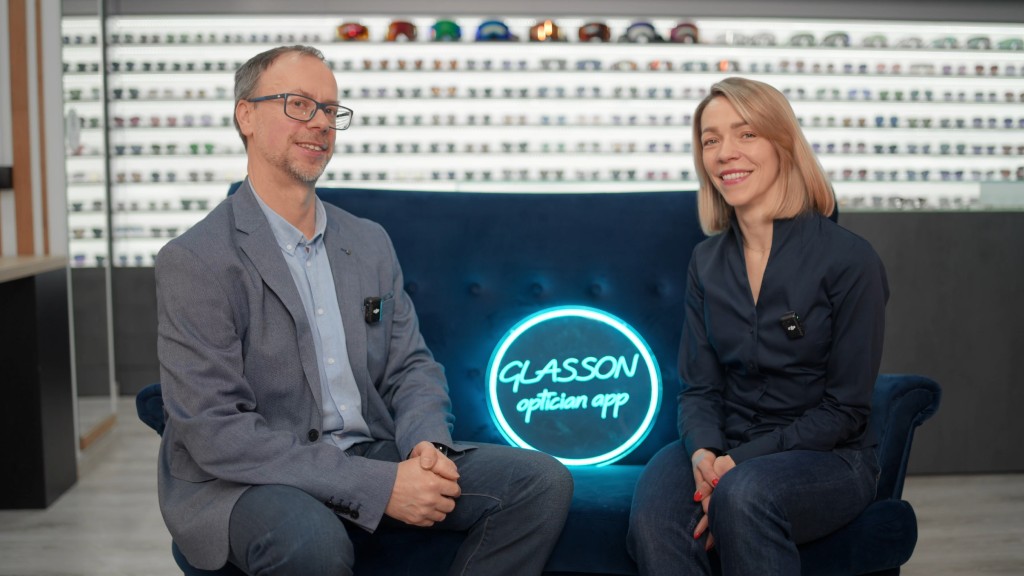
“Independent opticians often think marketing is something separate from running the shop — a thing you bolt on when there’s spare cash. It isn’t. The way you greet a returning client, the text that tells them their glasses are ready, the review you ask for at the right moment — that’s the marketing. The stores that grow are the ones that stopped treating it as a project and built it into the everyday rhythm of the counter.”
— Marcin Debski, Product Manager @ Glasson
How do you put the playbook into action?
Pick one tactic per stage and make it consistent before adding more. Trying to do everything at once is how marketing plans die in week two. Set up your Google profile and booking link for attraction, sharpen your in-store service for conversion, and switch on automated recalls for retention — then keep them running.
The thread running through all of it is that your marketing and your store data belong in the same place. When client records, communication, and reporting connect, the playbook stops being a document and becomes how your store simply works. You can see how those pieces fit together on the Glasson features overview.
Test Glasson for 7 days free of charge
Any questions? Leave your contact details and we'll call you back.
Frequently asked questions
What’s the single most effective marketing tactic for an optician?
For most independent stores, it’s a strong local search presence. A complete Google Business Profile with good reviews reaches people actively looking for an optician nearby, which is the highest-intent audience you can get.
How much should a small optical store spend on marketing?
Less than you’d think, if you use free and low-cost channels well. Local search, reviews, and client communication cost little and often outperform paid advertising for a single store. Spend time before money.
Does my optical store really need a website?
A simple one, yes. You need a clear, mobile-friendly page showing your location, services, and a way to book — it doesn’t have to be elaborate, just easy to find and act on.
Why does customer service count as marketing?
Because it directly drives buying decisions and word of mouth. When most clients say service shapes their decision, the experience at your counter is your conversion engine, and happy clients become free referrals.
How do I use client data for marketing without being intrusive?
Use it to be helpful, not pushy — relevant reminders and genuinely useful offers. A recall when a check-up is due or a note about a frame style they liked feels like good service, not spam. Always respect data protection rules.
Is text or email better for reaching optical clients?
Text generally gets read faster, while email suits longer messages. A practical approach uses text for time-sensitive nudges like ready glasses and email for newsletters or detailed offers. Many stores use both.
How do I get more reviews for my optical store?
Ask happy clients right after they collect their glasses. A short follow-up message with a direct link to your review page turns satisfied customers into public recommendations. Make it as easy as one tap.
Can I run marketing campaigns without special skills?
Yes, with the right tools. Glasson lets you send templated campaigns to client groups from inside the system, with no design or technical skills required. You can promote offers, holidays, and recalls easily.
How do I measure whether my marketing works?
Track revenue trends, best-selling products, and top clients over time. Reporting tools show what’s selling and who’s spending, so you can tell which efforts are paying off and adjust accordingly.
Where should I start if I’ve never done marketing before?
Start with one tactic per stage and keep it consistent. Sort your Google profile and booking, improve in-store service, and switch on automated recalls before adding anything else. Consistency beats complexity.