Hiring Opticians: Data, Strategies, and Tools for Optical Store Owners

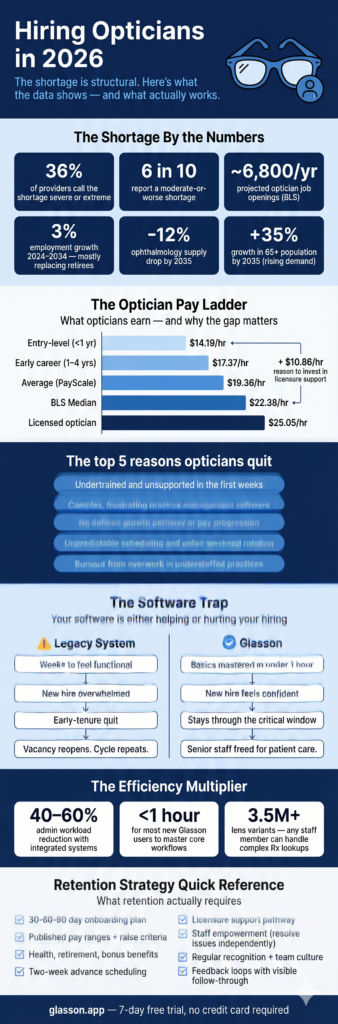
You have had a position open for six weeks. Your best optician is covering extra hours and starting to show it. Every candidate who looks promising either doesn’t apply, accepts a competing offer, or quits during onboarding before you’ve gotten any return on the training investment. Sound familiar? According to the Vision Council’s 2025 survey, 36% of eyecare providers describe the optician shortage as severe or extreme — and staffing has become the single biggest concern for optometry practices heading into 2026.
This is not a vent piece about how hard things are. It is a strategy guide for optical store owners who want to hire more effectively, keep great staff longer, and — critically — get more out of the team they already have. We will cover the data behind the shortage, the reasons hiring has gotten harder, what compensation actually needs to look like, the strategies that work for retention, and the operational changes that let practices do more without endlessly searching for headcount they cannot find.
Key Insights
Here is the short version before we go deep:
- 6 in 10 eyecare providers report a moderate-or-worse optician shortage; 36% call it severe or extreme — and this is a structural problem, not a temporary hiring cycle
- The BLS projects ~6,800 optician openings per year through 2034, but most of those replace retirees, not net new positions. The pool of experienced opticians is shrinking
- The median optician earns $46,560/year; licensed opticians average $52,100. Pay alone does not win the recruitment battle — benefits, schedule, and growth pathways matter equally
- The top five reasons opticians leave: feeling undertrained and unsupported, complex frustrating software, no defined growth pathway, schedule instability, and burnout from overwork
- Integrated practice management software that reduces admin workload by 40–60% and gets new staff functional within hours — rather than weeks — directly changes the hiring math for optical stores
How bad is the optician shortage — and is it going to get better?
Before diving into strategy, it is worth understanding exactly what you are dealing with. Because the answer to “is it going to get better?” is not encouraging — and knowing that shapes the decisions you should be making today.
What do the numbers actually show?
The Bureau of Labor Statistics projects 3% employment growth for dispensing opticians from 2024 to 2034 — modest by any measure. That growth translates to roughly 6,800 annual job openings projected on average. The critical context is where those openings come from: the majority exist to replace retiring workers and those transferring out of the field, not to fill net new positions.
This means the experienced optician pool is effectively shrinking. As senior opticians retire, their institutional knowledge — built over decades of patient interactions, complex lens fittings, and frame adjustments — exits with them. What remains is an increasingly thin pipeline of new entrants competing for those same roles.
The optician shortage by the numbers (2025–2026)
| Metric | Value | Source |
|---|---|---|
| Providers reporting moderate or worse shortage | 6 in 10 | The Vision Council, April 2025 |
| Providers reporting severe or extreme shortage | 36% | The Vision Council, April 2025 |
| Top concern for optometry practices | Staffing and hiring | Optometry 411, April 2025 |
| Projected optician employment growth (2024–2034) | 3% | BLS Occupational Outlook |
| Annual optician job openings projected (avg.) | ~6,800/year | BLS Occupational Outlook |
| Primary driver of openings | Replacing retirees, not net new positions | BLS Occupational Outlook |
| Providers who think expanding training pipelines would help | 34% | The Vision Council, April 2025 |
Is the broader eye care workforce in trouble too?
The optician shortage does not exist in isolation. Every tier of the eye care system is under pressure simultaneously — and that pressure flows downward onto opticians. Ophthalmology supply is projected to decrease by 12% by 2035 while demand increases by 24%, creating a 30% supply-demand mismatch. By 2035, ophthalmology is projected to have the second-worst workforce adequacy rate among all 38 medical and surgical specialties studied.
Optometry is only slightly better positioned. Employment is growing at 8%, faster than average, but only 1,700–1,800 new optometrists graduate annually while 1,200–1,300 exit the field each year — producing a net gain of roughly 500–600 per year. Meanwhile, the 65+ population will grow by 35% by 2035, and cataract procedures alone are projected to jump from 4.2 million to 5.6 million over the same period.
The practical consequence for optical stores is this: as the physician-level workforce thins, opticians absorb more responsibility. More patient education. More complex dispensing. More managing patient expectations when wait times grow. This makes having competent, confident, well-supported opticians not just a staffing preference but a clinical and business necessity.
7-day free trial
Got Any Questions? Let us know in the Contact Us form below.
Why is hiring opticians harder than it was ten years ago?
The shortage itself is one factor. But the difficulty of hiring in 2025–2026 has structural layers beyond simple supply and demand. Understanding them helps you address the right problems — rather than just competing harder for a shrinking candidate pool.
Why is the pipeline so thin?
Training programs for optical technicians and dispensing opticians are limited in number and low in visibility. High school and college career counseling rarely surfaces optical careers as a path, which means the field competes poorly for early-career attention against more prominently promoted healthcare roles. The result is a narrow entry funnel that has never kept pace with demand — and shows little sign of widening.
Some stores have responded to this by hiring candidates without licensure and investing in supporting them through the licensing process. This creates both a loyalty dynamic — the employee feels the investment — and a clear pay progression, since licensed opticians earn measurably more than unlicensed staff. The gap is significant: entry-level hourly pay averages around $14.19, while licensed dispensing opticians average $25.05.
What role does competition from other industries play?
The talent pool that might have entered optical retail a decade ago now has options that did not previously exist at scale. Remote and hybrid roles in technology, financial services, and customer experience offer schedule flexibility that in-person optical retail cannot match. Optical requires physical presence, technical proficiency, patient-facing skill, and a comfort with clinical detail — a demanding combination that competes against roles offering work-from-home flexibility and comparable or higher pay.
This is not a problem optical stores can solve entirely. But it is a reason why culture, schedule predictability, and non-monetary benefits carry more weight in candidate decision-making than they used to. The stores winning on culture are often doing so with very concrete, operational decisions — not slogans.
What is the software barrier — and why does most hiring advice ignore it?
Here is the factor that almost nobody talks about when discussing optician hiring: your practice management software is either helping or hurting you. When a new hire’s first weeks involve navigating a complex, poorly designed legacy system — with weeks of training required before they feel functional — two things happen. The onboarding cost spikes. And the risk of that hire quitting during the highest-attrition window of their tenure rises sharply.
The first 30 days of any new job are when attrition is highest. That window coincides exactly with the period of peak software confusion in a practice running legacy systems. A talented candidate who has other options — and in a tight labor market, good candidates usually do — will exercise those options if the job feels overwhelming before they’ve had a chance to succeed at it.
What does optician compensation actually need to look like in 2026?
Pay is the baseline. It will not win you every candidate — other factors matter just as much — but underpaying relative to market will lose you candidates before conversations begin. Here is where the numbers currently sit.
| Role / Experience Level | Avg. Hourly Rate | Annual Equivalent | Source |
|---|---|---|---|
| Entry-level optician (<1 year) | $14.19/hr | ~$29,500/year | PayScale 2026 |
| Early career optician (1–4 years) | $17.37/hr | ~$36,100/year | PayScale 2026 |
| Optician average (PayScale) | $19.36/hr | ~$40,000/year | PayScale 2026 |
| Optician average (ZipRecruiter) | $20.05/hr | ~$41,700/year | ZipRecruiter 2025 |
| Optician median (BLS, May 2024) | ~$22.38/hr | $46,560/year | BLS Occupational Outlook |
| Licensed optician (average) | $25.05/hr | ~$52,100/year | ZipRecruiter 2025 |
| Licensed dispensing optician (top tier) | $28.17/hr | $58,600/year | ZipRecruiter 2025 |
The gap between entry-level and licensed pay — roughly $14 to $25 per hour — is a tool, not just a data point. Practices that invest in helping staff progress toward licensure can build a clear pay ladder with defined milestones. That ladder is itself a retention mechanism: people stay when they can see exactly what they are working toward and exactly what it pays.
But compensation strategy goes beyond base hourly rate. Health insurance (even partial coverage), retirement contributions with matching, predictable scheduling with fair weekend rotation, and performance-tied bonuses all rank highly in what optical employees say influences their decision to stay or leave. Candidates increasingly expect pay ranges to be published upfront, and vague promises of “room to grow” no longer carry the weight they once did. Define the criteria for raises. Post the range. These are small operational decisions with outsized retention effects.
“The pay conversation is the one most practice owners find uncomfortable, so they avoid it — which costs them more in the long run. When a candidate asks what the growth path looks like and you can hand them a one-page document showing year-one, year-three, and licensed optician compensation with the criteria for each, the conversation changes completely. That document takes an afternoon to create and runs for years.”
— Marcin Debski, Product Manager @ Glasson
Want to see Glasson's full potential?
Book a presentation
Why do opticians leave — and what actually makes them stay?
Hiring is only half the equation. In a market where opticians are scarce, every departure costs you more than the vacancy itself: recruitment time, training investment already spent, the productivity drag on remaining staff, and the morale hit that comes with a short-staffed team carrying extra load. The compounding cycle of turnover in understaffed practices — fewer staff, more burden, more burnout, more departures — is one of the most expensive problems in optical retail, and one of the most preventable.
What are the real reasons opticians leave?
Industry research points to five consistent drivers of optician turnover. They are worth sitting with honestly, because most of them are within a practice owner’s control.
- Undertrained and unsupported: Staff who feel underprepared feel stressed, make more mistakes, and leave not because optical is hard but because they were never set up to succeed. Unstructured onboarding is one of the fastest routes to early-tenure exits.
- Complex, frustrating technology: When the practice management system fights staff at every turn, job satisfaction deteriorates. This is the factor most owners overlook — and the one that affects every single working day.
- No defined growth pathway: Employees who cannot see a clear path to more responsibility, higher pay, or professional development disengage. People stay for trajectory, not for static roles.
- Schedule instability: Unpredictable hours and inequitable weekend rotation drive turnover, particularly among staff with family obligations. Posting schedules at least two weeks in advance and rotating weekends fairly are small commitments with significant loyalty returns.
- Burnout from overwork: In understaffed practices, existing employees absorb the load. This accelerates their own burnout — and creates the self-reinforcing cycle where turnover generates more turnover.
What do the retention strategies that actually work have in common?
The industry-recommended approaches to retention share a common thread: they all involve making your practice a place where opticians feel prepared, respected, and able to grow. That sounds simple. The specifics require deliberate choices.
Structured 30-60-90 day onboarding gives new hires a map: what they will learn, when they will be evaluated, what success looks like at each stage. The practices with the lowest early-tenure turnover are the ones where employees know what the first three months look like before they start. Cross-training, certification support, and annual development conversations give people reasons to stay beyond the current role. The employee who can see a defined path to licensure and the pay increase that comes with it is not looking at job boards.
Culture and recognition matter more than most owners expect. Team-building, regular acknowledgment of wins — even routine ones — and the simple experience of feeling heard through feedback loops that lead to actual change are all documented drivers of retention in optical retail. Empowering staff to resolve customer service issues within a defined budget without needing managerial approval every time signals trust. And trust is what keeps people.
| Retention Strategy | What it requires | Impact |
|---|---|---|
| Structured 30-60-90 onboarding | A written plan for the first three months | Reduces highest-attrition early-tenure window |
| Published pay ranges + defined raise criteria | Transparency and documented criteria | Removes ambiguity; builds trust in the employer |
| Competitive benefits (health, retirement, bonuses) | Financial commitment beyond base pay | Differentiates offers; improves loyalty |
| Predictable, fair scheduling | Two-week advance posting; fair weekend rotation | Especially critical for staff with families |
| Clear growth and licensure pathways | Role progression map, certification support | Gives employees a reason to stay |
| Empowered decision-making | Defined budget for resolving issues without approval | Signals trust; reduces staff frustration |
| Regular recognition and team culture | Consistency, not grand gestures | Creates belonging; retained staff refer others |
| Feedback loops that lead to change | Anonymous surveys + visible follow-through | Staff who feel heard stay longer |
Where do you actually find opticians to hire?
Once you have your retention infrastructure in place — because advertising a role into a revolving door is just expensive — the question is where to look. The standard job boards are part of the answer, but not the whole answer.
What sourcing channels work best for optical hiring?
General job boards like Indeed and LinkedIn reach a broad audience but dilute your pool with unqualified applicants. Specialty optical job boards — iHireOptometry, Local Eye Site, and Vision Source Careers — surface candidates who are already in or interested in the field. The candidates on specialty boards are self-selected; they know what dispensing means and are not going to balk at the technical requirements of the role.
Optical school alumni networks and continuing education events are worth cultivating proactively — not just when a seat is empty. Instructors at optical programs often know which graduates are looking. Industry conferences and trade shows create relationship-building opportunities with candidates who might not be actively searching but are open to conversations. Social media communities where opticians spend time — Facebook groups, LinkedIn communities — can surface passive candidates you would never reach through job boards alone.
Should you write job descriptions or job ads — and what is the difference?
A job description lists duties. A job ad sells the role. The difference matters more than most employers realize. If your posting is ten bullet points of responsibilities and a vague reference to “competitive pay,” you are competing on the same terms as every other store — and the candidates with the most options will go to whoever makes the best case for working there. Your job ad should lead with what makes your practice a good place to work: the culture, the schedule, the growth path, the team, the technology you use, and the type of patients you serve.
Write as if you are talking to the candidate who has two other offers on the table. What would make them choose you? Practical specifics — actual pay range, actual benefits, actual schedule structure — outperform aspirational language every time.
Is there a case for hiring for trainability over experience?
In a tight market, waiting for a fully licensed experienced optician to become available is sometimes a waiting game that lasts months. Some practices have found success hiring candidates without licensure — people with strong customer service backgrounds, technical aptitude, and genuine interest in optical — and investing in their development toward licensure. This approach creates loyalty that a market-rate lateral hire rarely produces, and it builds a pay progression structure that gives the new hire clear milestones to work toward.
It requires a more deliberate onboarding plan and a longer runway to full productivity. It also requires software that does not make a new, unlicensed employee feel immediately overwhelmed — which brings us to the factor most hiring guides never mention.
Test Glasson for 7 days free of charge
Any questions? Leave your contact details and we'll call you back.
How does your practice management software affect your ability to hire and keep staff?
Most optical store owners think about practice management software in terms of scheduling efficiency, billing accuracy, or inventory control. Fewer think about it as a hiring and retention variable. But the connection between the tools you give your team and the likelihood that they will stay is direct — and measurable.
What does complex software actually do to new hires?
Here is the sequence that plays out in practices running legacy or poorly designed systems. A new hire starts. The first days involve navigating screens that were not designed with clarity in mind. They rely on senior staff for help with tasks they expected to be able to handle independently. Mistakes happen — in patient records, billing, inventory — creating embarrassment and anxiety. The path to feeling competent takes weeks, not days. And the window of highest attrition — the first 30 days — coincides exactly with the window of peak software confusion.
Some of those new hires will quit before you have gotten any return on the training investment. The vacancy opens again. The cycle repeats.
Legacy systems also create an ongoing drag on your experienced staff. Senior opticians spend hours each week troubleshooting for colleagues, explaining workarounds, and absorbing the frustration of a system that makes simple tasks complicated. That is hours not spent on patient care, lens consultations, or the higher-value work that experienced opticians are uniquely capable of.
What does the right software change about the hiring equation?
Purpose-built, intuitive practice management software changes three things that directly affect your ability to hire and retain:
- Onboarding speed: New staff who can handle basic tasks confidently within hours rather than days are less likely to quit during the highest-attrition period. The path to feeling competent is shorter — which means the window of vulnerability is narrower.
- Senior staff relief: When the system is intuitive, experienced opticians spend less time troubleshooting for colleagues and more time on the work only they can do. That reduction in daily frustration matters for their own retention.
- Capacity without headcount: Integrated systems that reduce administrative workload by 40–60% mean your existing team can handle more patient volume without burning out. Appointment booking that takes 30 seconds rather than 3 minutes. Automated reminders that run without staff input. Lens selection from a database of 3.5M+ variants that returns results in seconds rather than requiring manual catalog searches. The efficiency compounds.
How does Glasson specifically address the staffing challenge?
Glasson was built from the ground up for optical salons — not adapted from a general healthcare system. The result shows up in onboarding: most users master the essential workflows in under an hour. New staff members can handle basic tasks confidently within hours rather than days, and teams are typically up and running on core features after a single onboarding session. Both tech-confident and tech-hesitant staff adapt quickly, because the system is designed to guide new users through processes naturally rather than requiring them to navigate complexity before they feel ready.
For practices that have made the switch from legacy systems, the documented outcomes include lower staff turnover rates, reduced training costs, and improved staff satisfaction — alongside the operational efficiency gains. The software does not replace opticians. But it makes the opticians you have more productive, more confident, and more likely to stay.
On the infrastructure side: Glasson is cloud-based with no IT requirements, runs on any device, and charges a flat monthly rate with unlimited staff members — so adding another hire does not trigger a per-user fee. Professional data migration assistance is included, onboarding and training support are free, and the transition is designed to maintain normal operations while the team gets up to speed. There is a 7-day free trial with full access at Glasson Price List.
The client management, scheduling, communication, and statistics modules that directly affect daily staff workflows are detailed in Glasson Clients, Glasson Online Reservation, Glasson Communication, and Glasson Statistics.
Where does this leave you?
Hiring opticians is hard. It is going to stay hard. The structural forces driving the shortage — a thin training pipeline, retiring experienced staff, rising competition from other industries — are not going to reverse in a meaningful timeframe. Practices that build their strategy around finding more opticians are going to be constantly underpowered.
The practices that do best in this environment share something: they treat hiring and retention as one continuous system, not two separate problems. They invest in onboarding that actually prepares people. They publish pay ranges and define what earns a raise. They give their team schedules they can plan around. They create growth pathways with real milestones. And they give their staff tools that help rather than frustrate — because every hour a good optician spends fighting their practice management software is an hour they are thinking about whether they want to keep doing this.
If you hire smarter, retain longer, and get more out of the team you already have — with better infrastructure supporting all three — the staffing equation changes. Not solved. Changed. That is the realistic goal, and it is within reach.
FAQ — Hiring Opticians

How serious is the optician shortage in 2025?
Very serious. The Vision Council’s April 2025 survey found that 6 in 10 eyecare providers report a moderate or worse shortage, with 36% describing it as severe or extreme. Staffing and hiring ranked as the top concern for optometry practices. The BLS projects only 3% employment growth through 2034, and most of those openings replace retirees rather than filling net new positions.
Why is it so hard to find qualified opticians?
Several structural factors compound the shortage: a thin training pipeline with low career visibility, retirement outpacing new entrants, competition from industries offering remote work flexibility, rising technical complexity of the role, and — often overlooked — legacy software that extends onboarding and increases early-tenure quit rates.
What is the average optician salary?
The BLS reports a median annual wage of $46,560 (approximately $22.38/hour) for dispensing opticians as of May 2024. PayScale puts the average at around $19.36/hour; ZipRecruiter at $20.05/hour. Licensed opticians average $25.05/hour — a significant jump from entry-level ($14.19/hour) that creates a useful pay progression ladder for practices that support staff through licensure.
What are the top reasons opticians leave their jobs?
Based on industry research: feeling undertrained and unsupported in the early weeks, complex or frustrating practice management software, lack of a defined growth pathway, schedule instability, and burnout from overwork in understaffed practices. Most of these are within a practice owner’s control.
What does a good onboarding plan for a new optician look like?
A 30-60-90 day structure with clear milestones: what the new hire will learn, when they will be evaluated, and what success looks like at each stage. Day one should include a software walkthrough, introduction to the patient record system, and a shadow shift on the dispensing floor. Unstructured onboarding is one of the fastest routes to early-tenure exits.
Where are the best places to recruit opticians?
A combination of specialty job boards (iHireOptometry, Local Eye Site, Vision Source Careers), optical school alumni networks, continuing education events, and social media communities where opticians spend time. Proactive, relationship-based recruiting — getting ahead of openings before they exist — consistently outperforms reactive posting when the role is finally empty.
Should I consider hiring unlicensed candidates and supporting them through licensure?
In a tight market, yes — for the right candidates. Hiring for optical aptitude, technical comfort, and patient-facing skill, then investing in licensure support, creates loyalty that lateral hires rarely produce. It also gives you a built-in pay progression structure and a defined development conversation that gives the employee a reason to stay.
How much does optician turnover actually cost?
Every departure triggers: recruitment cost (advertising, time spent on interviews), lost productivity during the vacancy, the training investment already made in the departing employee, and the morale impact on remaining staff who absorb the extra load. In a short-staffed practice, turnover creates a self-reinforcing cycle where higher burden on remaining staff accelerates their own burnout — and their own exit.
How does practice management software affect optician retention?
More directly than most owners realize. Complex, poorly designed legacy software makes the first weeks of a new hire’s tenure overwhelming — and the first 30 days are the highest-attrition period of any employment. Software that gets new staff functional within hours rather than weeks reduces early-tenure quit risk. For existing staff, intuitive software that reduces daily frustration directly improves job satisfaction and retention.
Can better software help me do more without hiring more staff?
Yes. Integrated practice management systems reduce administrative workload by 40–60%. When appointment booking takes seconds instead of minutes, when reminders run automatically without manual input, and when lens selection from a 3.5M+ variant database takes 30 seconds instead of 15 minutes of catalog searching, your existing team handles significantly more patient volume. The capacity equation is not only solved by adding staff.