What Is a Dispensing Optician? Optical Dispensing Explained

You’ve had an eye test, you’ve got a prescription in your hand, and now someone helps you turn that slip of paper into glasses that actually work on your face. That someone is a dispensing optician, and the work they do has a name: optical dispensing. It’s the bridge between “here’s your prescription” and “here are your glasses,” and it’s more skilled than most people realise.
Key insights
Here’s the quick map before we dig in. A dispensing optician fits and supplies eyewear; they turn a prescription into glasses that fit and perform.
- Not the same as an optometrist: the optometrist tests your eyes, the dispensing optician fits your glasses.
- Optical dispensing is a process: interpreting the prescription, choosing frames and lenses, taking measurements, and fitting.
- Measurements matter: small errors in fit can make correct lenses feel wrong.
- Software supports the role, from lens selection to keeping the whole order accurate and on record.
What exactly is a dispensing optician?
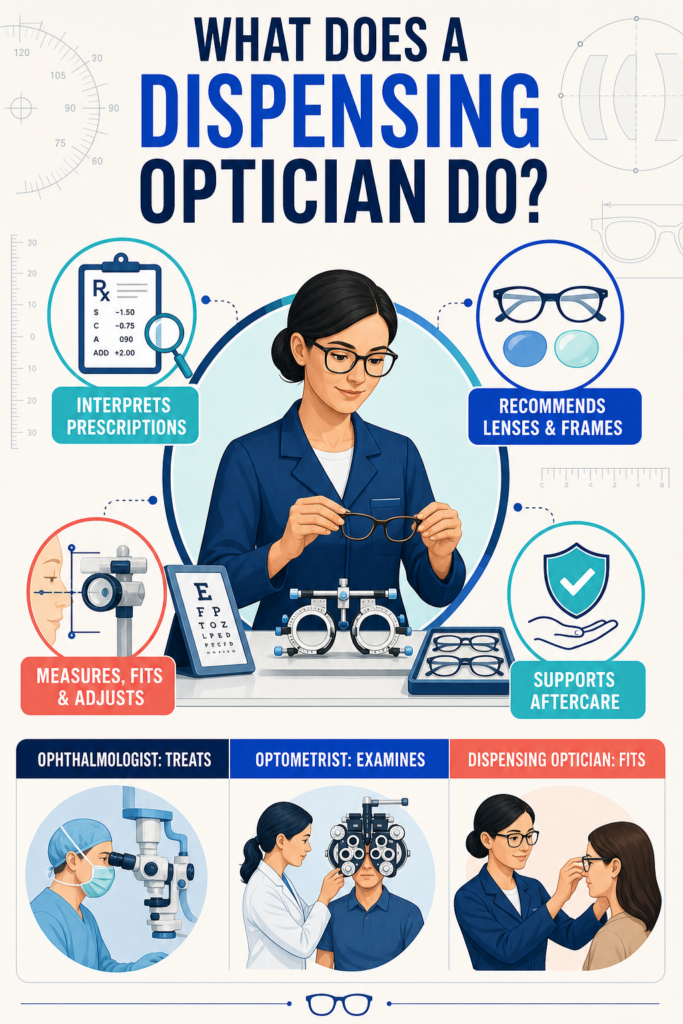
A dispensing optician is the professional who interprets your prescription and supplies, fits, and adjusts your eyewear so it works correctly for your eyes and your face. They don’t test your vision, and they aren’t diagnosing eye conditions; their expertise is everything that happens once a prescription exists.
Think of it as the difference between a doctor writing a prescription and a pharmacist making sure you get exactly the right medication in the right form. A prescription is just numbers until someone with dispensing skill turns it into eyewear that sits right and sees well. They guide your frame choice, recommend suitable lenses, take the measurements that position those lenses correctly, and adjust the finished glasses so they’re comfortable.
The role carries real weight because the same prescription can end up feeling completely different depending on the dispensing. Get the lens type or the measurements wrong and a “correct” pair of glasses can cause headaches or blurry edges, which is why the job is a proper skilled profession rather than a shop assistant handing over a box.
7-day free trial
Got Any Questions? Let us know in the Contact Us form below.
How is a dispensing optician different from an optometrist?
The difference comes down to what happens before and after the prescription: the optometrist produces it, the dispensing optician acts on it. People mix these up constantly, partly because they often work in the same store, sometimes side by side, so it’s worth drawing a clean line between them.
An optometrist examines the eyes, tests vision, and writes the prescription. A dispensing optician takes that prescription and handles the eyewear: frames, lenses, measurements, and fit. One measures the eyes; the other makes sure your glasses match the result. The table below lays the roles side by side.
| Task | Optometrist | Dispensing optician |
|---|---|---|
| Eye examination & vision test | Yes | No |
| Writing the prescription | Yes | No |
| Frame selection guidance | Sometimes | Yes |
| Lens recommendation | Sometimes | Yes |
| Measurements & fitting | No | Yes |
| Adjustments & aftercare | No | Yes |
In many optical stores the two roles hand off to each other smoothly, and software that keeps both the examination and the sale in one place makes that handoff seamless rather than a game of paperwork telephone.
What does the optical dispensing process actually involve?
Optical dispensing involves a series of steps that take a prescription and end with glasses fitted to your face. It looks simple from the customer’s chair, but each step carries decisions that affect how well you’ll end up seeing.
Here’s the process in plain terms, roughly in the order it happens in the store:
- Read the prescription: understand the correction needed and any special requirements.
- Choose frames: balance the look the client wants with what suits their face and prescription.
- Recommend lenses: pick the index, material, and coatings that fit the prescription and lifestyle.
- Take measurements: position the lenses correctly relative to the eyes.
- Order and assemble: get the exact lenses and fit them to the chosen frame.
- Fit and adjust: make the finished glasses sit comfortably and correctly.
The lens step is where a lot of skill and, frankly, a lot of time goes. Glasson’s own figures show 74% of opticians find searching catalogues for lenses time-consuming and often difficult. Tools like the Glasson Lens Finder analyse over 3 million lens combinations and return matches in under 0.2 seconds, so the dispensing optician spends less time in catalogues and more time with the client. The form even mirrors the prescription layout they already know.
Want to see Glasson's full potential?
Book a presentation
Why do accurate measurements matter so much?
Accurate measurements matter because a lens only delivers its prescription when it sits in exactly the right spot in front of the eye. This is the part customers rarely think about, and it’s often what separates glasses that feel great from glasses that never feel quite right.
Consider progressive lenses, where the correction changes gradually down the lens. If the measurements are a few millimetres out, the “reading zone” ends up in the wrong place and the wearer tilts their head at odd angles just to see clearly. The prescription can be perfect and the glasses still fail, purely because of how the lenses were positioned. That’s why dispensing is a hands-on, precise craft, not a formality.
Because so many details ride on one order, keeping them together is essential. When the frame, the exact lens, the coatings, and the measurements all live in a single sale record, there’s far less room for a detail to get lost between the counter and the lab, which is exactly the kind of accuracy good optical software is built to protect.
“People assume dispensing is just handing over glasses, but it’s where a prescription becomes something you can actually wear all day. The frame, the lens index, the coatings, the measurements, they all have to line up. Our job with the software is to keep every one of those details connected and accurate, so the optician can focus on the person in front of them, not on chasing paperwork.”
— Marcin Debski, Product Manager @ Glasson
How does software support optical dispensing?
Software supports dispensing by holding the whole job together, from finding the right lens to recording every detail of the order in one place. The dispensing optician’s skill is in the fitting and advice; the software’s job is to remove the friction around it so nothing gets dropped.
In Glasson, the sale flows naturally through dispensing: you search for lenses, add the frame, then select additional services, all in one transaction that you can edit as you go. That order sits against the client’s record in Glasson Clients, alongside their prescription and history, so a repeat visit doesn’t start from scratch. The next time that client comes in, the optician already knows what they wore and how it was dispensed.
Everything the lens choice depends on lives in Glasson Inventory, which keeps lenses, frames, contact lenses, and accessories in one integrated catalogue. And when the finished glasses arrive, Glasson Communication can text the client that they’re ready to collect, a small touch that 85% of clients say they find helpful.
Test Glasson for 7 days free of charge
Any questions? Leave your contact details and we'll call you back.
Do you always need a dispensing optician to get glasses?
Not always, but you’ll usually get a better result with one, especially for anything beyond a simple, mild prescription. You can buy glasses online or off a rack, and for straightforward cases that may be fine. The trouble is that “straightforward” is easy to misjudge.
For progressive lenses, strong prescriptions, unusual face shapes, or anyone who’s had comfort problems before, the fitting expertise is exactly what makes the glasses work. A cheap online pair that gives you headaches isn’t a bargain; it’s a return trip to someone who can fit them properly. This is precisely the ground where an independent optician outperforms a website, and it’s worth knowing when the expertise is worth paying for.
If you run an optical store, the takeaway flips around: the quality of your dispensing is a genuine differentiator, and the systems behind it protect that quality. You can see how the pieces fit together across Glasson Statistics and the wider platform, and test the whole thing with a 7-day free trial before deciding.
Frequently asked questions
What is a dispensing optician in simple terms?
They’re the professional who turns your prescription into glasses. They guide frame choice, recommend lenses, take fitting measurements, and adjust the finished eyewear, but they don’t test your eyes.
Is a dispensing optician the same as an optometrist?
No. An optometrist examines the eyes and writes the prescription; a dispensing optician takes that prescription and handles the frames, lenses, measurements, and fitting.
What does optical dispensing mean?
It’s the process of supplying and fitting eyewear from a prescription. It covers interpreting the prescription, choosing frames and lenses, measuring, assembling, and adjusting the final glasses.
Can a dispensing optician test my eyes?
No, that’s the optometrist’s role. A dispensing optician works from a prescription that already exists rather than producing one themselves.
Why do measurements matter in dispensing?
Because a lens only delivers its prescription when positioned correctly. Small errors, especially with progressive lenses, can leave the reading zone in the wrong place and cause discomfort.
Do I need a dispensing optician for online glasses?
Not for simple cases, but expertise helps for complex ones. Progressive lenses, strong prescriptions, or past comfort issues are much better handled with professional fitting.
How does software help a dispensing optician?
It keeps the whole order accurate and connected. Glasson’s Lens Finder speeds up lens selection, and the sale ties the frame, lenses, and measurements to the client’s record.
How fast is lens selection with the right tools?
Very fast. The Glasson Lens Finder analyses over 3 million lens combinations and returns matching results in under 0.2 seconds, replacing slow catalogue searches.
Does the dispensing record stay on file for next time?
Yes. The order sits against the client’s record in Glasson Clients with their prescription and history, so a return visit doesn’t start from scratch.
Is good dispensing a real advantage for an optical store?
Absolutely. Quality fitting is something websites can’t match, and reliable software protects that quality by keeping every order detail accurate and in one place.